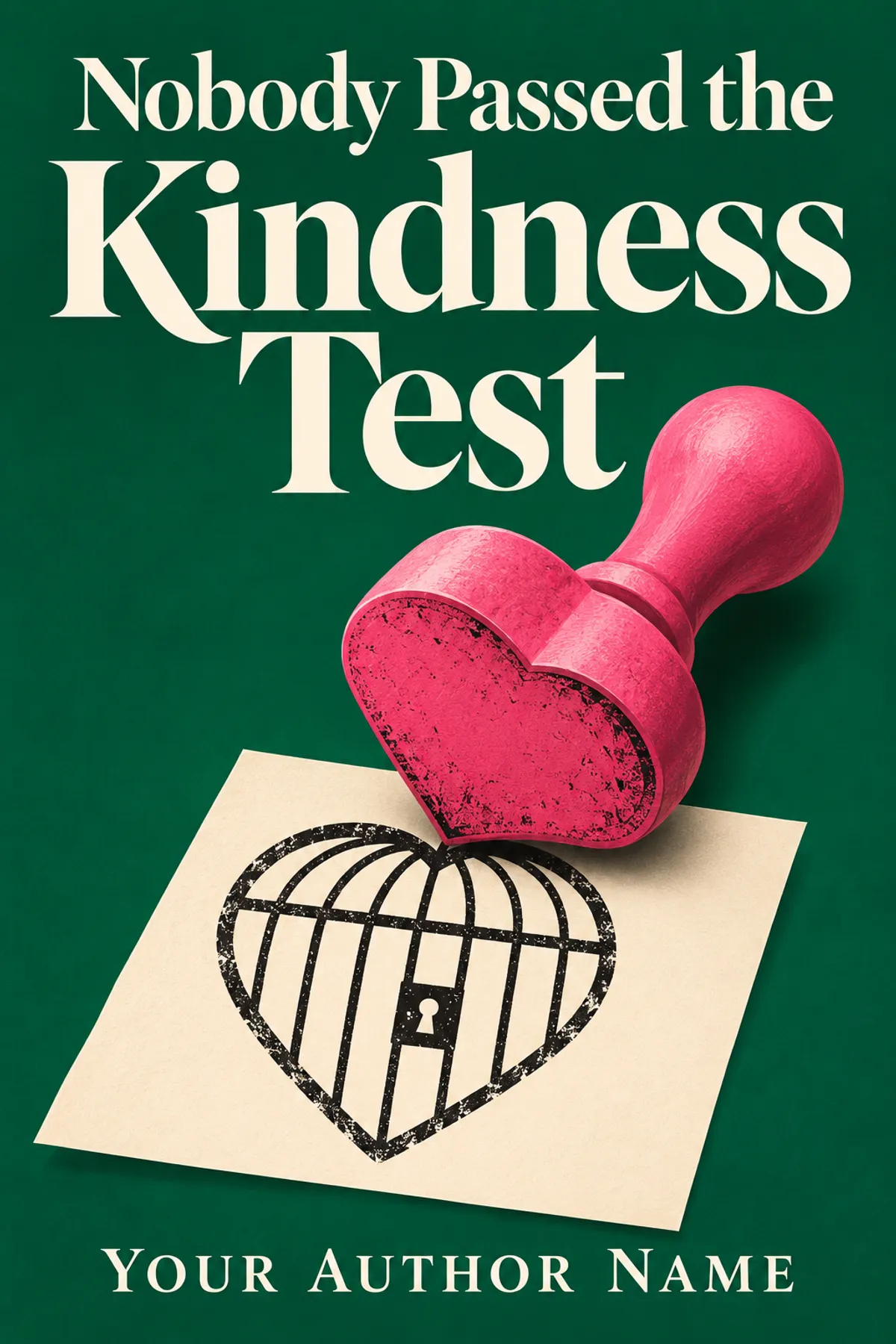
Nobody Passed the Kindness Test
A city allocates housing by recorded acts of kindness. A cleaner discovers the test rewards people who manufacture emergencies and begins helping without being seen.
ImagineYourBook writes a fresh draft from this idea.
How it begins
Lio lost his flat because he carried a woman upstairs.
He should have waited for a witness.
The appeal officer explained this gently, as if he had forgotten a receipt for a perfectly reasonable purchase.
"You performed the action outside a verified kindness window."
"She'd fallen."
"That is not disputed."
"She couldn't stand."
"Also not disputed."
Lio looked through the glass wall at the waiting room. A man in a gold volunteer sash was filming himself helping another man fill a water bottle.
The other man did not appear thirsty.
"Then what is disputed?"
"The public benefit."
The officer turned the screen.
His housing score had dropped below renewal level. The unverified intervention had interrupted his scheduled litter collection. Four witnesses had reported his absence.
He had cleaned that estate for seven years.
He had carried Mrs. Venn to her door because the lift was broken and nobody had answered the assistance buzzer.
The officer offered him a list of qualifying opportunities.
One involved planting a tree that had already been planted twice that month.
Outside the office, Sera Venn waited on a bench with a bag of groceries.
Her mother was the woman from the stairs.
"I've brought you lunch."
"I can't accept it."
"Why?"
"Gift disclosure."
Sera looked at the camera above the entrance.
Then she moved the bag beneath the bench.
"Now you've found it."
Inside was a warm container of rice and a folded photograph.
The man in the gold sash stood beside a broken water fountain. In the next photograph, he broke it with a hammer.
Lio looked back through the glass.
The bottle was still being filled.
"How many?" he asked.
Sera lifted another envelope from her bag.
"Depends whether you want to count the acts of kindness," she said, "or the people they had to hurt first."
Lio sat down and began eating before anyone could award him a point.
Your idea. Your book.
Keep the spark. Change anything.
Create my bookCreated with ImagineYourBook. Free to use as inspiration.
Outline and characters
Develop this idea
A social-credit dystopia needs visible incentives, not just cruel slogans. Show how a decent person becomes dependent on a bad scoring system, then make Lio's unrecorded help cost him something concrete. Sera can represent the labor that public metrics overlook. For your version, design one believable appeal form or scoring rule and test it against an ordinary emergency. The ending should expose the measurement's failure without suggesting that a kinder algorithm solves every political problem.
- Lio loses housing points for helping without recording it
- Sera shows him emergencies staged to generate charitable acts
- A high-scoring neighbor manufactures another small crisis
- Lio starts an invisible network of practical help
- The network improves lives while its members lose access to housing
- An official offers to restore Lio's score if he exposes the network
- Sera discovers the scoring model measures witnesses rather than outcomes
- Residents document one manufactured emergency from beginning to end
- Lio publishes the evidence without claiming credit for the rescue
- The estate demands housing decisions based on needs people can challenge
Characters
- Lio Fern, 34. Housing-estate cleaner who stops recording his good deeds
- Sera Venn, 48. School cook whose kindness score has vanished
Series possibilities
- Sera is asked to join a school pilot that ranks children by their parents' public generosity.