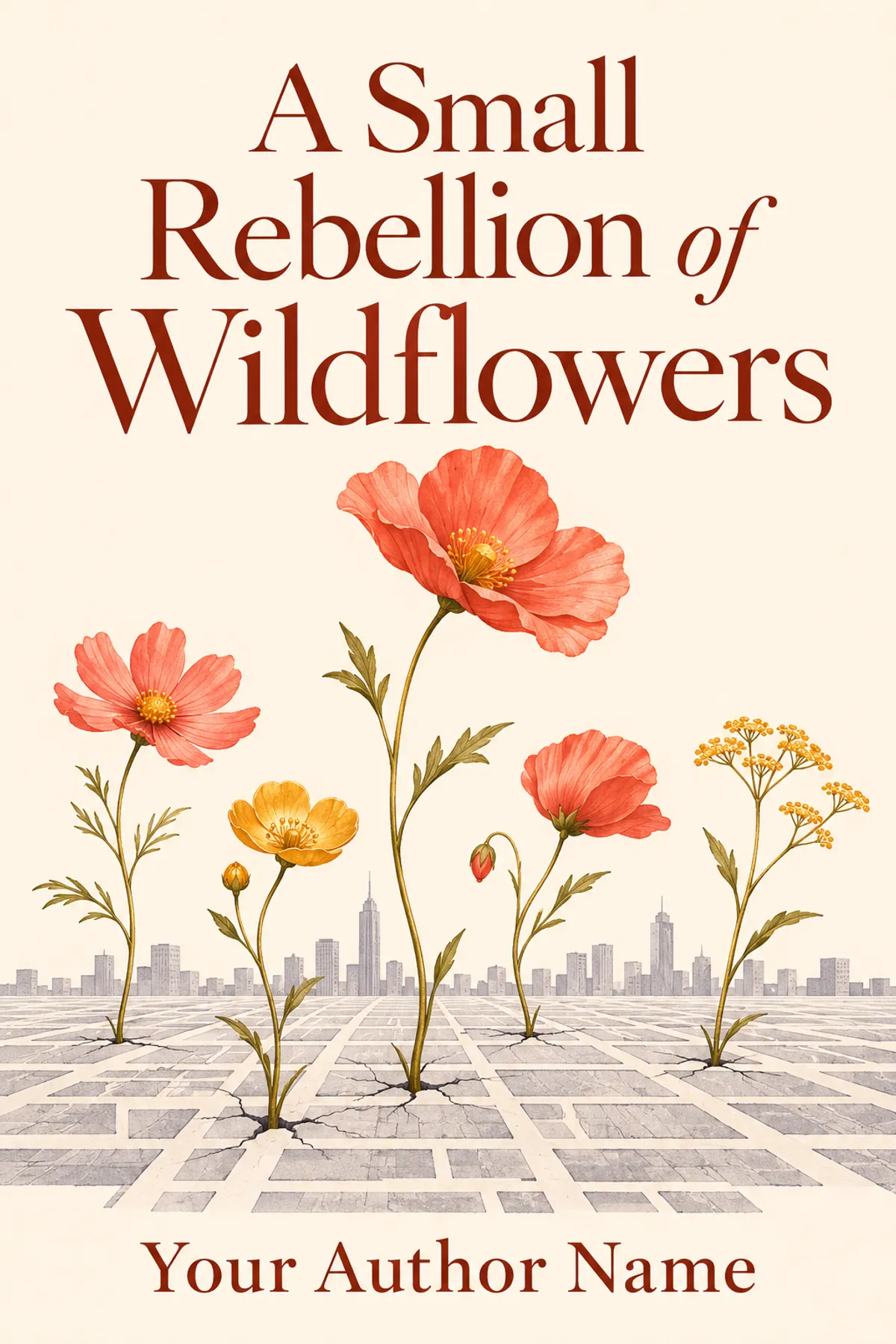
A Small Rebellion of Wildflowers
Poems move through an abandoned city plot as neighbors turn a place marked for erasure into a garden that refuses to behave like a tidy symbol of hope.
ImagineYourBook writes a fresh draft from this idea.
How it begins
Survey Mark
They spray a pink cross on the pavement. By June, a plant has grown through its center. Nobody knows its name, which does not prevent us from choosing it as our emblem. Sal prints it on a leaflet. I look it up later and discover it spreads aggressively. This complicates the speech I was writing. At the meeting, someone asks whether the new building will have a lift. Her knees hurt. I put down my speech and listen. Outside, the plant continues its campaign without consulting any of us.
Watering Rota
Tuesday belongs to a man who works nights. He waters at dawn, when the city has not yet decided how loud to be. Thursday belongs to three people who assume one of the others has done it. By August the beans have given up. We stand around their dry strings, six citizens in possession of a shared failure. Sal says we must show solidarity. The man from Tuesday asks who can carry the water when his shift changes. This is a smaller question and therefore one we might answer. I take Thursday. Someone repairs the tap.
At the Hearing
The official asks what the plot produces. We have brought photographs of flowers and one disappointing marrow. We could say belonging. We could say resilience. Instead, Mrs Bell says it gives her somewhere to sit between the bus stop and home. A boy says he learned that worms are animals. The night worker says nothing until the official begins collecting the papers. Then he describes the city at dawn, the bins being emptied, the first window lit above the bakery, a fox waiting while he fills the cans. The official makes a note. I cannot read it. Outside, rain has begun, and for once no one has to hurry back to water anything.
Your idea. Your book.
Keep the spark. Change anything.
Create my bookCreated with ImagineYourBook. Free to use as inspiration.
Outline and characters
Develop this idea
Let the garden contain disagreement, failed crops, tired volunteers, and people who prefer a bench to a flower bed. Avoid making regeneration a simple battle between good plants and bad buildings. The poems can use a planning notice, a watering rota, and a botanical observation as different forms. Attend to who has time, mobility, and money to participate in the project.
- A wildflower grows through a survey mark.
- Jo begins a deliberately untidy planting.
- Residents argue about access and aesthetics.
- Sal uncovers the development consultation's omissions.
- A summer drought exposes unequal resources.
- The garden fails to supply an easy symbol.
- Neighbors preserve seeds and conflicting testimonies.
- A hearing measures more than property value.
- A mixed-use agreement protects open ground.
- The flowers return beyond the agreed boundary.
Characters
- Jo, 46. City gardener
- Sal, 59. Neighbor organizing against redevelopment
Series possibilities
- A later sequence could examine the community after it has something to administer as well as defend.