We Own the Last Picnic Table
A road-widening project leaves one public picnic table stranded on a tiny island of grass. A retired cook and a delivery driver begin serving lunch there, turning a planning oversight into an awkward question about who a town is designed to keep moving.
ImagineYourBook writes a fresh draft from this idea.
How it begins
The picnic table appeared on the road plan as an obstruction.
Ruth Porter had eaten her lunch there every Thursday for nineteen years. She studied the red circle around it and considered the word ungrateful.
A delivery driver stood beside her, holding a paper bag and looking at the newly widened road.
'Can we cross?' he asked.
'Apparently we are an island.'
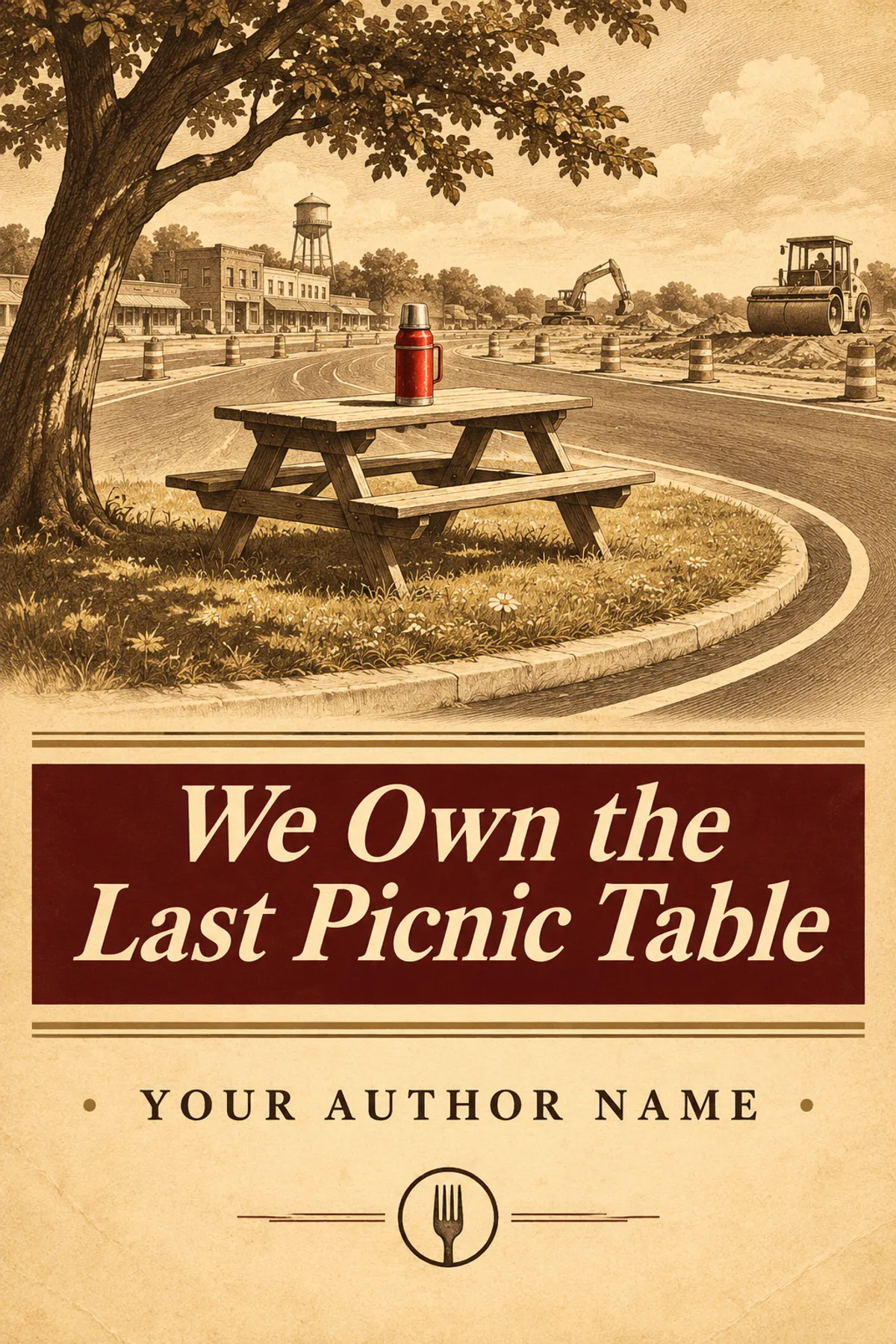
The contractors had finished on Friday. By Monday the old square was a sweep of tarmac surrounding one oval of grass, one table and the plane tree whose roots had defeated an earlier attempt at improvement.
Joseph Lane tested the crossing button. Nothing happened.
'It's not connected,' Ruth said.
'How do you know?'
'I asked the man carrying it.'
A lorry passed close enough to stir the napkins in her basket. Ruth waited, then stepped onto the grass with the determined calm she had once used to carry soup through a school dining hall. Joseph followed.
He set down his bag. A sandwich slid out, flattened almost transparent.
'You need a plate,' she said.
'I need six minutes.'
She gave him both.
Across the road, two office workers watched them through the window of a new coffee shop. Behind them, every seat was occupied by someone who had bought a drink. Ruth unfolded a second napkin.
Joseph's telephone sounded. He checked it, winced, and put it face down.
'You aren't buying anything here,' she said.
'I wasn't worried about that.'
'Good. Neither am I.'
The office workers came outside. They stood at the disconnected crossing, then looked toward the long route around the traffic island.
Ruth opened her basket. She had brought four portions because old habits were harder to remove than public furniture.
By the time the first planning officer arrived, there were six people at the obstruction, and somebody had put the kettle on.
Your idea. Your book.
Keep the spark. Change anything.
Create my bookCreated with ImagineYourBook. Free to use as inspiration.
Outline and characters
Develop this idea
Make road safety part of the conflict rather than an obstacle the story cheerfully ignores. Research planning review, accessible crossings and worker breaks for a plausible local process. Ruth should not become an endlessly available unpaid cook. Her boundaries give the community a chance to share responsibility. Joseph's work pressure needs concrete consequences, and the final table should remain useful even when no campaign or publicity is attached.
- Ruth and Joseph continue using the stranded public picnic table.
- Their lunches attract residents priced out of nearby indoor seating.
- A safety complaint forces them to document the inaccessible road design.
- Joseph's delivery schedule reveals how little usable rest space remains.
- The council offers a sponsored table inside a commercial courtyard.
- Residents disagree over accepting immediate convenience or preserving public access.
- Ruth's informal meals strain her budget and threaten to become unpaid obligation.
- Joseph organizes evidence from delivery workers without exposing private tracking data.
- A public review funds a safe crossing and accessible open seating.
- The lunches continue as voluntary gatherings with shared costs and no purchase required.
Characters
- Ruth Porter, 66. Retired cook
- Joseph Lane, 40. Delivery driver
Series possibilities
- Further community novels follow overlooked spaces in the town as residents negotiate whose needs count in planning.