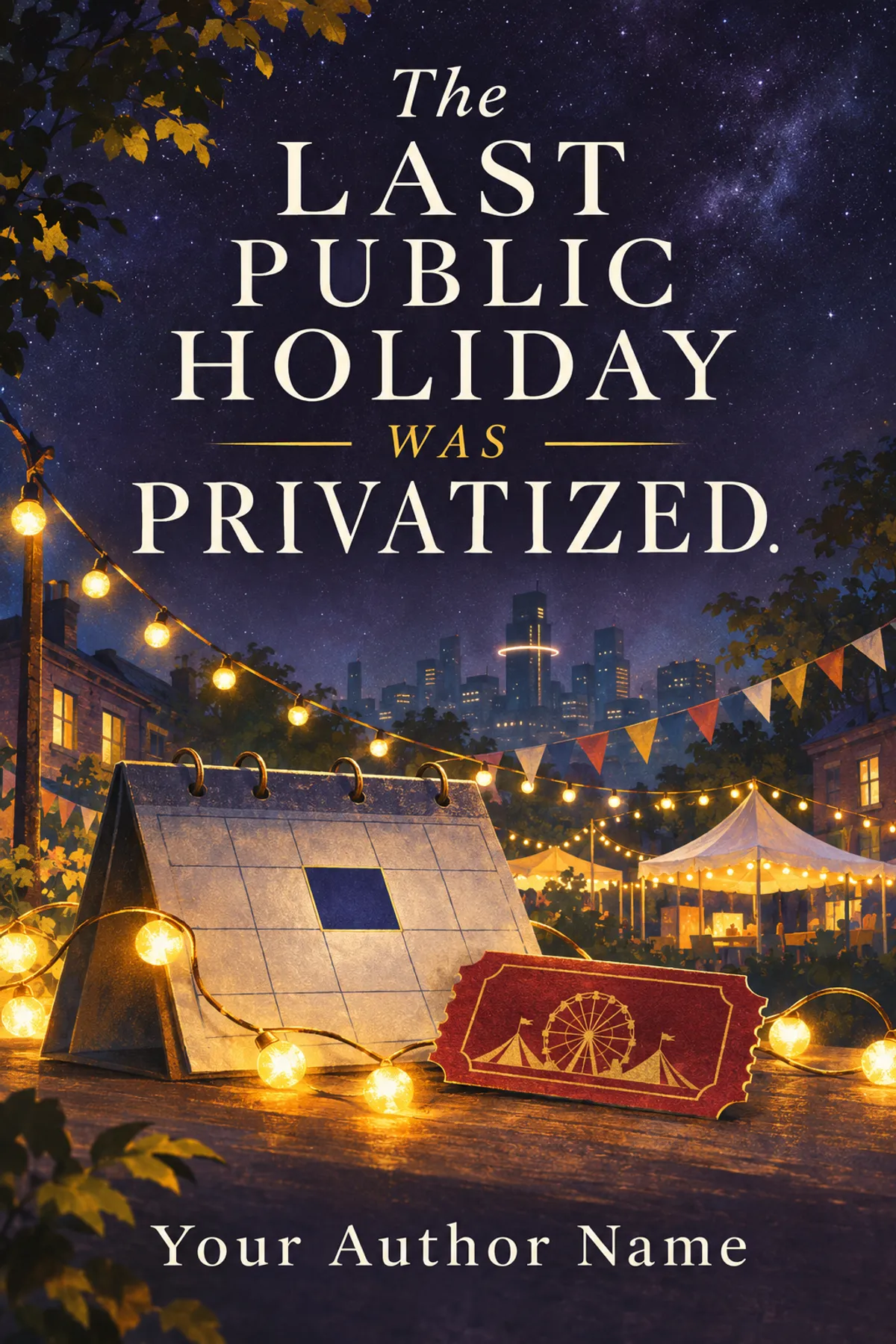
The Last Public Holiday Was Privatized
A festival electrician learns the city's final shared day off has been sold as a premium event. Keeping a neighborhood celebration alive becomes an argument over whether time together can belong to anyone.
ImagineYourBook writes a fresh draft from this idea.
How it begins
The public holiday needed a wristband.
Ada found the box beside the temporary power cabinet.
Gold for premium access. Blue for standard. Gray for staff, valid only during assigned hours.
She clipped on gray.
Across the square, a fence divided the old gathering place into viewing zones. The fountain where children usually floated paper boats now stood behind a sign offering a private heritage experience.
Nabil waited outside the staff gate.
"Can you get me in?"
"Not on this."
He showed her a folded photograph.
The square twenty years earlier. Tables. Folding chairs. Ada's mother holding a tray of food. Nabil with hair.
"This used to be free."
"So did parking."
"Don't start."
She opened the gate long enough to speak without the fence between them.
Beyond the square, traffic continued through a working morning. The city's final shared day off had been moved into the event company's premium package.
People could purchase the holiday they had once simply had.
Ada checked the installation plan.
At the bottom, under cultural rights, the company claimed exclusive use of the neighborhood's traditional songs, decorations, and ceremonial lunch.
She laughed.
Nabil did not.
"They sent my sister a notice about her bunting."
"Her bunting?"
"Apparently the colors are part of the experience."
From the stage, an announcer welcomed guests to a celebration of community.
Ada looked at the gray band around her wrist.
It would stop opening doors at six.
"What are you planning?" she asked.
Nabil unfolded a second paper.
Not a petition.
A schedule.
Care visits. Shop cover. Bus shifts. Meals for people who could not leave work.
Across the center, someone had drawn an empty hour.
"We're trying to find a time," he said.
Ada studied the gaps.
For the first time that morning, something in the square looked difficult enough to be real.
Your idea. Your book.
Keep the spark. Change anything.
Create my bookCreated with ImagineYourBook. Free to use as inspiration.
Outline and characters
Develop this idea
Shared rest is complicated by essential work, care, and unequal employment. Let the neighborhood plan address those differences rather than celebrate an effortless universal walkout. Ada's electrical work supplies a concrete role, but avoid dangerous sabotage as the solution. The holiday contract can embody the satire while the residents' practical arrangements make an alternative believable and imperfect. Give essential workers a role in planning.
- Ada is hired to wire the privatized public holiday
- Her neighborhood cannot afford entry to its own traditional gathering
- Nabil proposes an unlicensed celebration during ordinary work time
- Workers reveal incompatible schedules imposed to prevent shared rest
- The event company offers Ada a personal exemption
- She finds the holiday contract claims rights over public rituals
- Residents negotiate a shared pause with essential workers included
- Ada refuses to power the exclusive spectacle under deceptive terms
- A coordinated neighborhood celebration challenges the ownership claim
- The city begins renegotiating common time without pretending every worker can stop together
Characters
- Ada Ren, 44. Festival electrician
- Nabil Bell, 59. Neighborhood organizer
Series possibilities
- A neighboring district sells its nights to a productivity service and asks Ada to inspect the lighting.