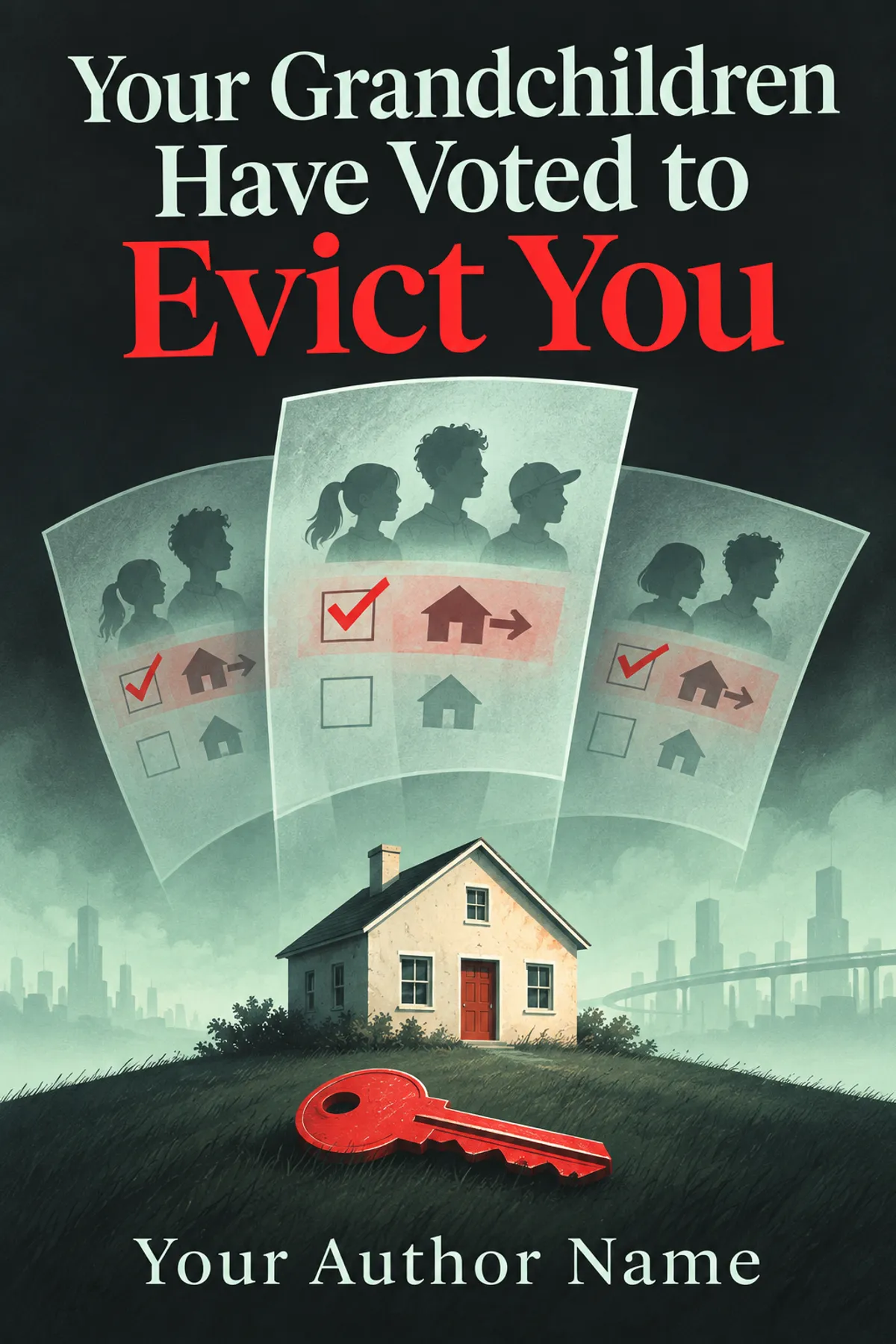
Your Grandchildren Have Voted to Evict You
A housing mediator receives an eviction notice signed by descendants who do not yet exist. Challenging it means exposing who has been selling votes in the name of the unborn.
ImagineYourBook writes a fresh draft from this idea.
How it begins
Marta's grandchildren had voted to evict her. This was surprising because her only son did not want children.
She checked the notice for a mistaken address.
Her flat. Her name. Three descendant signatures, each accompanied by an estimated birth year.
The youngest would arrive in 2089.
She called the housing authority from the kitchen, standing beside the radiator that had needed repair since March.
“The notice is correct,” said the adviser.
“My descendants do not exist.”
“They are represented.”
“By whom?”
“A licensed future-interest provider.”
Marta closed her eyes.
For twenty years she had mediated housing disputes. She had explained the future-resident provisions to pensioners, young parents, and a woman whose forecast family had been revised upward after an investor purchased her street.
She had said the rules were intended to protect people who could not yet speak.
Now three of those people had requested her removal to improve the projected value of a development fund.
“What evidence did they consider?”
“The provider's model.”
“Can I see it?”
“Commercially sensitive.”
Marta wrote the phrase on the back of the envelope.
At work, an analyst named Jules had once raised a question about duplicate descendant accounts. The department had transferred him to records quality. She had signed the transfer because the mediation queue was long and someone had called his concern theoretical.
She found his number.
He answered immediately.
“I thought you might call.”
“Why?”
“Your family tree sold twice last night.”
Marta sat down.
The notice lay beside her breakfast plate, polite and final. It allowed fourteen days to leave the flat or appeal to the same provider that had purchased the votes.
“Jules,” she said, “how many grandchildren do I apparently have?”
“Depends which company is asking.”
Outside her window, workers began measuring the street.
For once, she did not intend to help anyone reach an efficient compromise.
Your idea. Your book.
Keep the spark. Change anything.
Create my bookCreated with ImagineYourBook. Free to use as inspiration.
Outline and characters
Develop this idea
Give the future-generation principle a reasonable original purpose before showing how proxy trading corrupted it. Avoid framing care for descendants as the problem. The fraud should involve a clear chain of authority and payment. Marta must confront cases she approved under the same rules. The ending should preserve responsibility to future residents while making present decision makers answer for the choices they actually control.
- Marta receives an eviction signed by unborn descendants.
- Jules finds their votes traded through proxies.
- A tribunal insists the future has priority.
- Marta meets tenants displaced by conflicting forecasts.
- Her own mediation decisions resurface.
- The proxy firms revise descendants to fit bids.
- A public hearing compares incompatible family trees.
- Present and projected needs receive separate accounting.
- The eviction mechanism loses its purchased mandate.
- Housing decisions return to accountable representatives.
Characters
- Marta Venn, 59. Housing mediator
- Jules Arden, 31. Analyst of future-vote contracts
Series possibilities
- Marta investigates institutions claiming to speak for people who cannot challenge their representation.