The Woman Who Sold the Ending
In 1910, a traveling storyteller offers audiences a choice of endings for a woman whose life the town considers finished. When the woman herself arrives to object, both must decide whether a satisfying story can make room for an inconvenient living person.
ImagineYourBook writes a fresh draft from this idea.
How it begins
Dora Collins paid sixpence to discover how her life had ended.
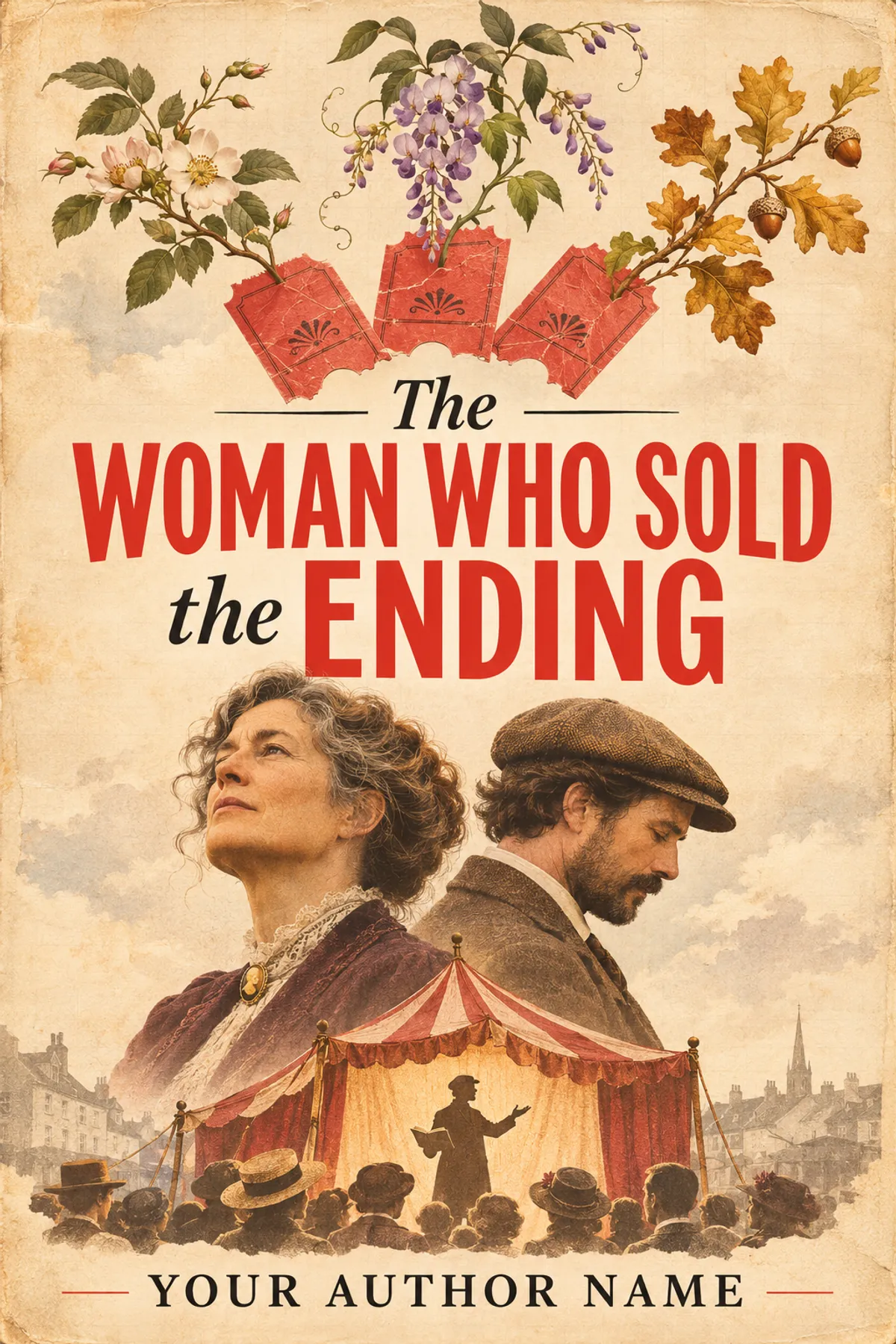
The lecture hall smelled of wet coats and lamp oil. Beside the platform stood three jars, each labeled with a possible conclusion. MARRIAGE. TRAGEDY. A NEW BEGINNING. Someone had put a button in the first jar.
Dora chose a seat near the back. She was fifty-two, her boots pinched, and she had promised to collect a parcel before the draper closed. None of this seemed likely to interest the man arranging his lantern slides.
'An extraordinary woman,' he began. 'Wronged by fortune. Unclaimed by happiness.'
Dora took off her gloves.
George Marsh, according to the handbill, had traveled extensively. His travels had not brought him within speaking distance of her, although she recognized the boarding house in his first illustration. The shutters were the wrong color. Her former employer's dog had acquired an unnecessary tragic expression.
The story proceeded through a dismissal, a winter illness, and a departure by train. Every event was recognizable. Every explanation was wrong.
At the interval, the audience was invited to purchase an ending. A small boy offered to lend his mother a penny for the tragedy.
Dora walked to the platform.
'I should like my sixpence back.'
George smiled the accommodating smile of a man familiar with hecklers.
'Did the story disappoint?'
'Not nearly enough. I had three perfectly disappointing years you have left out.'
The front row turned.
George looked at her face, then at the painted likeness on the screen. He was forty-one, she guessed, and had just become considerably less certain of being charming.
'You're Dora.'
'I was before your introduction.'
He reached for the lantern shutter. She stopped him. The audience had already paid to inspect her. Let them also see what embarrassment looked like on the man who had sold the tickets.
'Which ending would you prefer?' he asked quietly.
Dora picked up the jar marked A NEW BEGINNING.
'An account of where the money went,' she said. 'That would be novel.'
Your idea. Your book.
Keep the spark. Change anything.
Create my bookCreated with ImagineYourBook. Free to use as inspiration.
Outline and characters
Develop this idea
The book's energy comes from the gap between recognizable facts and false emotional explanations. Dora need not be admirable in every remembered scene to deserve authority over her own account. George should have skills and obligations that make his retreat from certainty costly. Keep the theatrical choice of endings concrete and comic. Avoid replacing the first simplified life story with a supposedly perfect authorized version that merely flatters its subject.
- Dora interrupts George's successful touring account and demands a financial reckoning.
- George shows her the fragmented newspaper sources from which he assembled the story.
- She corrects concrete errors but refuses to provide a more marketable secret.
- The hall owner offers Dora a share if she performs the version audiences already love.
- A former employer requests corrections that would protect his reputation at her expense.
- George's revised lecture sells poorly because it admits what he does not know.
- Dora discovers that neighbors have built useful and damaging identities around her supposed ending.
- They design a final event in which witnesses own their words and silence remains an option.
- An audience demand for closure forces George to abandon his profitable voting jars.
- Dora leaves the hall to do an ordinary thing the story never predicted, with the account still open.
Characters
- Dora Collins, 52. Woman whose life became a public story
- George Marsh, 41. Traveling storyteller
Series possibilities
- Independent novels can follow ordinary people confronting the profitable stories strangers have made from their lives.