
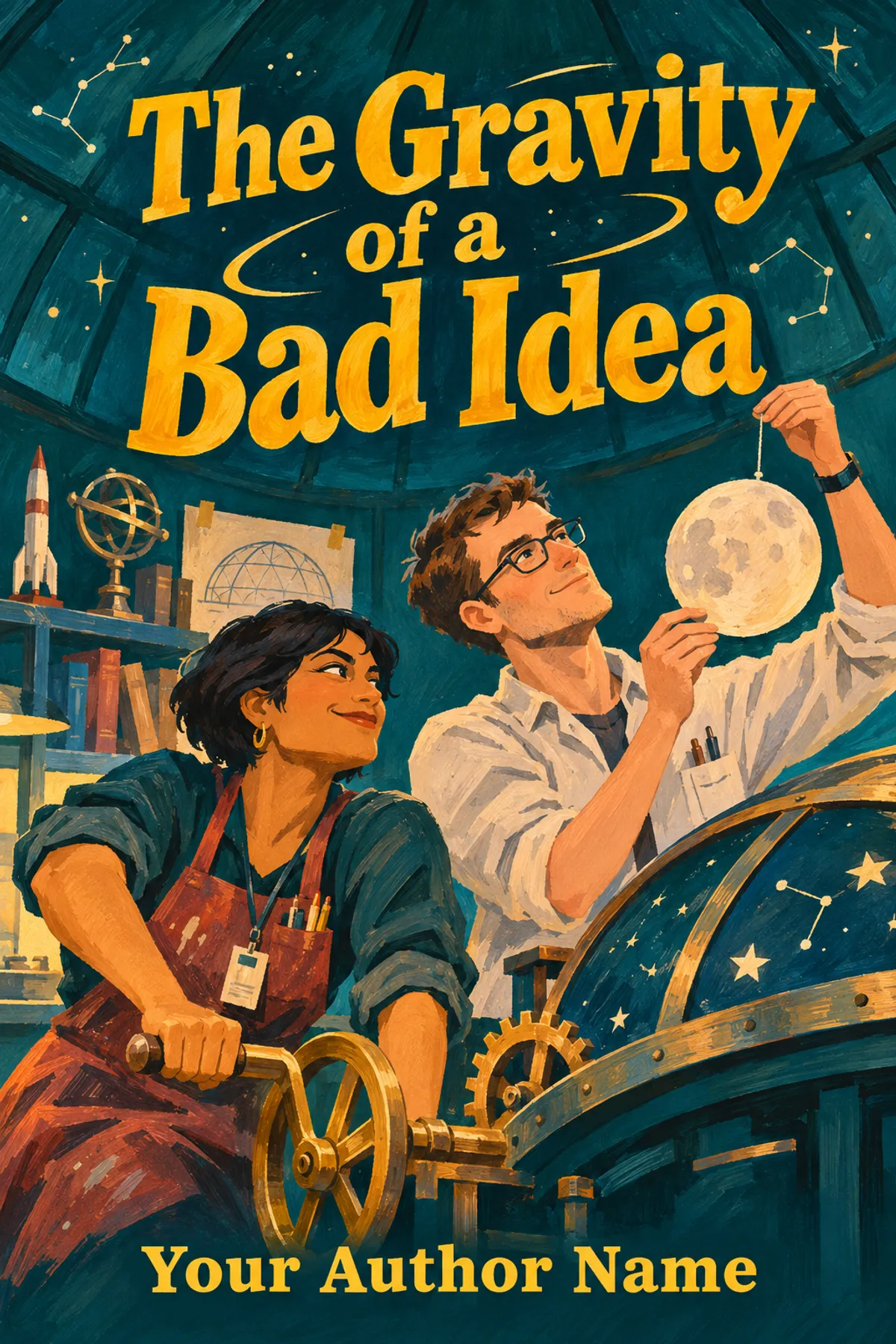
The Gravity of a Bad Idea
A museum demonstrator and an aerospace engineer build a human-powered planetarium after a funding cut, arguing over every orbit except their own.
ImagineYourBook writes a fresh draft from this idea.
How it begins
Priya's sun had fallen into the refreshments.
It floated in the tea urn, a yellow foam sphere with three carefully painted sunspots and a mounting hole that had proved optimistic.
The visiting engineer watched her fish it out with a serving spoon.
"Your axle needs a collar."
"My department needs a budget. We're both disappointed."
Luke Bennett set his bag down beside the folding table. The museum had sent her his biography, which contained several spacecraft and no evidence that he had ever entertained a room full of restless people using a torch and a length of string.
"I brought a few parts."
"We can't buy anything."
"I know. These were going to be discarded."
He opened the bag. Priya saw bearings, brackets and a small hand crank. Nothing glittered. Nothing required a subscription. Her opinion of him improved against her will.
The museum's digital dome had closed the previous month. Its replacement would arrive when funding allowed, a phrase that had already outlived two school terms. Priya had promised the outreach team a portable model by Friday. She had not promised realism. Unfortunately, someone had invited an aerospace engineer.
Luke examined the cardboard planets.
"The scale isn't consistent."
"Neither is the room. If Neptune goes where it belongs, it will be in the bakery."
He considered this.
"Good bakery?"
She laughed before deciding whether he deserved it.
Together they lifted the frame onto the table. His hand steadied the far corner without taking the weight away from hers.
"What do you want people to understand?" he asked.
Priya had prepared defenses against twelve kinds of criticism. She had not prepared for that question.
"That movement can make sense. That you can turn something with your own hand and watch a pattern appear."
Luke fitted the crank to the frame.
"Then let's begin there."
The sun dripped quietly onto the tablecloth. For the first time that morning, Priya thought Friday might be possible.
Outline and characters
Develop this idea
Make the scientific model intentionally simplified, with its limits explained through the demonstrator's choices. Priya and Luke should bring different, equally necessary expertise. Physical testing offers lively scenes and reveals how each handles failure. Avoid a benefactor who solves everything without tradeoffs; the funding choice should test the purpose they have developed together. Their emotional resolution can mirror the working mechanism through shared effort, but resist turning every orbit into a romantic metaphor.
- Priya and Luke meet over a failing portable planetarium.
- They agree on a clear educational purpose before refining the mechanism.
- Community testing exposes assumptions both have made about their audience.
- Priya reveals how often she has hidden underfunding with personal overwork.
- Luke admits his prestigious canceled project left him unsure what useful work means.
- Their successful first demonstration ends in an unexpected kiss.
- A donor offers money only for a polished display visitors cannot touch.
- Priya and Luke disagree over accepting a compromise that would change the project.
- They present evidence from users and secure support for an interactive traveling version.
- The first tour begins with shared responsibility and a date unrelated to planets.
Characters
- Priya Desai, 34. Museum demonstrator building a portable planetarium
- Luke Bennett, 37. Aerospace engineer volunteering after a project cancellation
Series possibilities
- An outreach coordinator and a skeptical community-hall caretaker create a hands-on exhibition together.