
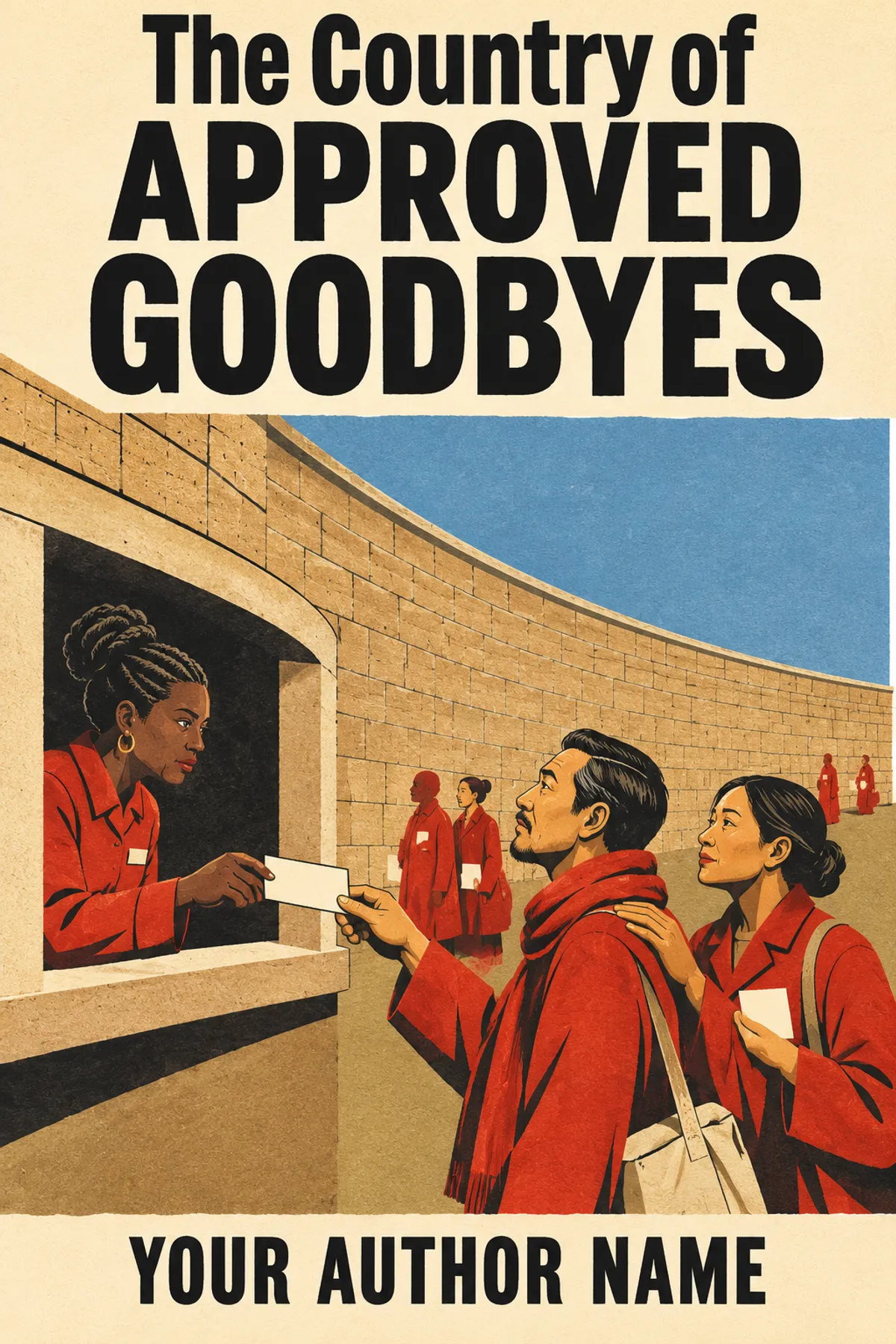
The Country of Approved Goodbyes
A border clerk in a nation regulating farewell ceremonies helps families leave without the government-written final words that permanently define those who stay.
ImagineYourBook writes a fresh draft from this idea.
How it begins
Elise rejected the goodbye because it contained a question.
Will you visit when you can?
Questions were not permitted in final statements. They implied an ongoing relationship that the Departure Office could not reliably classify. The approved alternatives were gratitude, closure and confidence in the nation's continuing care.
Rafael read the correction in silence.
"She's my daughter."
"I can see that."
"Then it isn't final."
Elise had an answer for that. She had given it often enough that the words arrived before she decided whether to use them. Final referred to the statement, she explained, not necessarily the relationship.
Rafael looked at the small print.
The statement would remain attached to his daughter's domestic record. If he declared complete satisfaction, future complaints from her household could be classified as inconsistent. If he expressed concern, she might lose permission to work in a trusted profession.
He had been offered several ways to love her badly in public.
Elise glanced at the queue. Other families waited beneath posters showing smiling departures and empty speech bubbles. Somewhere beyond the hall, a train sounded its departure warning.
"What happens if I say nothing?" Rafael asked.
She opened the rulebook. Silence at the ceremony counted as acceptance of the default statement.
For the first time, Elise noticed how thoroughly the office had prepared for the absence of consent while calling every option a choice.
Rafael folded the corrected page.
"I taught children to ask clear questions for thirty years. Now I can't ask my own child one."
Elise thought of the farewell her brother had read from this same desk. She had kept the recording, although it sounded less like him each year.
She marked Rafael's application for a language review, buying one day under a provision nobody used.
Then she wrote his original question on a separate sheet, preserving the words before the system replaced them with something easier to approve.
Outline and characters
Develop this idea
Make the coercion concrete through the different consequences attached to seemingly harmless phrases. Families should choose their own level of risk, and those who use the approved wording are not morally inferior. Elise's small procedural delay begins the action but cannot solve the system alone. Preserve the distinction between public records and private relationships. The ending should establish a specific institutional change while leaving the regime and the costs of resistance larger than one successful departure.
- Elise rejects Rafael's farewell question under rules requiring a final approved statement.
- The available wording carries lasting consequences for his daughter's status.
- Elise uses a legitimate review provision to delay the ceremony.
- Other clerks reveal that they have privately preserved rejected statements too.
- Families disagree about risking departures to challenge the rule.
- The office attempts to classify silence and refusal as acceptance of its default language.
- Elise and colleagues expose the contradictory options through a collective documented appeal.
- Travelers choose a shared minimal declaration limited to their own departure, refusing claims about those who remain.
- Public scrutiny forces a separation between departure records and relatives' domestic status.
- Rafael leaves after asking his daughter his own question privately, while Elise faces consequences and continues challenging the office from outside it.
Characters
- Elise Morgan, 38. Border clerk approving departure ceremonies
- Rafael Nouri, 52. Teacher leaving the country while his adult daughter remains
Series possibilities
- A companion novel follows the adult daughter living with the aftermath of a departure record that no longer defines her.