The Clock Eats Weekends
A clock restorer repairs a factory timepiece that runs on leisure. The more efficiently the town works, the more its weekends vanish. Recovering them requires her to ally with the least productive man in town, whose apparently wasted afternoons hide a remarkable achievement.
ImagineYourBook writes a fresh draft from this idea.
How it begins
Lydia March repaired the factory clock and lost her Saturday. At first she assumed she had slept through it. This would have been disappointing but not unprecedented.
Then the whole town arrived at work on Monday carrying unopened picnic baskets.
The clock had been silent for thirty years. Its restoration contract promised improved productivity and civic pride, two phrases Lydia had learned to charge for separately. She had cleaned the escapement, replaced three teeth and polished the brass plaque beneath the pendulum. TIME WELL SPENT.
Now the pendulum ticked with a sound like someone chewing very carefully.
Omar Finch stood in the square holding a tomato plant. He had intended to put it in the community garden yesterday. The pot still wore the paper label Lydia remembered seeing on Friday.
'I thought weekends were personal,' he said.
'They usually are.'
'It seems someone has purchased this one.'
At the factory gate, workers watched the new performance figures rise. Management announced a remarkable voluntary effort. Nobody remembered volunteering. A child asked why her birthday cake was still in the refrigerator. Her father checked his calendar and frowned as though the cake had made an administrative error.
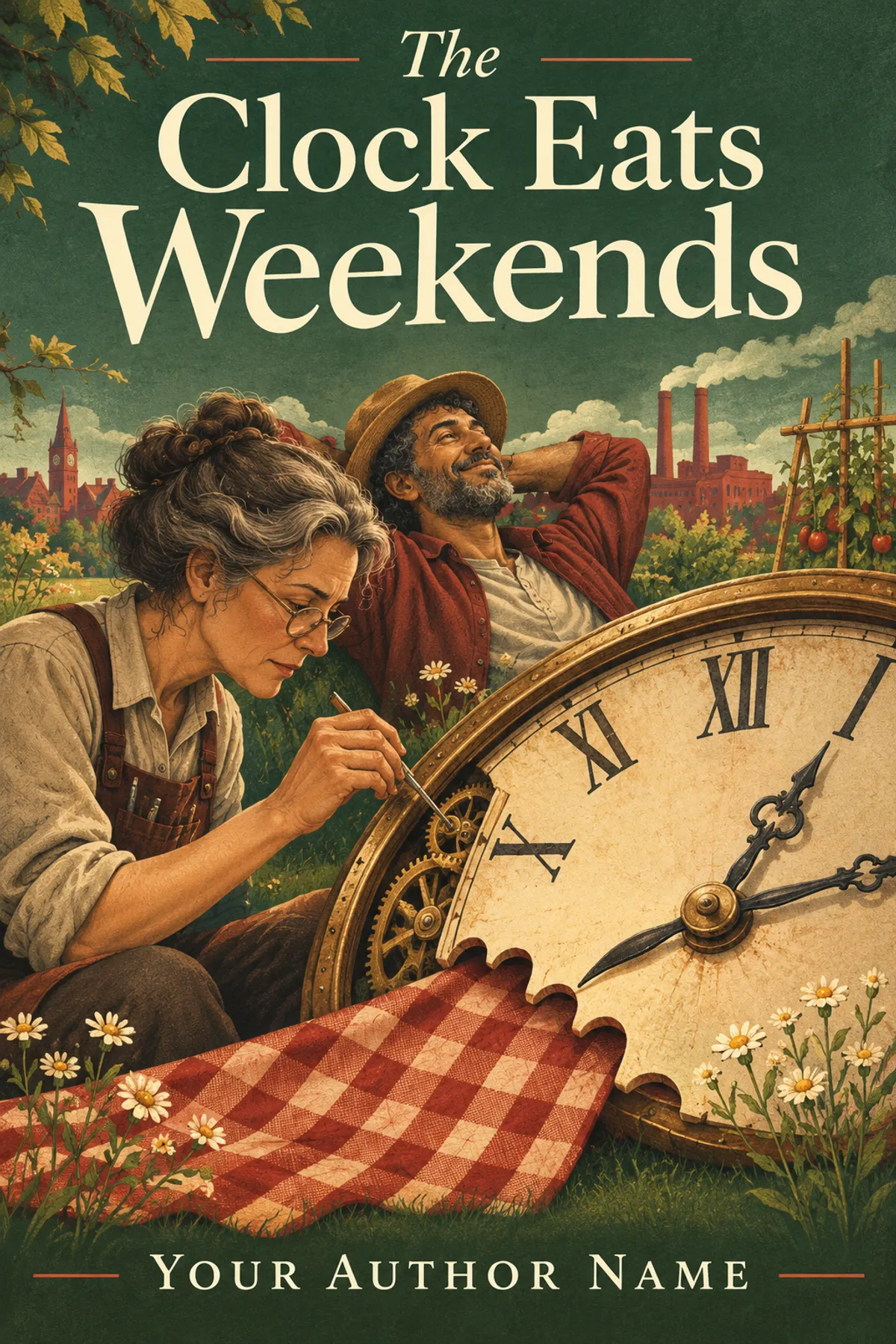
Lydia climbed the clock tower. Behind the face, the restored wheel had grown a second ring of teeth. Between them lay a scrap of blue gingham. She recognized it from the picnic blanket folded on her kitchen chair.
Omar followed more slowly, carrying the plant.
'You should be working,' she said.
'I am. Just not for anyone who counts this sort of thing.'
Through the tower window, Lydia saw his garden: vegetables for neighbors, benches repaired with old timber, a path wide enough for the woman from number twelve.
The clock swallowed another inch of gingham.
Lydia set down her tools. For the first time in forty years of fixing timepieces, she wondered whether making one run accurately was the wrong job.
Your idea. Your book.
Keep the spark. Change anything.
Create my bookCreated with ImagineYourBook. Free to use as inspiration.
Outline and characters
Develop this idea
Give the lost leisure physical traces and measurable social effects. Lydia's pride in accurate work should complicate her responsibility for the restored clock. Omar's apparently unproductive hours produce care that formal metrics miss, but leisure need not prove its usefulness to deserve protection. The factory's gains should not vanish without consequences for livelihoods. A collective resolution can redistribute work and preserve chosen time, with the clock altered to serve residents rather than consume their unscheduled lives.
- Lydia's repaired clock consumes Saturday.
- Residents arrive with unfinished weekend plans.
- Omar shows work absent from productivity measures.
- The clock grows teeth fueled by efficiency gains.
- Stopping it threatens factory wages.
- Lydia traces the original plaque's missing inscription.
- Workers define time they will not sell.
- The town tests a shared reduced-production schedule.
- Lydia rebuilds the mechanism around protected intervals.
- A picnic happens without needing to justify itself.
Characters
- Lydia March, 54. Clock restorer
- Omar Finch, 50. Community gardener
Series possibilities
- Lydia repairs other useful machines whose definitions of efficiency have become dangerous.