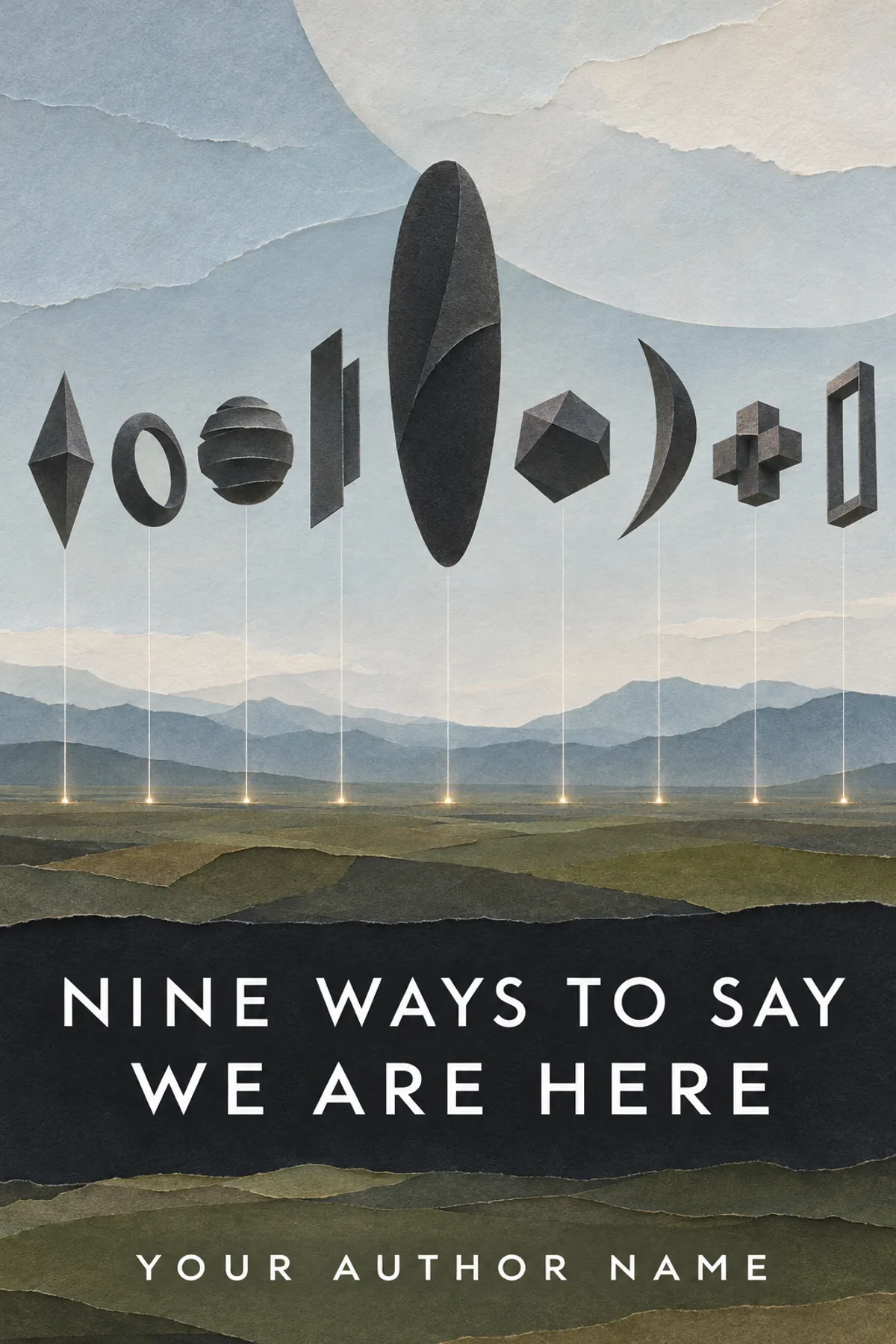
Nine Ways to Say We Are Here
Nine linked stories follow different human communities answering the same alien signal, each revealing what its chosen greeting conceals about who gets to speak.
ImagineYourBook writes a fresh draft from this idea.
How it begins
The harbor wanted to answer with a foghorn.
Rosa considered this more sensible than the mayor's proposal, which began with a list of municipal achievements and exceeded the available transmission window before reaching the harbor itself.
The signal had arrived everywhere at once. Scientists had verified its source and repeated structure, but the meaning remained uncertain. A coordinated project invited communities to submit short representations of where they were and how they understood being here.
Twenty seconds. No claim to speak for everyone.
Rosa had read that last condition aloud at the meeting. The mayor had nodded and continued speaking for everyone.
Daniel arrived at the radio station with recordings made by his adult evening class. Waves beneath the pier. A bus reversing. Someone saying a name slowly so a newcomer could pronounce it.
"Which one do you like?" he asked.
"That's not the question."
"I know. But it's the question people keep answering."
Outside, fishing boats moved through mist. The foghorn sounded from the breakwater, an old instruction to unseen vessels: there is something here; take care how you approach.
Rosa's father had worked on that horn. He also refused to speak to the neighbors who arrived after the cannery closed. His idea of welcome had always depended on who was coming.
She listened to the recordings again.
A perfect greeting would be a lie if it claimed the town had already learned how to receive strangers. A hostile one would ignore the people who kept trying.
Daniel placed a blank label beside the recorder.
"We could say who made it."
Rosa nodded. Names, date, place. A message from some people, not the final account of a species.
They began with the foghorn. Then they left enough time for the voices around it, including one that asked whether the visitors might prefer a different sound.
Far away, eight other communities were preparing answers the harbor could not yet imagine.
Outline and characters
Develop this idea
The nine stories need independent conflicts, settings and satisfying turns, not nine illustrations of one thesis. Keep the alien signal's meaning uncertain enough that human choices remain interpretive. Avoid claiming any fictional community represents an entire real culture. Attribution is the structural link: each greeting reveals who was included, excluded or allowed to dissent. Let recurring sounds and names connect the stories lightly, and reserve the final response for a consequence that deepens plurality rather than proving one greeting correct.
- Story one: a harbor's radio operator replaces an official boast with a clearly attributed, imperfect greeting.
- Story two: a mountain repair collective sends the sound of shared work and debates whether exhausting labor should define it.
- Story three: residents of a crowded city block refuse a landlord's claim to represent their home and record separate introductions.
- Story four: a remote observatory chooses to disclose its funding dispute alongside its scientific confidence.
- Story five: a community of displaced adults sends multiple place names rather than accepting one imposed origin.
- Story six: a farming cooperative argues over sending abundance while some members remain hungry, then includes the disagreement.
- Story seven: an island choir invites non-singers to shape the pauses and attribution of its reply.
- Story eight: workers on an orbital station negotiate a message acknowledging both attachment to Earth and a different daily sky.
- Story nine: a translation group assembles the replies without smoothing their contradictions and receives a response addressed to the named groups separately.
- The closing sequence revisits each community's local consequences, showing that answering outward changed who was heard at home.
Characters
- Rosa Almeida, 46. Coastal radio operator anchoring the first story
- Daniel Park, 39. Teacher coordinating one community's proposed reply
Series possibilities
- A second linked collection follows the communities when the reply asks a question that cannot be answered collectively.