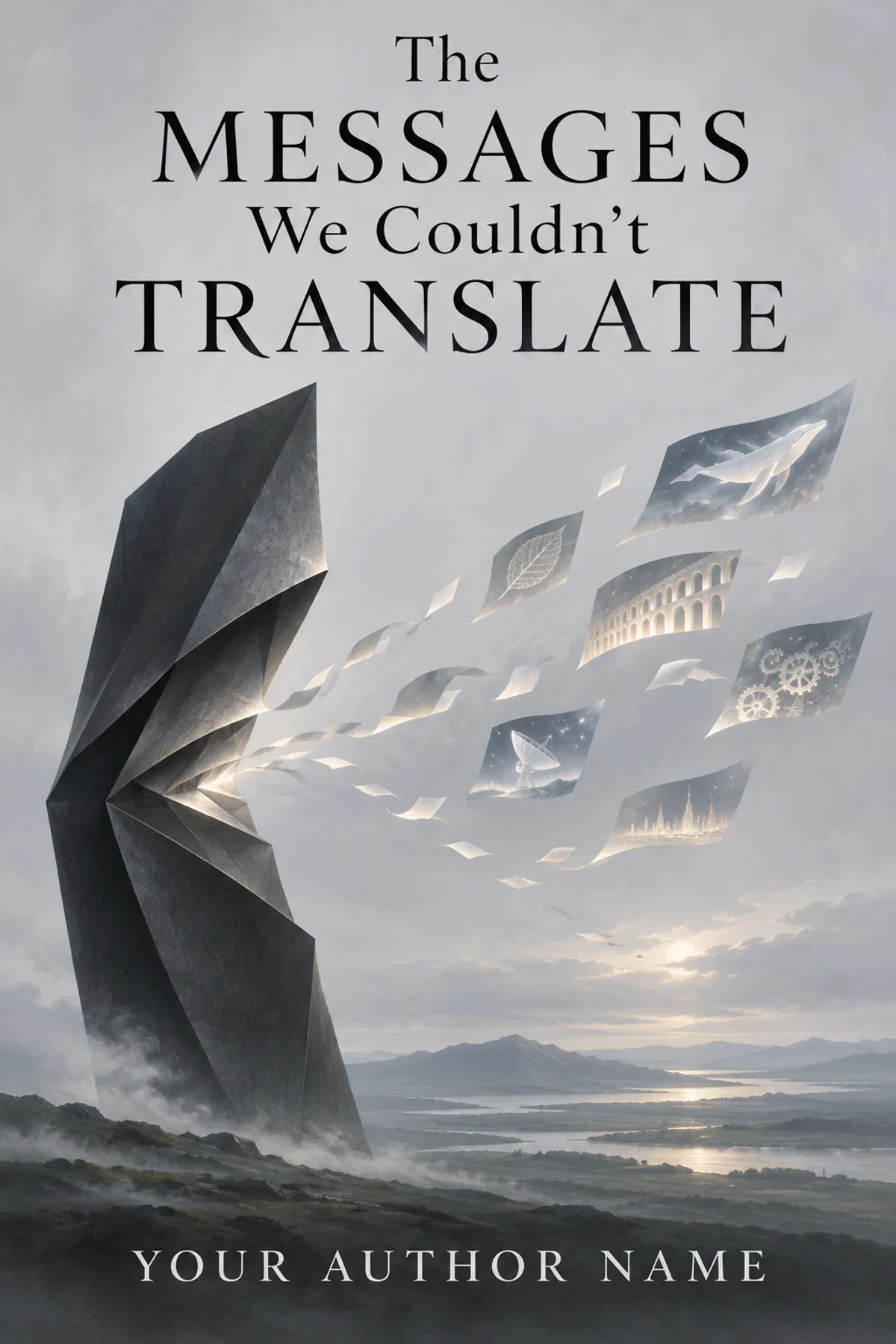
The Messages We Couldn't Translate
A linked speculative collection explores interpreters confronting messages from animals, buildings, machines and distant people, with each translation changing the relationship that made it necessary.
ImagineYourBook writes a fresh draft from this idea.
How it begins
The building did not say help.
That was the first correction Mina made to the report.
Its pipes struck three times at dawn, the lift paused between floors and every window on the east wall fogged at the edges. The owners had called those events a distress signal because distress justified an emergency contract.
Mina was less certain.
She had translated speech for twenty years and unusual signals for six months, ever since a municipal water tower began responding to maintenance questions. Her new profession had acquired a name before it acquired a reliable method.
Arthur met her in the entrance hall with a ring of keys.
"It does that when the cleaners leave."
"The knocking?"
"All of it."
He showed her the service schedule. At dawn, the night cleaners finished, the heating shifted and the lift returned to its daytime pattern. Mina had seen the mechanical sequence. She had not noticed the people leaving within it.
On the east wall, a patch of condensation widened.
She asked Arthur to stand where he usually waited for the cleaners' last trolley. He did. The lift doors opened without a call.
"Perhaps it is thanking them," he said.
Mina wrote perhaps.
The word looked small beside the owner's confident diagnosis. It was also the most accurate part of her page.
They invited the cleaning team to describe what they noticed. One worker said the building always made the same sounds when a shift ran late. Another said the fog appeared near the room where they changed clothes. A third asked whether anyone intended to repair the broken heater in that room.
Mina stopped searching for a sentence.
Whatever the building meant, a human request had just become perfectly clear.
She added it to the report in ordinary language. Outside, a pigeon tapped the window, and for once she did not assume that every sound in the world had been addressed to her.
Outline and characters
Develop this idea
Vary the degree of speculation across stories so some messages are literal, some uncertain and some human projections. Each translation should change a relationship through a concrete action or mistaken assumption. Avoid granting effortless access to animal minds or presenting every natural pattern as speech. Recurring interpreters can connect the collection without solving one another's cases. The final gathering should preserve unresolved messages and demonstrate that useful communication sometimes begins by admitting what has not been understood.
- Story one: an interpreter's search for a building's meaning exposes a plainly spoken request from overlooked workers.
- Story two: a researcher interprets an animal's repeated action as affection until a changed habitat reveals a practical preference.
- Story three: an old machine's error messages become legible only when a retired operator explains the work they interrupted.
- Story four: distant siblings translate a parent's recipe differently and cook both versions without declaring one authentic.
- Story five: a spacecraft receives a message whose intended recipient is a river rather than a government.
- Story six: a translator discovers that a town's warning bells mean different things to residents who cannot hear them.
- Story seven: a household device refuses an instruction because two users' needs conflict, forcing a human negotiation.
- Story eight: a botanist's uncertain reading of seasonal patterns becomes useful only when separated from a claim of verbal speech.
- Story nine: a returned migrant finds that familiar words have changed while their community was living without them.
- Story ten: Mina meets several earlier interpreters and assembles an account of useful uncertainty, leaving some messages untranslated by choice.
Characters
- Mina Reyes, 35. Interpreter of an unusual building message in the opening story
- Arthur Chen, 62. Caretaker whose familiarity challenges the first translation
Series possibilities
- A second collection follows replies that arrive after the original translators have changed their minds.