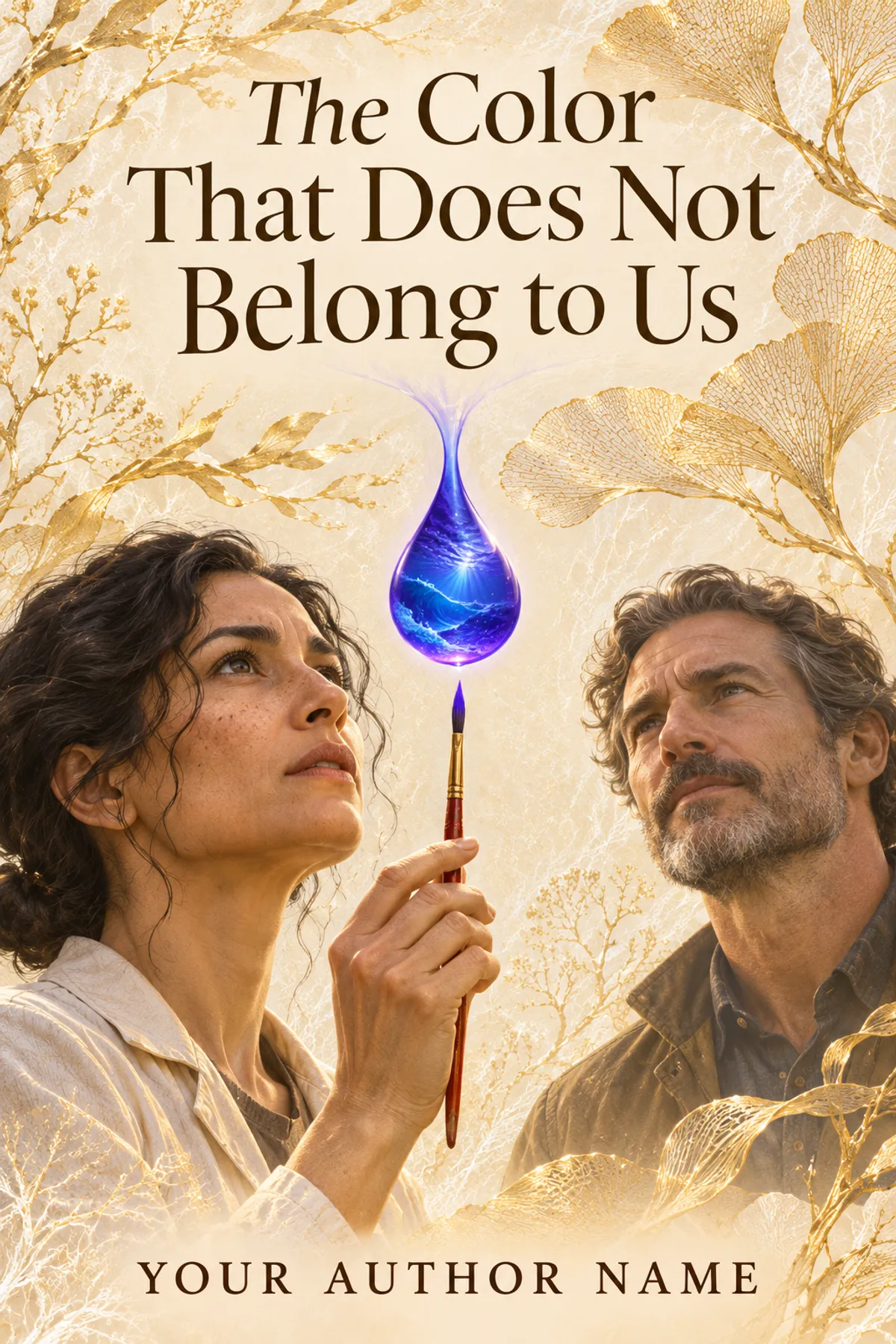
The Color That Does Not Belong to Us
A pigment conservator discovers a new color that makes viewers remember an ocean humanity has never visited. A marine biologist helps her trace its origin, while the city moves to classify the color as a contagious species with no right to enter human vision.
ImagineYourBook writes a fresh draft from this idea.
How it begins
Isha Moss found the color beneath a painting of an ocean that did not exist. It appeared only where the varnish had cracked, a narrow line between blue and something her eyes had no practice naming.
She leaned closer. Salt filled her mouth. For one second she remembered swimming beneath a sky with two pale suns. Then the studio returned, bright and ordinary, with her untouched tea cooling beside the solvents.
Nolan Reed arrived to inspect the painting's biological pigments. He carried sample cases and a waterproof coat that made every room smell faintly of boats.
'Where is this coast?' he asked.
'Nowhere in the catalogue.'
He looked at the exposed line. His hand closed around the edge of the table.
'I've been there.'
'You can't have.'
'I know.'
They compared memories. Different swimmers, different weather, the same impossible ocean. Nolan described a current turning beneath black floating leaves. Isha knew its pull before he finished the sentence.
Her colorimeter returned no result. The city perception registry, however, identified the sample immediately. UNAUTHORIZED VISUAL ORGANISM. DO NOT PERMIT ENTRY.
Isha had restored pigments for eighteen years. She understood mold, light damage and reactions between incompatible materials. She had never been asked to treat sight as a border checkpoint.
Nolan moved away from the painting. The unfamiliar memory remained.
'It isn't just showing us something,' he said.
Outside, a gull struck the studio window, recovered and landed on the sill. Its feathers carried one thin line of the new color. It looked through the glass at the painted sea.
Isha's phone began ringing with an official number. The line beneath the varnish widened by the width of a breath.
She covered the painting with clean cloth. In the sudden darkness, she could still feel an ocean waiting for someone to decide whether it was allowed to be seen.
Your idea. Your book.
Keep the spark. Change anything.
Create my bookCreated with ImagineYourBook. Free to use as inspiration.
Outline and characters
Develop this idea
Treat the color as an ecological encounter rather than a simple symbol of liberation. Isha and Nolan must investigate effects on viewers, birds and environments without assuming either contagion or harmlessness. Shared memories need limits and conflicting perspectives. The registry's language can conceal a genuine earlier event, giving caution some basis. A responsible resolution allows informed contact and containment choices, while challenging the claim that all unfamiliar life must prove usefulness before entering human experience.
- Isha exposes an unregistered color in a painting.
- Nolan shares a memory of its impossible ocean.
- A registry labels the pigment a visual organism.
- Bird behavior reveals contact beyond human perception.
- An uncontrolled viewing creates a conflicting memory.
- The pair uncover a concealed earlier encounter.
- Authorities propose erasing every affected image.
- Volunteers test bounded informed exposure.
- Isha protects both viewers and the organism's habitat.
- A new protocol treats sight as contact rather than ownership.
Characters
- Isha Moss, 42. Pigment conservator
- Nolan Reed, 48. Marine biologist
Series possibilities
- Isha and Nolan investigate other artworks serving as habitats for unfamiliar forms of life.