
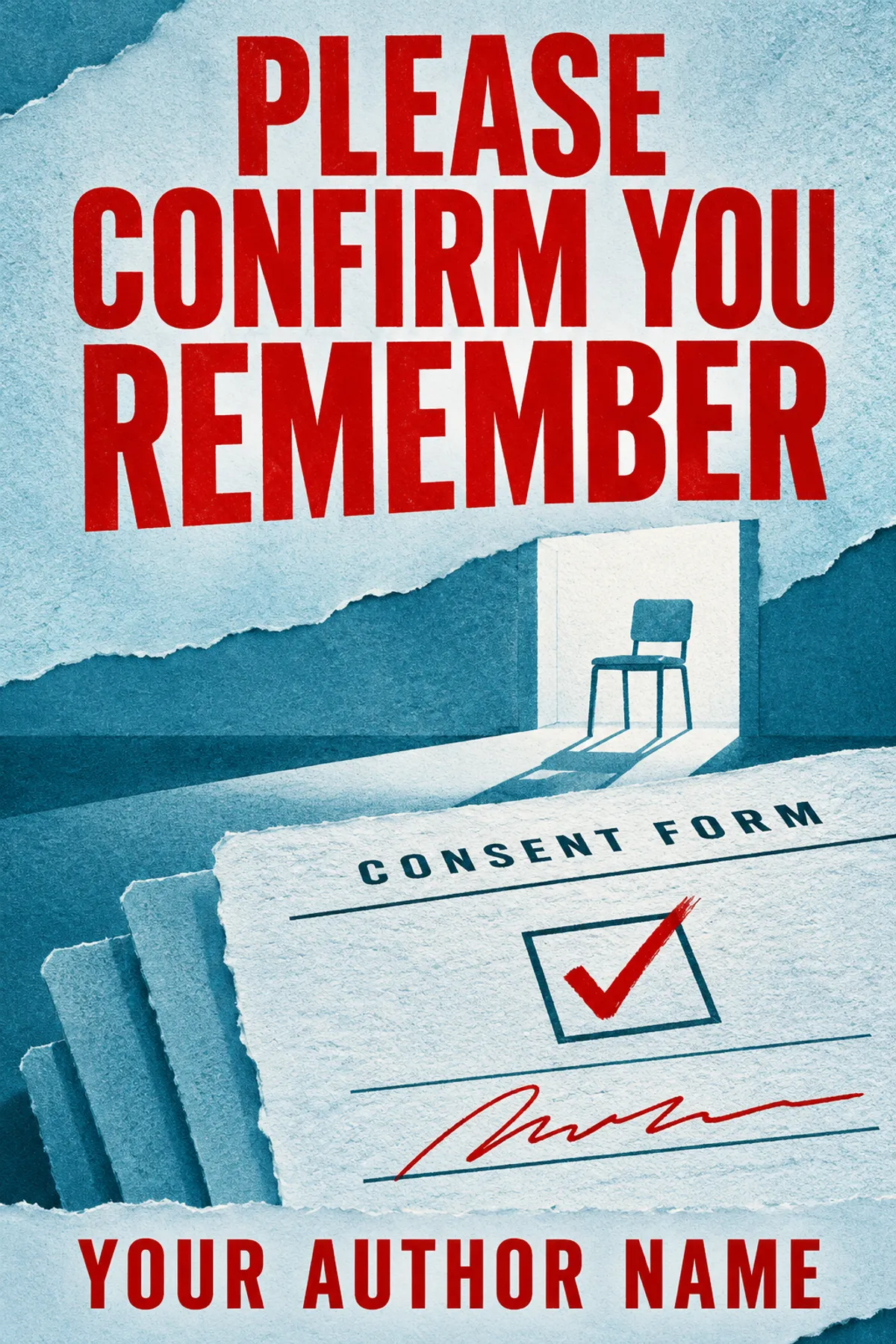
Please Confirm You Remember
A memory-study administrator receives daily consent forms signed in her own handwriting for sessions she never attended, and follows the audit trail into a carefully staged family reconciliation.
ImagineYourBook writes a fresh draft from this idea.
How it begins
Alice's signature appeared on the consent form at 8:14, while she was watching a plumber remove her kitchen sink.
She knew the time because the plumber had asked her to photograph a cracked fitting before he touched it. The picture showed his hand, the fitting and her watch.
The form said she had attended a forty-minute memory session across town.
It was the fourth such form that week.
Alice printed it and laid it beside the others. The signature was not merely similar to hers. It included the small upward mistake she made when signing too quickly, a broken loop she had never been able to stop making.
At the laboratory, her supervisor smiled as though Alice had repeated a pleasant story.
"You said there might be confusion."
"I said there were forms I hadn't signed."
"Of course."
The agreement in his voice unsettled her more than an argument would have.
She asked for the session-room booking. It was there. She asked for the facilitator's name. It belonged to a contractor whose access had expired six months earlier.
Her brother.
Alice sat down. Beyond the office glass, students were pinning cheerful recruitment posters to a board. Better recall. Better understanding. Compensation available.
David had sent three messages since their mother's house went on the market. All mentioned healing. None mentioned the money missing from the sale account.
Her phone rang.
"Before you get upset," he said, "we agreed this might happen."
Alice looked at the four signatures.
For years, David had told family stories so confidently that disagreeing felt like interrupting a performance. She had usually let him finish.
This time she opened the photograph of the plumber. She could see the cracked fitting clearly, water pooled beneath it, her own hand steady at the edge of the frame.
"Then show me the agreement," she said.
Outline and characters
Develop this idea
Anchor Alice's confidence in concrete records rather than an abrupt perfect-memory revelation. The story's pressure comes from other people treating disagreement as evidence of confusion. Distinguish legitimate memory research from the misuse of its language and paperwork. Give the colleague a believable procedural failure and meaningful accountability. David's aim should be specific enough to explain the effort of staging sessions. The ending can restore records and agency without requiring forgiveness or a tidy family reunion.
- Alice receives consent forms for sessions she can independently prove she missed.
- Her brother's expired contractor identity appears in the bookings.
- David frames her objections as expected resistance to a family reconciliation study.
- Alice secures original system logs before anyone can replace them with summaries.
- Signature comparisons reveal reuse of an earlier legitimate scanned form.
- A colleague admits approving paperwork after trusting David's account of family consent.
- The staged sessions were intended to undermine Alice's challenge to missing inheritance funds.
- Alice separates the financial evidence from the false therapeutic narrative and obtains independent review.
- The forged records are corrected and David's transfers are traced.
- Alice decides the terms of future family contact without accepting reconciliation as an obligation.
Characters
- Alice Bennett, 43. Memory-study administrator
- David Bennett, 46. Her estranged brother and a former research contractor
Series possibilities
- A standalone companion follows another administrator confronting a persuasive story embedded in official records.