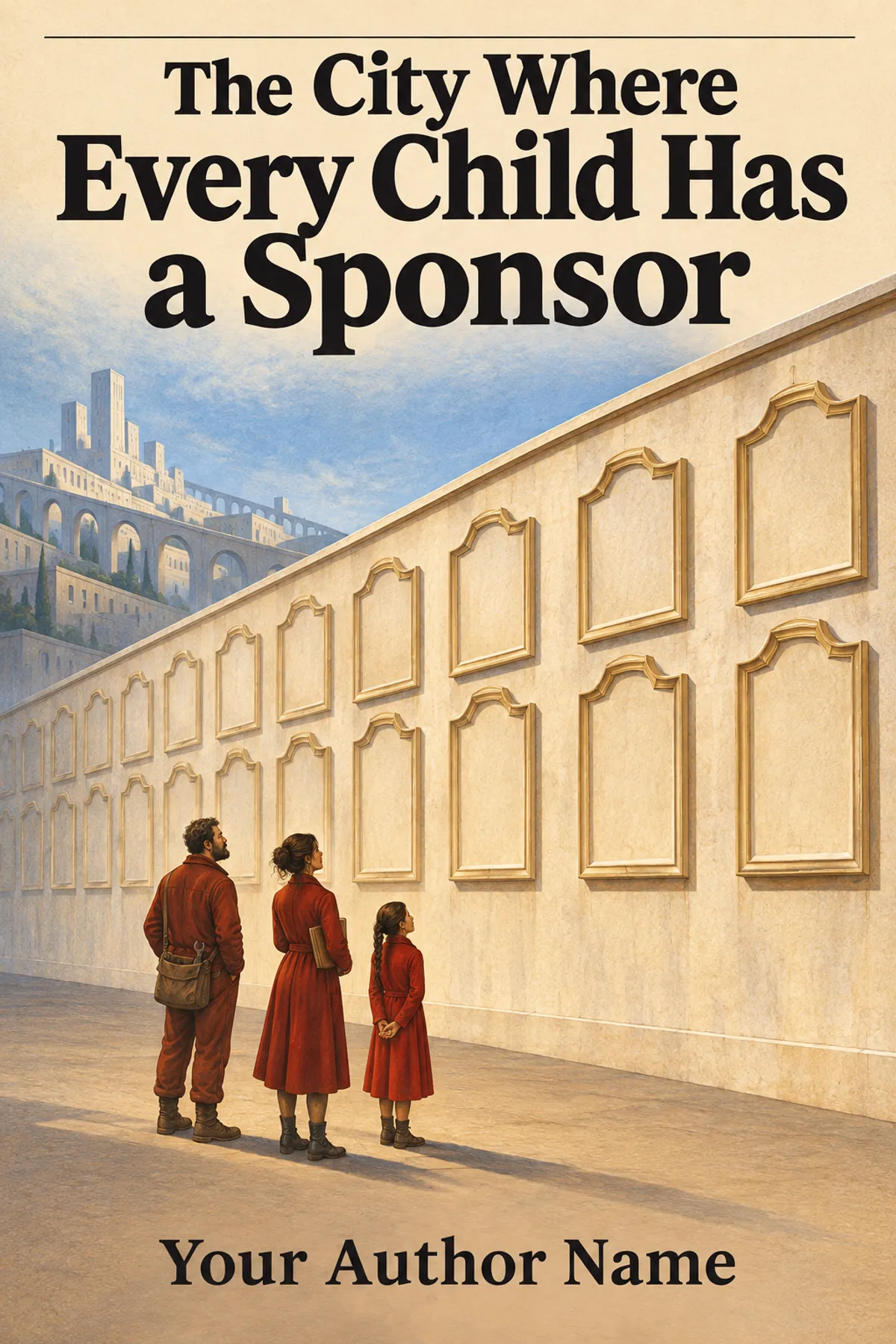
The City Where Every Child Has a Sponsor
An adult teacher learns that her city's sponsors now own the future career choices of the children they support. Protecting a pupil's ordinary wish to change her mind exposes how gratitude has replaced permission.
ImagineYourBook writes a fresh draft from this idea.
How it begins
The letter congratulated a nine-year-old on becoming a future structural engineer.
Beside the fish tank, a plant leaned toward the window. Iris had promised the class they could decide where to move it.
Iris Dorr read it beside the classroom aquarium.
The child had spent the previous week announcing an intention to become a person who repaired bicycles and kept three dogs. Before that, she'd wanted to design shoes for astronauts.
Neither ambition appeared in the sponsor's approved pathway.
"Can I change it?" the girl asked.
Iris looked at the embossed signature, the scholarship seal, and the paragraph thanking the family for its continued confidence.
"I'll find out."
At the sponsor office, a woman explained that educational support represented a mutual commitment.
"She's nine," Iris said.
"And fortunate."
The word followed Iris back through the city.
Fortunate appeared on school banners, bus shelters, and the certificates children carried home at the end of term. Every child had a sponsor. Every sponsor had a future it preferred not to leave uncertain.
Ivo Neri was waiting outside the classroom with oil on his hands from the community repair shop.
"She showed me the letter," he said.
"Did you see the original contract?"
"When she was three. We needed the place."
He said it without apology, and Iris was grateful. She did not want the first useful conversation to become a trial of a parent's choices under pressure.
He unfolded a copy on the small table.
The clause was not hidden. That made it worse. A clear sentence in a stack of clear sentences nobody had explained together.
Career allocation subject to sponsor continuity requirements.
From the next room came the sound of children arguing over a drawing of the moon.
Iris looked at the letter again.
"We should ask who else has received one."
Ivo nodded.
On the aquarium glass, the girl had taped a picture of three dogs beside a bicycle shop.
Your idea. Your book.
Keep the spark. Change anything.
Create my bookCreated with ImagineYourBook. Free to use as inspiration.
Outline and characters
Develop this idea
Children should be protected participants with age-appropriate voices, not props for an adult teacher's heroism. Iris and Ivo need to understand why families accepted support and why some fear losing it. Keep the sponsorship system specific enough to produce real tradeoffs rather than vague evil branding. A meaningful victory can restore the ability to change direction while funding remains contested. Avoid implying that gratitude and consent are interchangeable.
- Iris receives a pupil's sponsor-approved future
- A child asks to change an unremarkable ambition
- Ivo discovers the support contract's binding condition
- The school frames refusal as ingratitude
- Other families reveal conflicting dependencies
- Iris risks her role by sharing clear information
- The sponsors offer exceptions for selected pupils
- Families reject freedom granted only to favorites
- A collective challenge restores a right to reconsider
- The pupil chooses a future without promising to keep it
Characters
- Iris Dorr, 34. Teacher
- Ivo Neri, 41. Parent and community mechanic
Series possibilities
- Dystopian stories explore institutions that replace rights with conditional generosity and call the exchange opportunity.