
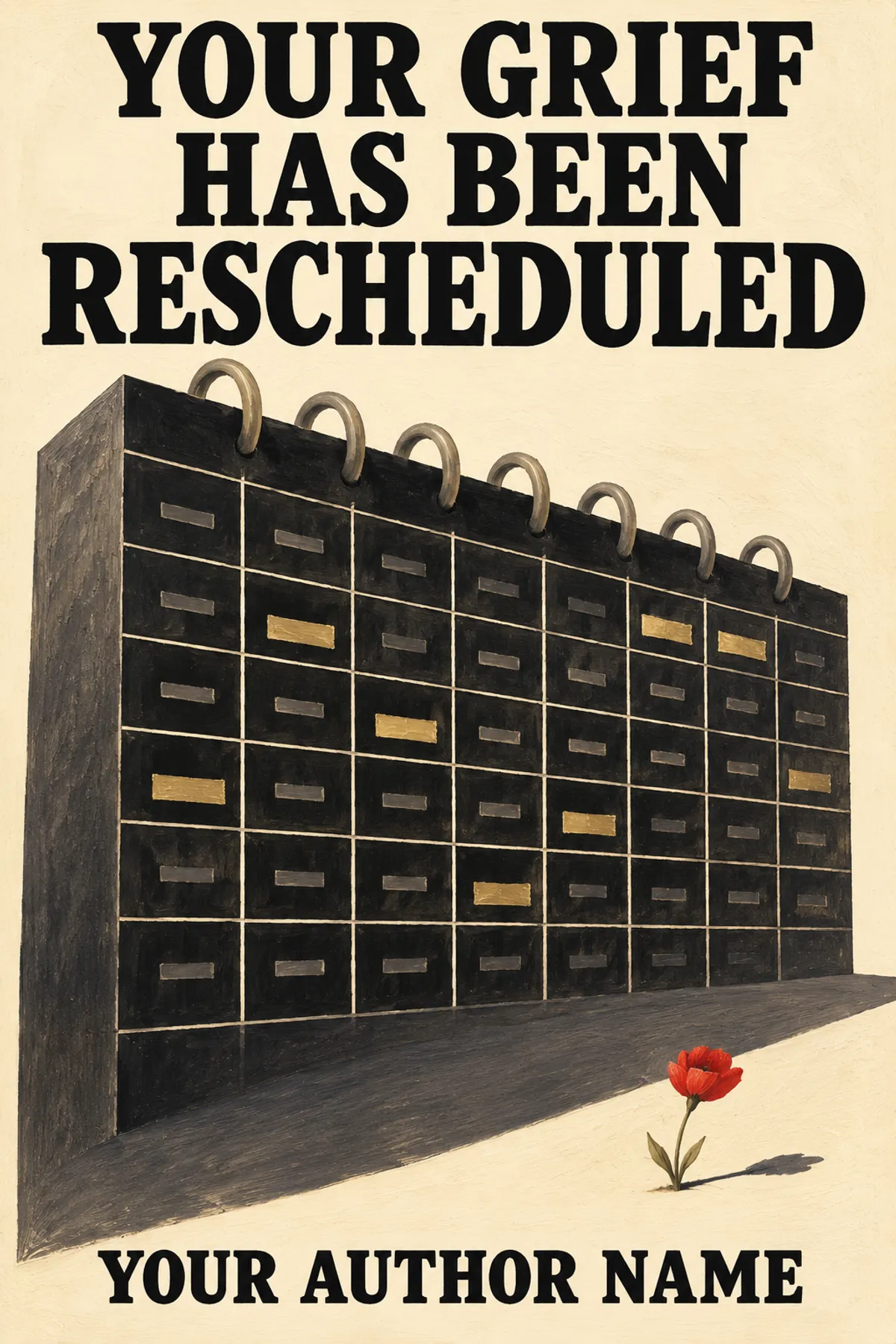
Your Grief Has Been Rescheduled
A funeral scheduler in a city rationing public mourning discovers that privileged families have been buying the grief hours allocated to strangers, and begins restoring the stolen time.
ImagineYourBook writes a fresh draft from this idea.
How it begins
Henry's wife had been moved to Tuesday without telling him.
Not her body. Her mourning.
The city allowed families a fixed period of public acknowledgment: bells, gathering space, permission to close a shop without penalty. Henry had booked Friday afternoon, when his daughters could leave work.
Clara's screen now showed Tuesday at six in the morning.
"I didn't change it," he said.
"I can see a transfer."
"Then you can see who asked."
The request field contained a code instead of a name. Clara had seen that code before on adjustments she was told were automatic. The training manual called them unused-capacity reconciliations.
Henry placed two train tickets on the counter.
"They've already paid to come."
Across the square, bells began for a businessman whose family had purchased an extended remembrance package. The sound entered the office through closed windows, rich and deliberate. Clara watched Henry count the strokes.
She opened the underlying allocation ledger.
His wife's Friday hours had not been left unused. They had been divided among three premium ceremonies, each receiving a few additional minutes of public attention. The system classified Henry's family as unlikely to make full use of the slot because they had booked no flowers through an approved provider.
Clara looked at the small bunch in his hand, wrapped in newspaper.
"Who chose that?" he asked.
She could have said the system. It would have been true in the way a locked door could be said to choose who entered.
Instead, she printed the transfer record.
"The office approved it. I'm going to find the approval."
Henry sat down. He did not thank her. Clara was relieved. Thanks would have made the beginning of her job sound like an exceptional kindness.
Outside, the purchased bells continued, using minutes that belonged to people whose names the city had already stopped saying.
Outline and characters
Develop this idea
The allocated hours govern public services and recognition, not the capacity to feel grief. This distinction keeps the premise concrete and avoids reducing mourning to a clock. Clara's complicity should appear in specific approvals, while affected families lead their own claims. Some people may decline public restoration, and their preference must remain valid. A changed allocation rule offers measurable closure without implying that recovered minutes compensate for the person who died.
- Clara discovers Henry's mourning slot was transferred without consent.
- Premium ceremonies receive time taken from families predicted to use less.
- The prediction relies on spending and employment patterns rather than actual wishes.
- Clara preserves allocation records and finds her own routine approvals among them.
- Affected families seek different remedies, from restored gatherings to financial compensation or privacy.
- The city offers quiet individual adjustments while preserving the resale system.
- Clara helps families obtain their own records and supports a public challenge led by them.
- A coordinated day of unscheduled remembrance reveals the scale of excluded grief.
- The city ends involuntary transfers and provides a practical process for restoring stolen allocations.
- Henry holds a gathering shaped by his family, and Clara works under a rule that public mourning cannot be valued by associated spending.
Characters
- Clara Ruiz, 43. Municipal funeral scheduler
- Henry Cole, 60. Widower whose allotted mourning hours have been sold
Series possibilities
- A companion novel follows a family that chooses private remembrance after winning back its public hours.