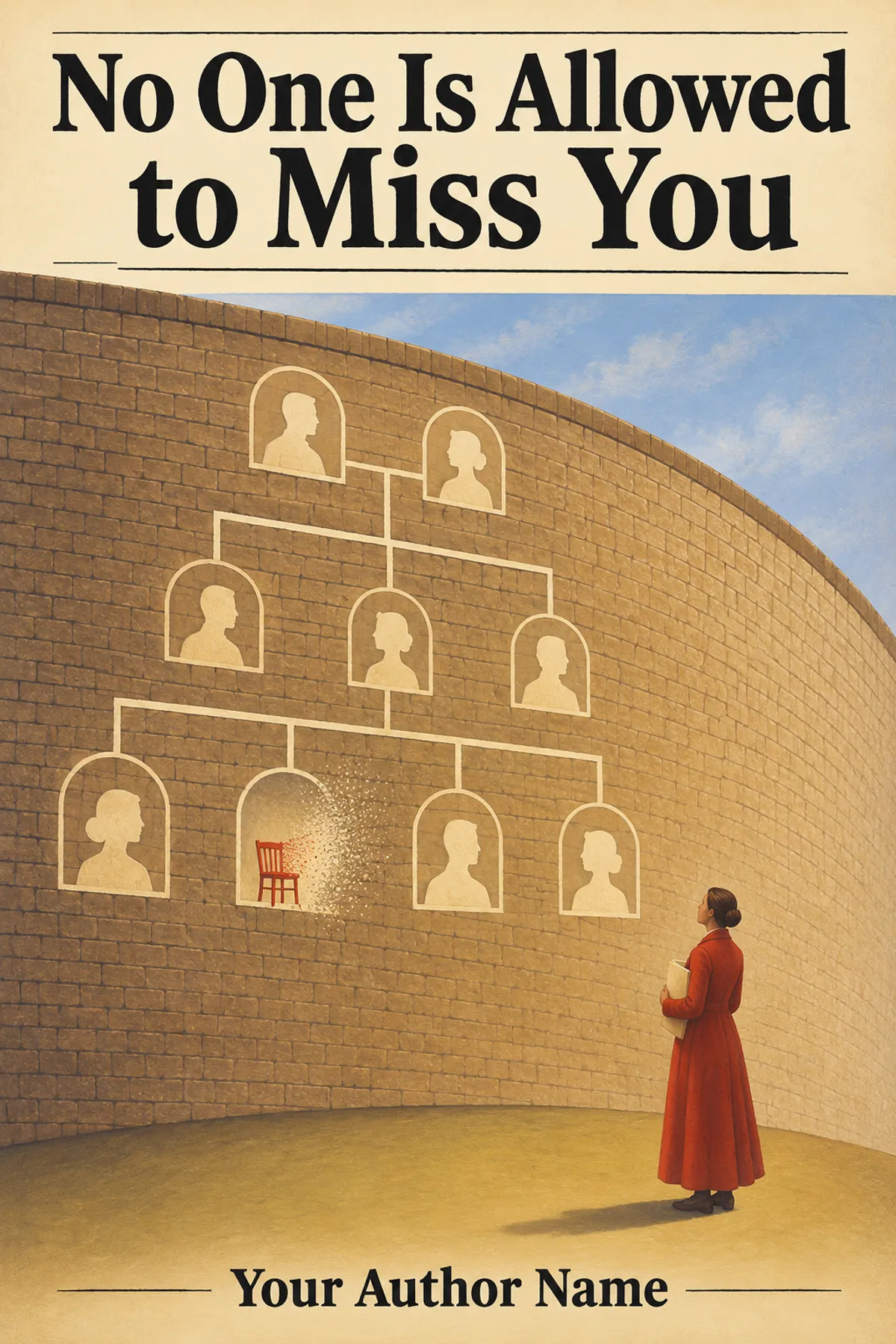
No One Is Allowed to Miss You
A municipal grief registrar removes unproductive attachments from citizens' records. When her own sister is declared unnecessary to remember, she must preserve a relationship without turning private love into public evidence.
ImagineYourBook writes a fresh draft from this idea.
How it begins
My sister had become administratively unnecessary.
The notice arrived in my own queue.
I recognized the case number before I read her name. I had used the same sequence when registering her death, then spent three years pretending numbers made the work less personal.
ATTACHMENT VALUE: BELOW CONTINUATION THRESHOLD.
RECOMMENDED ACTION: RELEASE.
I had approved six releases that morning.
A widower whose wife no longer appeared on his housing form. A woman who kept requesting the birthday of a brother removed from the public record. Four cases I had processed too quickly to remember.
Now the cursor waited beneath my sister's name.
Mara.
She had hated forms.
At school, she once wrote depends under a question asking whether our household was stable.
I smiled before I could stop myself.
The camera above my monitor adjusted.
I let my face settle.
Across the office, my supervisor looked up.
"Anything difficult?"
"Duplicate entry."
"Those are usually easy."
"Usually."
I moved the notice into a temporary folder.
That bought me eleven minutes.
At home, I had one of Mara's cups, a scarf she had never returned properly, and a message in which she asked whether I wanted anything from the shop.
No final wisdom.
No explanation of why she mattered.
The appeal form required both.
I opened it anyway.
PLEASE DESCRIBE THE CIVIC BENEFIT OF CONTINUED ATTACHMENT.
The words sat in a clean white box.
For years, I had helped people fit their love inside it.
I closed the form.
On my break, I went downstairs to Ruth Bell's flat.
She opened the door holding a plate.
"You're early."
"For what?"
"Dinner. Your sister said you'd forget to eat when work got ugly."
Mara had said that years ago.
Ruth stepped aside without asking for evidence.
I entered carrying nothing the city could use to decide whether I was allowed to miss her.
Your idea. Your book.
Keep the spark. Change anything.
Create my bookCreated with ImagineYourBook. Free to use as inspiration.
Outline and characters
Develop this idea
The story should defend privacy as well as memory. Mina must not earn freedom by making every painful detail available to officials or readers. Ruth can offer practices rather than a single correct way to grieve. Keep the civic policy's mechanisms concrete and limited. The ending can challenge institutional coercion while leaving loss unresolved and ordinary remembrance free from a productivity test.
- Mina removes attachments declared unproductive from civic records
- Her late sister is classified as unnecessary to remember
- Ruth shows her ways residents preserve relationships outside official proof
- Mina discovers that appeals require intimate details the city then exploits
- A supervisor offers a private exemption for her own loss
- She refuses to expose other people's grief to earn recognition
- Residents create a voluntary network with no central list of names
- Mina preserves evidence of the policy while withholding private testimonies
- The system's public claim of consent collapses
- She leaves the registry and keeps a small ordinary ritual for her sister
Characters
- Mina Cole, 42. Municipal grief registrar
- Ruth Bell, 64. Neighbor preserving a private loss
Series possibilities
- A former registrar receives a deletion notice for a relationship the city never knew existed.