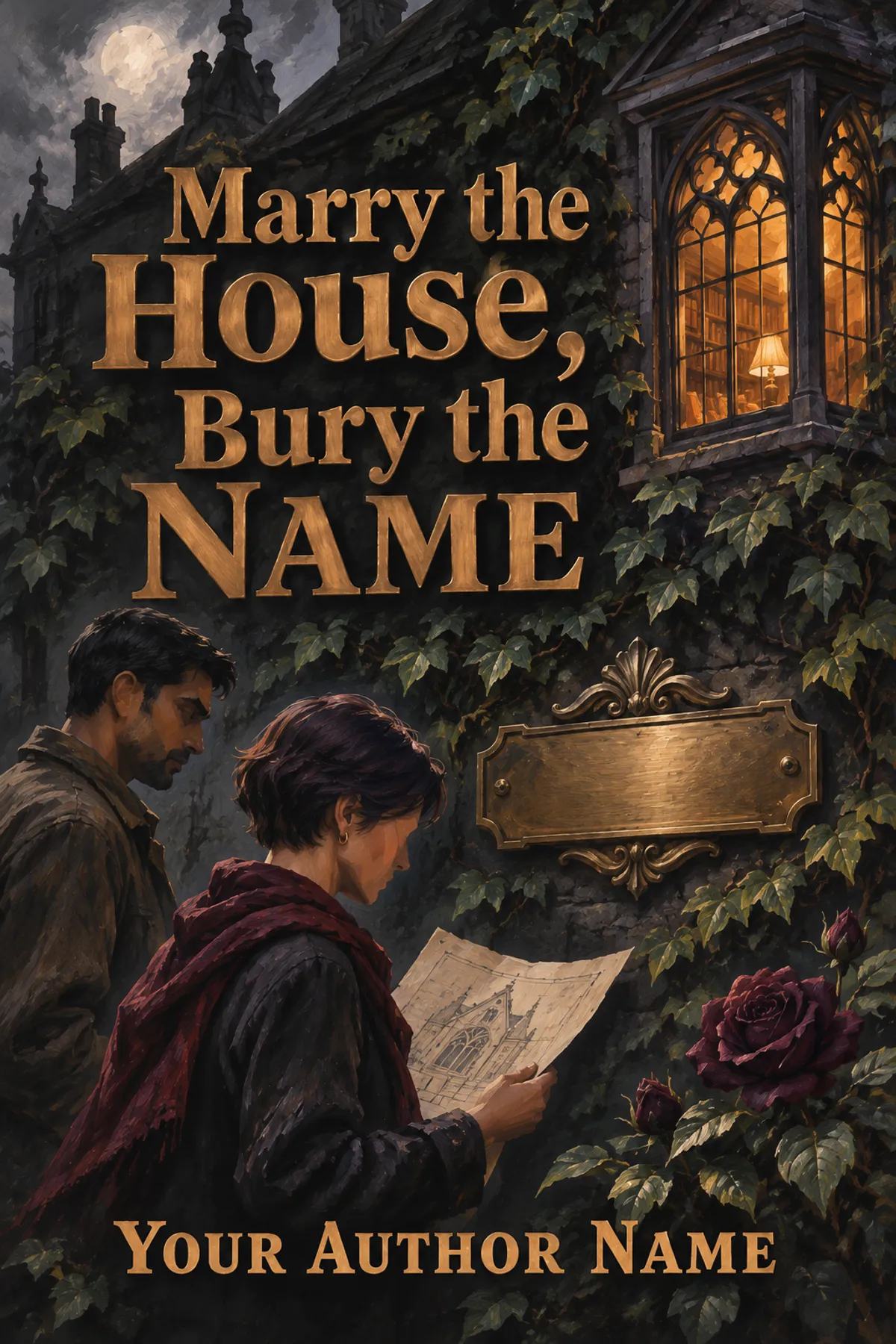
Marry the House, Bury the Name
A widowed architectural historian inherits a house only if she restores the erased identities of its previous owners, while a charming caretaker fears the final name will be his.
ImagineYourBook writes a fresh draft from this idea.
How it begins
The solicitor called it a condition of inheritance.
Helen called it a reason to reconsider.
Restore the names of all previous owners before taking permanent possession. Until then, the house would provide accommodation but no authority to sell, alter or remove its contents.
It was the word all that troubled her.
The official history listed six owners. The entrance hall contained eleven blank brass plaques.
Thomas Reed met her beneath them carrying a ring of keys so large it seemed ceremonial. He had the pleasant, practiced manner of a man who knew which questions visitors usually asked and which ones they ought to avoid.
"Your room is ready."
"Whose room was it?"
He paused.
"The east room has always been used for guests."
Not an answer. Helen noted the distinction.
Since her husband's death, people had become careful around her in ways that made ordinary conversation exhausting. Thomas's evasiveness was almost refreshing. At least it seemed to concern something other than her grief.
He led her through a corridor where the windows did not align with the exterior she had photographed from the drive. A door had been plastered over. Another opened into a room too shallow for its position.
"There have been alterations," she said.
"Every family makes itself comfortable."
"Not usually by removing the space where someone else stood."
Thomas looked back at her. For a moment, the agreeable expression failed.
In the east room, Helen found fresh linen, a vase of branches and a small card bearing her name. Beneath it, pressed into the wood of the bedside table, lay the faint impression of another name.
She angled her phone light across it.
The first letters were THO.
In the corridor, Thomas's keys went suddenly quiet.
Helen set down her bag and opened the door. He was still standing there.
"How long have you lived here?" she asked.
He looked at the card in her hand.
"That depends which record you believe."
Outline and characters
Develop this idea
Use architectural evidence to make the haunting tangible: mismatched windows, altered dimensions and blocked doors can carry the investigation. Thomas should be both helpful and self-interested, with a reason to fear the final name. Helen's grief must remain personal rather than a generic weakness the house exploits. Establish the bargain's rules before the climax. Refusing an idealized echo of her husband can be painful without suggesting that loving the dead prevents a meaningful future.
- Helen inherits the manor under a condition requiring every former owner's name.
- Architectural inconsistencies reveal more occupants than the official history admits.
- Thomas helps her locate records while concealing his own connection.
- Restored names cause altered rooms to return to their earlier dimensions.
- Helen learns the house erased owners who surrendered their identities to preserve the estate.
- Thomas reveals he once inherited it and failed the same condition.
- The house offers Helen a convincing room containing an echo of her dead husband.
- She refuses to exchange her identity for a preserved version of grief.
- Naming Thomas and the other erased owners breaks the inheritance cycle.
- Helen opens the house's history to independent stewardship and leaves with her own name intact.
Characters
- Helen Shaw, 44. Widowed architectural historian
- Thomas Reed, 46. Caretaker whose family has served the house for generations
Series possibilities
- Helen surveys another building whose renovations have concealed a bargain between memory and ownership.