The Poison Was in the Postage
An adult stamp dealer in a fictional 1880 city notices that valuable stamps are being removed from harmless letters and attached to fatal ones, linking a collector's death to a postal theft.
ImagineYourBook writes a fresh draft from this idea.
How it begins
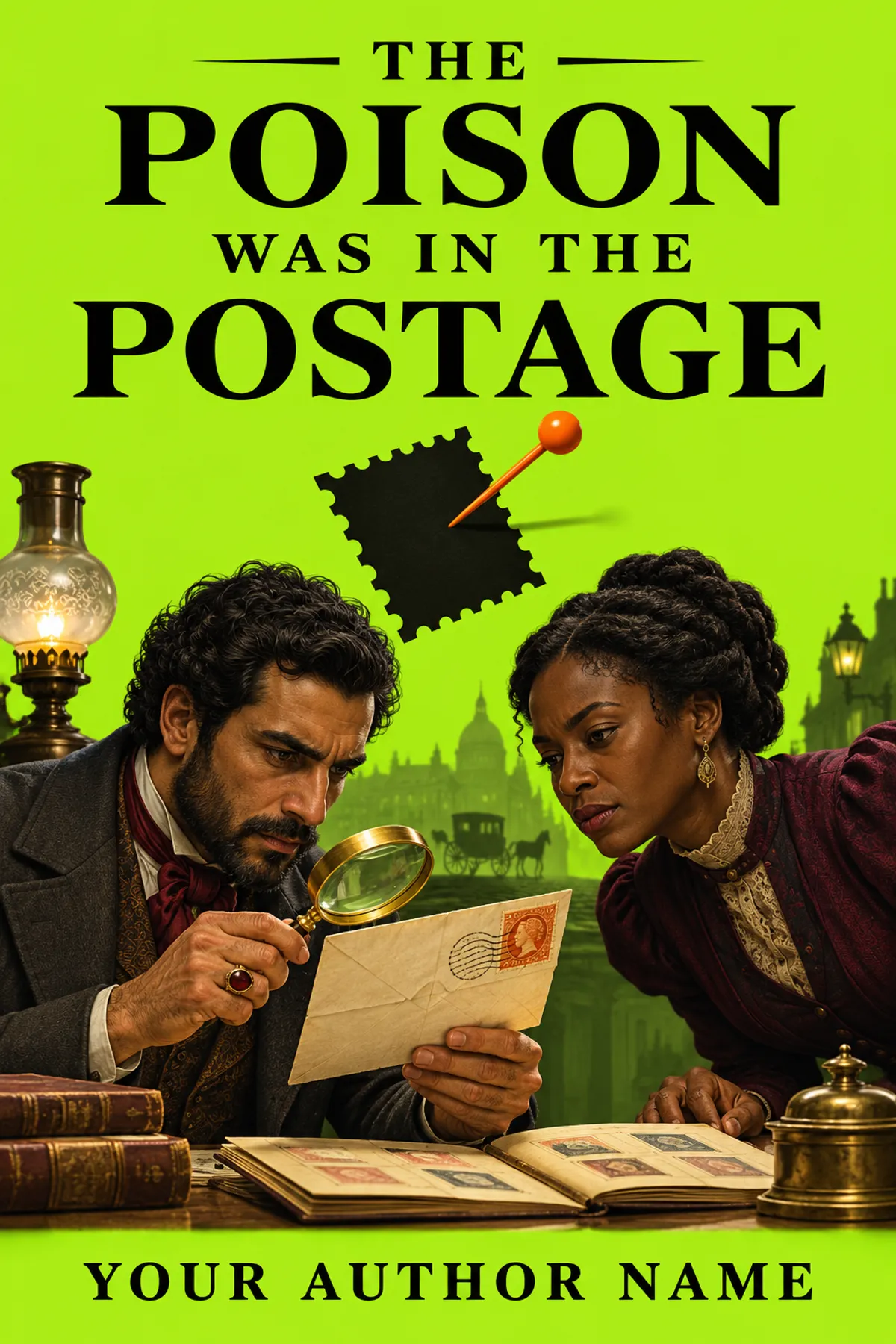
The stamp was worth more than the letter, which was why Edith noticed it had been moved.
Its perforations did not match the faint outline beneath it. Someone had lifted an ordinary stamp and replaced it with a rare printing, aligning the new corner carefully enough to fool anyone interested only in the address.
Edith was interested in corners. They paid her rent.
The letter belonged to a collector who had died the previous evening. His widow brought it in a hatbox, wrapped in tissue with several others.
"He said you would understand the mistake."
"Did he say what mistake?"
"Only that it had happened before."
Edith placed the letter beneath a glass cover and stopped handling the others. The widow had mentioned a sudden illness. That did not make the paper dangerous, but it made careless examination unnecessary.
She sent for the officer already investigating the death and asked Samuel, from the postal counter opposite, to identify the cancellation.
He leaned over without touching the glass.
"That mark belongs to the eastern sorting office."
"The letter came from the west."
"Then it traveled oddly."
Samuel found a second envelope in the box with the same cancellation placed at an unusual angle. Its stamp was common, but the paper beneath showed a larger pale rectangle. Something valuable had been taken from that one.
Edith pictured a pair of letters exchanging their most visible feature while nobody questioned the contents.
Across the street, the afternoon mail cart rattled into the yard. A clerk began sorting bundles beneath the awning.
The widow reached for her hatbox, then stopped.
"Was he killed for a stamp?"
Edith looked at the collector's final note, visible through the glass. Beside a penciled catalogue number, he had written a name she knew.
"I think," she said, "he noticed someone doing more than collecting."
Outline and characters
Develop this idea
Keep the harmful substance and its preparation unspecified; the mystery depends on provenance, not poisoning technique. Edith should stop handling suspicious material and defer examination to the investigation. Perforations, paper outlines and cancellation marks can supply fair visual clues. Give the theft a distinct mechanism and motive before connecting it to the death. Research postal procedures and collectible terminology for the fictional period during development, avoiding modern forensic certainty in an 1880 setting.
- Edith identifies a valuable stamp transferred onto a dead collector's letter.
- Paired envelopes show rare stamps removed from ordinary correspondence.
- Samuel traces an anomalous cancellation to a sorting office.
- Authorities establish that the fatal exposure was associated with altered mail, without Edith experimenting with it.
- The collector had uncovered thefts disguised as exchanges between collectible envelopes.
- A dealer used a postal accomplice to redirect items and suppress complaints.
- Edith's catalogue records reveal which stolen stamp the collector recognized.
- The accomplice's handling records connect the threatening correspondence to the dealer.
- Investigators distinguish the theft network from the deliberate fatal act and secure evidence against both participants.
- Edith returns recovered material to its owners and preserves the collector's final discovery in an accurate catalogue note.
Characters
- Edith Lane, 41. Stamp dealer
- Samuel Hart, 32. Postal clerk assisting an inquiry
Series possibilities
- Edith encounters another postal curiosity whose provenance conceals a present danger.