
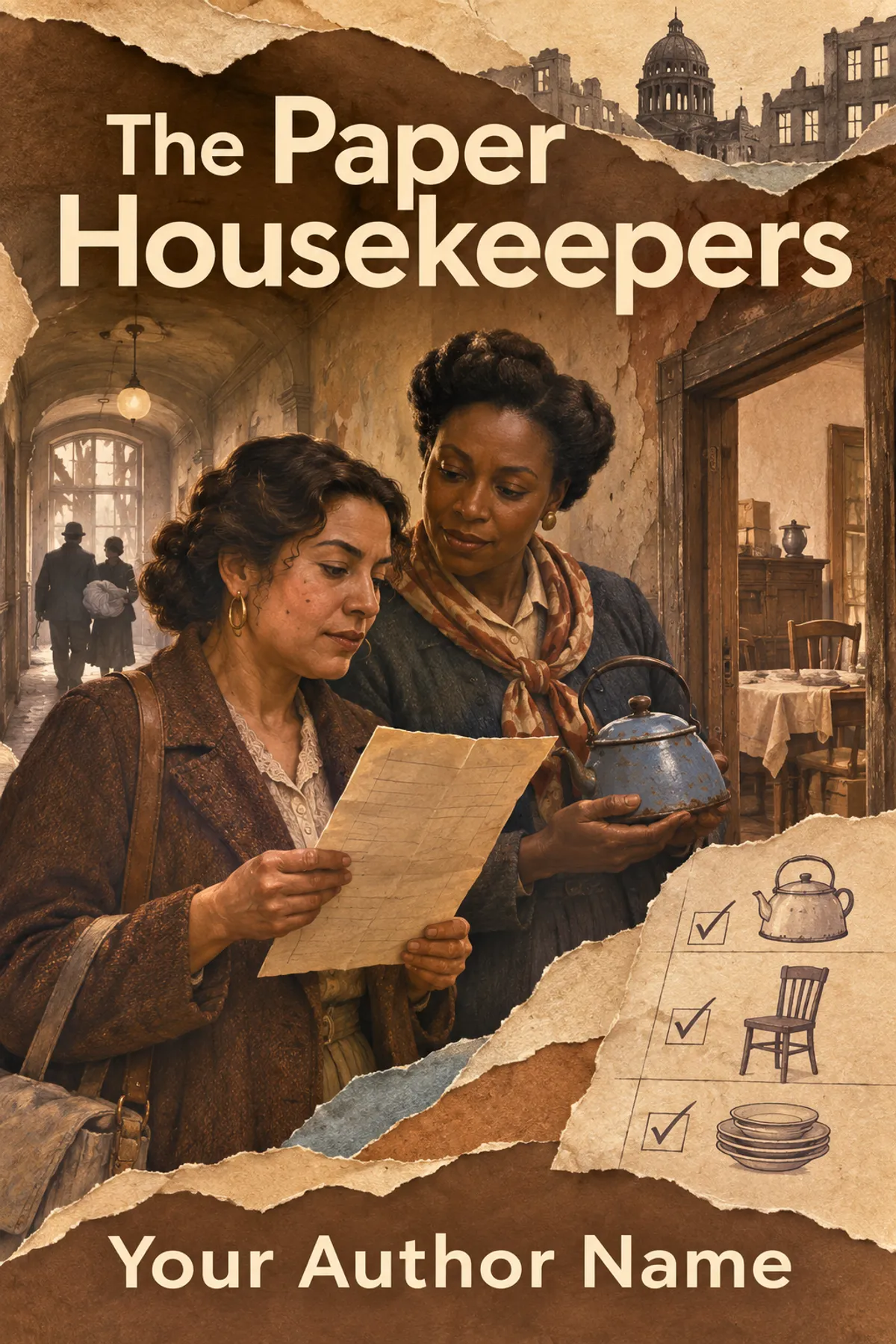
The Paper Housekeepers
In a fictional postwar city, two adult women salvage abandoned household inventories and help displaced families reclaim ordinary objects whose value the official restitution office cannot see.
ImagineYourBook writes a fresh draft from this idea.
How it begins
The official would record a painting but not a saucepan.
Eva asked him to explain the difference.
"Value," he said.
Marta, standing beside her with the dented pan under one arm, made a sound that could have become a laugh under kinder circumstances.
The pan had belonged to a family whose address no longer existed. Inside it, Marta had found a folded inventory: six plates, two blankets, one blue cup, a sewing machine with a broken treadle. No paintings. No silver. Nothing the form seemed designed to remember.
Eva copied the address anyway.
Outside the restitution office, people waited with photographs, keys and descriptions of rooms. The city had reopened shops before it had learned what to do with all the absent owners. In the market, familiar objects changed hands under the practical phrase available goods.
Marta set the saucepan on a low wall.
"We could keep a separate list."
"A list doesn't return anything."
"Neither does refusing to write one."
Eva looked at the inventory. She had once kept records for a household large enough to lose umbrellas without noticing. She knew the language of linen cupboards and replacement costs. She also knew how a careful list could make a life look orderly while leaving out everyone who maintained it.
They rented half a table in the market for the price of two buttons and a promise to mend the stallholder's coat. Marta placed the saucepan where people could see its repaired handle. Eva opened a school notebook.
Their first visitor asked whether they had a bread tin with a star scratched into the lid.
Their second recognized the blue cup.
By afternoon, Eva had filled four pages with descriptions the official had called valueless. When the market bell rang, she did not close the book. A woman was still waiting to tell them how her mother's blanket had smelled after rain.
Outline and characters
Develop this idea
Keep the city fictional until detailed research supports a specific historical setting. Restitution is morally and administratively complex; avoid implying that a market notebook can resolve every competing claim. Eva and Marta should sometimes disagree about whether an object is evidence, livelihood or memory. Give claimants distinct voices and allow uncertainty to remain visible. The project's value lies in making neglected losses legible and enabling some returns, not in replacing formal justice or repairing every consequence of war.
- Eva and Marta find that ordinary household losses fall outside the office's practical priorities.
- They begin an independent inventory table in the market.
- Descriptions connect displaced families to objects circulating through salvage sellers.
- Conflicting claims reveal that possession, memory and legal ownership do not always align neatly.
- A recovered sewing machine offers livelihood to one family while another recognizes it as theirs.
- Eva's faith in precise records clashes with Marta's urgency to meet immediate needs.
- They develop a transparent process for uncertain claims, loans and voluntary transfers.
- A dealer threatens the project after its records expose knowingly concealed provenance.
- Families and traders support a public register that the office agrees to consult.
- Eva and Marta return several objects, leave unresolved entries open and accept that the notebook records absence as well as recovery.
Characters
- Eva Stern, 38. Former household clerk salvaging abandoned inventories
- Marta Bell, 47. Displaced seamstress helping families identify possessions
Series possibilities
- A companion novel follows the families connected by one disputed sewing machine as the city rebuilds.