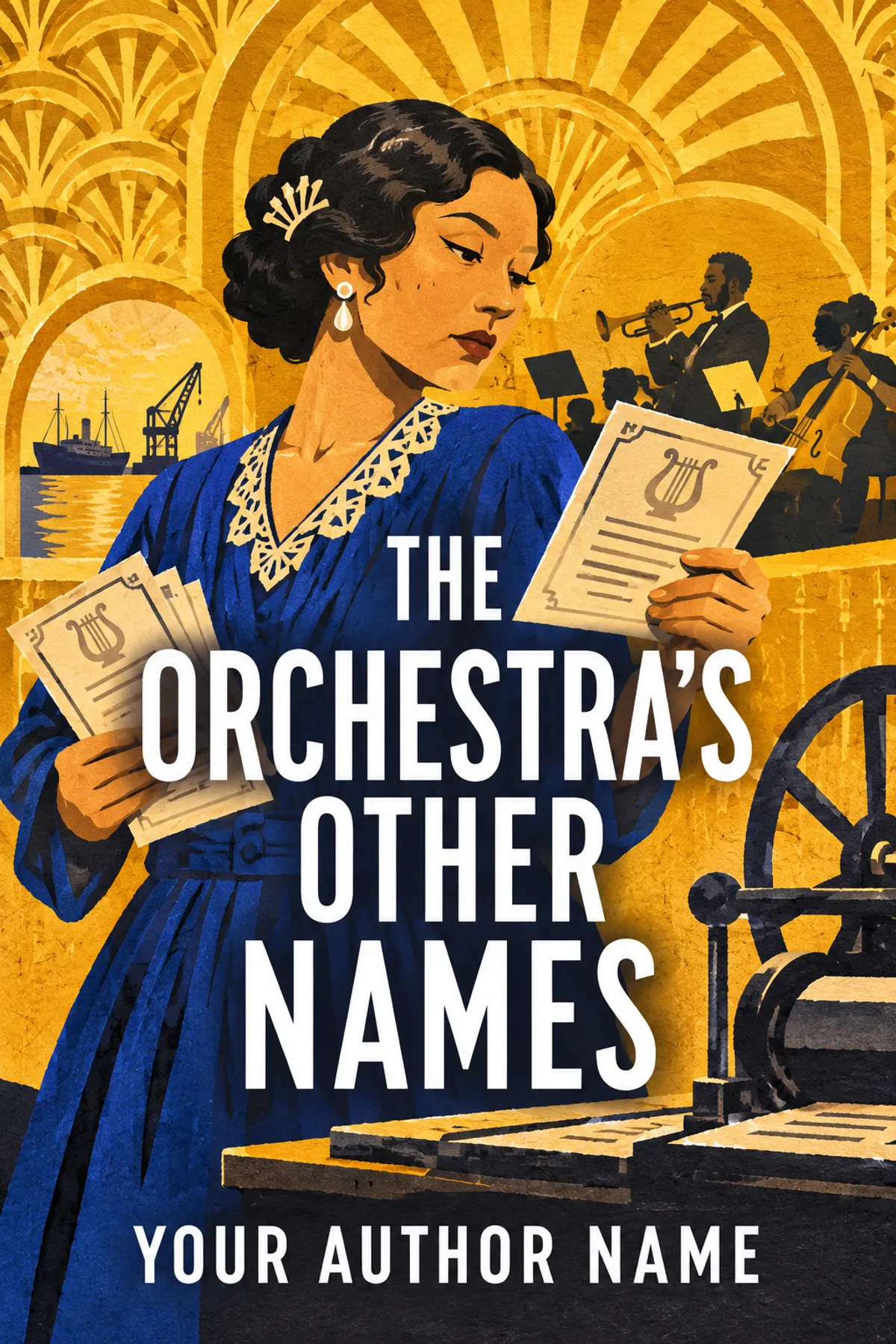
The Orchestra's Other Names
A concert program printer in a fictional 1920 port discovers that several musicians use borrowed names to cross borders and must protect their identities without erasing their work.
ImagineYourBook writes a fresh draft from this idea.
How it begins
Lucia found the wrong name beneath the right hands.
The violinist's photograph showed a bent little finger she remembered from the previous season. Then he had been Anton Weiss. Now the program called him André Vail and described a birthplace he had never mentioned.
She checked the order sheet. The conductor had underlined the new name twice.
At rehearsal, Lucia waited until the violinist finished tuning. He saw the proof in her hand and put his instrument away before she spoke.
"A printing correction?"
"That depends which name you want printed."
Beyond the stage door, the port's whistles rose and fell. Musicians came through the city carrying cases, permits and histories that did not always fit the spaces provided on official forms. Lucia knew that much. She did not know how a printer could preserve a person's work without exposing the person.
Anton took the proof.
"Use the name on the sheet."
"And the biography?"
"Shorten it."
That evening, three more corrections arrived. A cellist acquired a new surname. A pianist lost a place of study. A composer vanished entirely from a piece the conductor now described as traditional.
Lucia set the metal type in separate trays. Each change was small enough to call practical. Together, they made an orchestra whose printed history belonged to almost none of its members.
Her father, who had taught her the trade, would have told her to print what the customer ordered. He had also taught her never to discard a corrected proof until the account was settled.
She kept both versions.
The next morning, a border official came to the shop asking for advance copies. Behind him, Anton stood across the street with his violin case held close to his chest.
Lucia looked from the official's request to the trays of names and asked when, exactly, the copies were required.
Outline and characters
Develop this idea
Separate protective pseudonyms from the theft of artistic credit. Lucia should ask musicians what they want preserved and disclosed rather than treating complete documentation as automatically benevolent. Research the eventual setting's border rules, printing practices and musical networks before anchoring the story to real history. The conductor can face genuine commercial pressures while remaining accountable for erasure. A later archival resolution should depend on consent and timing, allowing some names to remain private.
- Lucia recognizes musicians whose new printed identities contradict earlier programs.
- Anton asks for a shortened biography that protects his travel arrangements.
- Further corrections reveal both necessary concealment and opportunistic erasure of authorship.
- A border official requests advance programs, increasing the danger of careless disclosure.
- Lucia consults the musicians separately rather than deciding their identities for them.
- They distinguish chosen public names from credits the conductor has removed without consent.
- The orchestra negotiates a program that preserves attribution through safe, agreed wording.
- Lucia retains a private set of proofs only with the affected musicians' permission and clear conditions.
- The concert proceeds after a tense inspection, while some performers choose different onward routes.
- Years later, authorized records reconnect the borrowed names to the work without making exposure the price of remembrance.
Characters
- Lucia Bell, 31. Concert-program printer
- Anton Weiss, 46. Violinist performing under a borrowed name
Series possibilities
- A companion novel follows one program's journey through archives and families as identities are gradually reclaimed.