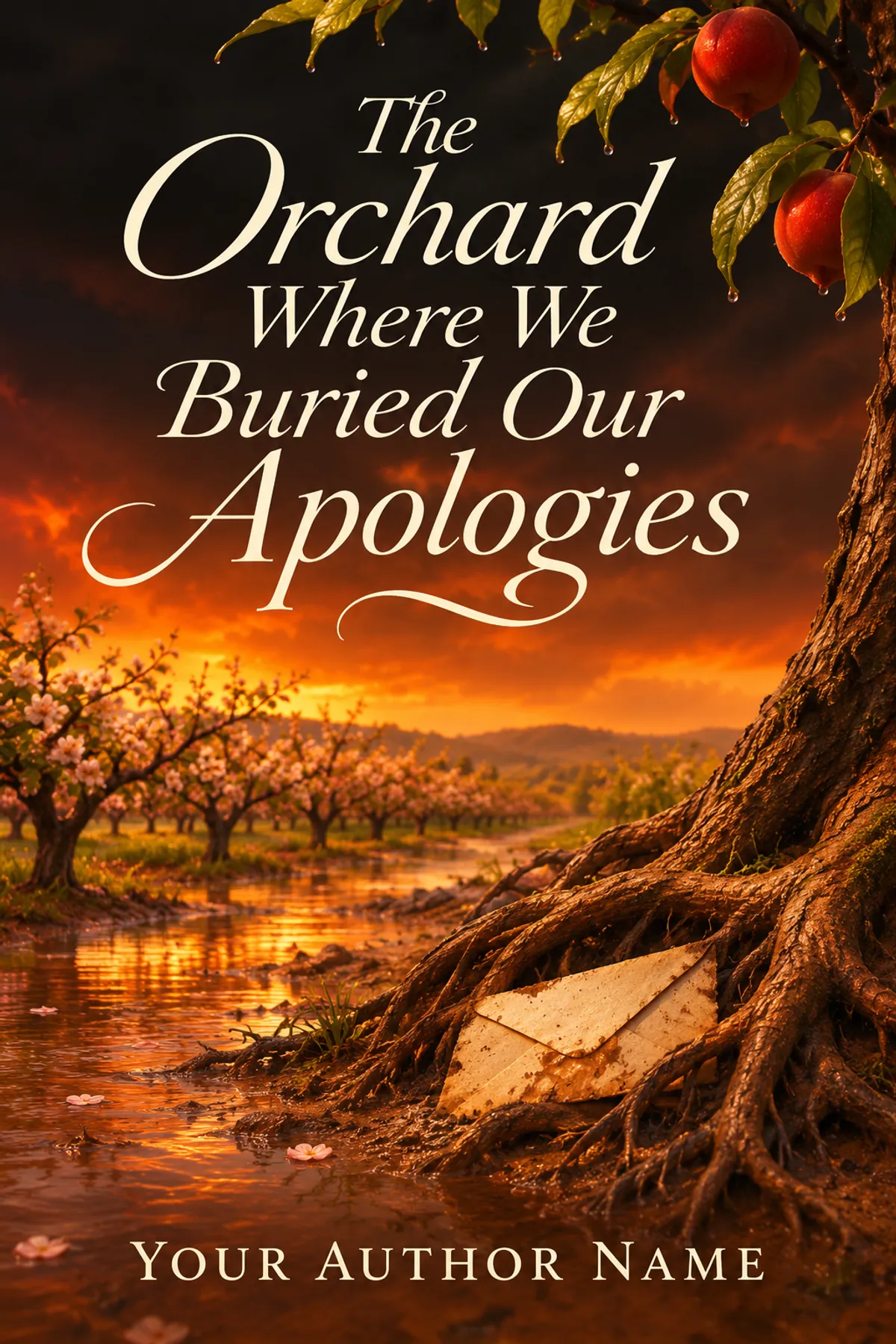
The Orchard Where We Buried Our Apologies
In an invented farming district in 1934, a fruit grower discovers neighbors have buried apology letters beneath her trees for decades. A flood brings them up unfinished, forcing a family to decide which old debts deserve repair rather than another harvest of silence.
ImagineYourBook writes a fresh draft from this idea.
How it begins
The first apology appeared between two roots of the oldest apple tree.
Grace Morton thought it was a feed label until she saw her mother's name written beneath the mud.
The flood had gone down overnight. It left a horse trough against the packing shed, three unfamiliar fence posts, and a dark line across every trunk showing where ordinary weather had become an event people would use to date their lives.
Grace lifted the paper without unfolding it.
William Hale stopped beside her with the irrigation tools over his shoulder.
"Leave that one," he said.
She looked up.
For six years, her cousin had managed to pass her gate without offering advice. The flood had apparently damaged his restraint along with everything else.
"You know what it is."
"I know what people did."
The paper opened under its own wet weight. Two sentences remained legible. One promised payment. The other asked that nobody be told.
Grace read the date twice.
Her mother had been twenty-three, unmarried, and already working more land than anyone admitted when they discussed who built the orchard.
"How many?" Grace asked.
William looked along the row.
A scrap of blue envelope clung to the next tree. Farther down, something cream had caught against a broken stake.
The orchard had kept its own accounts.
From the house, Grace's niece called that the kettle was boiling. The sound belonged to the practical morning ahead: damaged stores, washed-out tracks, fruit that could not wait for a family to decide whether it preferred history dry.
Grace placed the letter in an empty picking tray.
"We tell the people they're addressed to," she said.
"Some aren't here anymore."
"Then we begin with the ones who are."
William set down the tools, slowly.
Beneath the mud on his left hand, Grace could see the pale ring where he had once worn his father's signet.
She wondered which tree he was trying not to look at.
Your idea. Your book.
Keep the spark. Change anything.
Create my bookCreated with ImagineYourBook. Free to use as inspiration.
Outline and characters
Develop this idea
Choose the invented district's climate, crops, and labor arrangements before researching its 1934 setting. The buried letters should expose particular relationships rather than a convenient archive containing every answer. Grace and William are cousins, with family loyalties rather than a romantic arc. Give recipients authority over reading and publication. A credible resolution offers material repair and changed practice while leaving some apologies unanswered and some histories private.
- Grace finds a letter in flood-exposed roots
- William recognizes the old burial custom
- Neighbors disagree over who may read the papers
- An apology reveals an unpaid family debt
- Grace discovers her own father used the ritual
- William admits why he left the district
- The harvest requires help from the injured family
- Grace offers repair without demanding forgiveness
- The community changes how it records unfinished obligations
- One letter remains private by its recipient's choice
Characters
- Grace Morton, 48. Orchard grower
- William Hale, 55. Irrigation worker and estranged cousin
Series possibilities
- Historical family stories follow ordinary rural work through debts that cannot be settled by silence or a ceremonial gesture.