The City Runs on Forgotten Songs
A subway busker plays a melody that shuts down a corporate district. A grid engineer reveals the city is powered by songs erased from public memory. Restoring its stolen music may liberate the residents while leaving their hospitals without electricity.
ImagineYourBook writes a fresh draft from this idea.
How it begins
Alma played the wrong song and turned off the financial district.
Not the whole city. The hospitals stayed bright. The residential towers kept humming. Only the expensive glass streets above Platform Nine went dark, one polished window after another.
Her amplifier continued on its small battery.
The commuters stopped pretending not to hear her.
Alma Ren, thirty-seven, subway busker, lifted her fingers from the strings. The melody had come from a woman humming beside the soup stall. Alma had asked its name. The woman had looked startled and said she did not know any songs.
Now three security shutters were descending in perfect time with its last phrase.
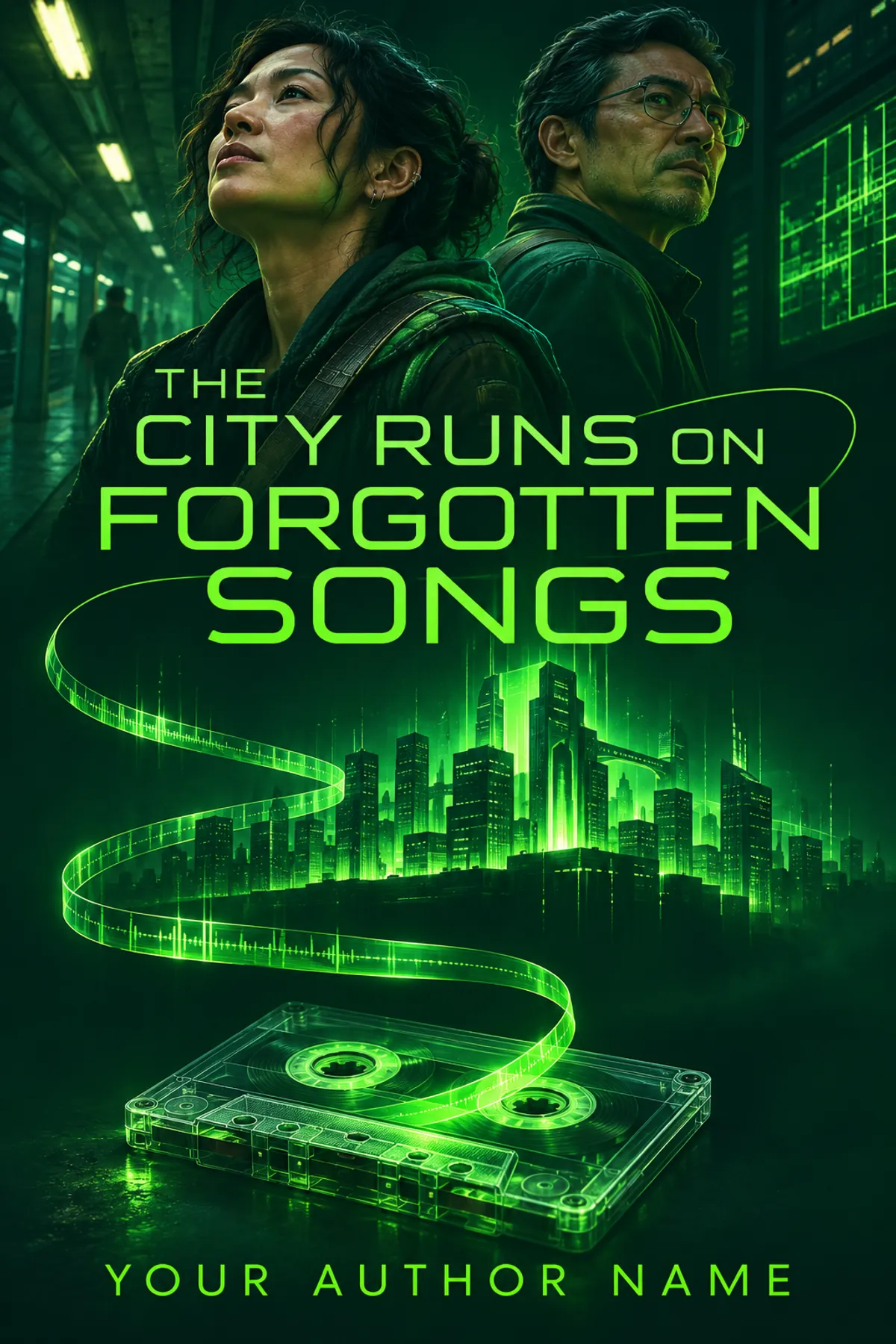
Victor Lin reached her before the station guards. Fifty-one, grid engineer, coat unbuttoned over yesterday's shirt.
'Please don't play that again yet.'
'Is it illegal?'
'I am trying to keep that from becoming the only question.'
He showed her the district's energy diagram. Beneath its ordinary power routes ran a second network labeled CULTURAL RESERVE.
Alma stared at the name.
'That sounds like a museum funding application.'
'It was supposed to.'
The city had bought songs. Not recordings, not performance rights. The songs themselves, removed from public memory by a process the contracts described as exclusive retention. Their stored patterns powered the corporate towers.
'You can't forget a song and still hum it,' she said.
'Apparently somebody can.'
Above them, emergency lights came on. Victor checked the hospital feed again before continuing.
'The reserve systems can carry essential services. But if every stored melody comes back at once, the transition will be ugly.'
Alma looked toward the soup stall. The woman was gone. Beside the empty bowl lay a cassette with no label and a slip of paper folded around it.
THEY TOLD US WE WOULD NOT MISS WHAT WE COULD NOT REMEMBER.
From the street above came a new sound. People singing a tune they were only beginning to recognize.
Your idea. Your book.
Keep the spark. Change anything.
Create my bookCreated with ImagineYourBook. Free to use as inspiration.
Outline and characters
Develop this idea
The energy network is invented, so its rules should remain simple and consistent rather than imitate real grid instructions. Alma's music matters because it belongs to people, not because one perfect song instantly fixes a city. Victor's caution protects vulnerable residents without excusing the exploitation. Preserve the tension between urgent restitution and a viable transition. Let different communities decide how their recovered songs are shared instead of treating the busker as everyone's appointed voice.
- Alma's borrowed melody interrupts the corporate district's acoustic power supply.
- Victor verifies essential-service reserves before explaining the erased-song network.
- They locate singers whose memories retain fragments the retention process failed to remove.
- Contracts reveal that cultural memory was bought through terms most signatories could not meaningfully understand.
- A public performance restores one song but causes a localized service failure with real consequences.
- Alma refuses a simple liberation concert that would make vulnerable residents bear the transition's cost.
- Victor exposes available backup capacity withheld to protect corporate margins.
- Musicians and residents negotiate a phased return of songs alongside funded power replacement.
- The corporation attempts to buy exclusive control of the restoration performance itself.
- The city hears a freely shared song while essential systems remain running, and ownership of the remaining music becomes an ongoing public decision.
Characters
- Alma Ren, 37. Subway busker
- Victor Lin, 51. Grid engineer
Series possibilities
- Alma and Victor uncover other forms of cultural life quietly converted into invisible city utilities.