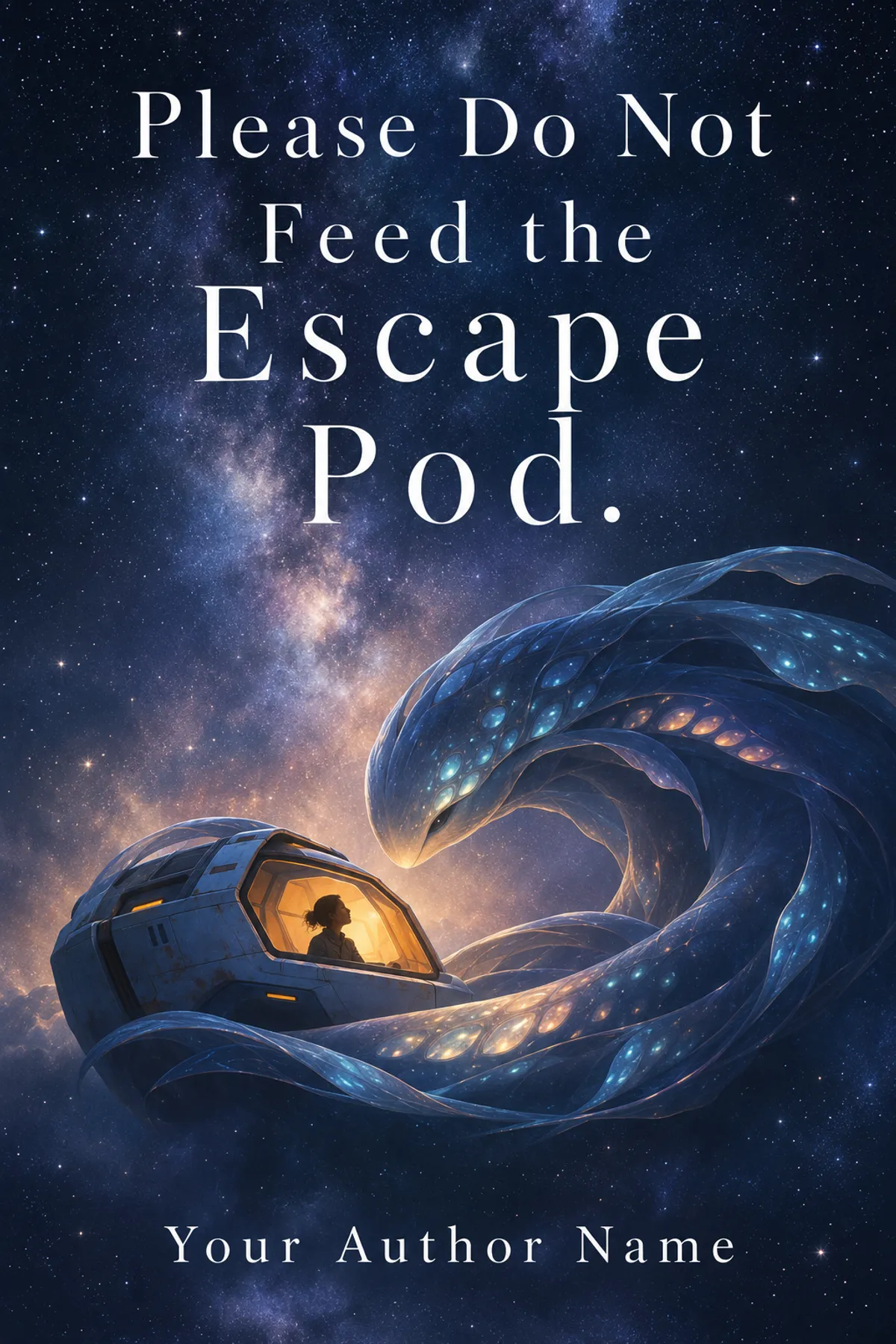
Please Do Not Feed the Escape Pod
A habitat designer discovers the emergency pod carrying her crew is a juvenile living vessel. Feeding it will keep them alive and signal their location to the hunters who sold its family as equipment.
ImagineYourBook writes a fresh draft from this idea.
How it begins
The emergency pod ate the seat belt.
Mara had been tightening it around her waist when the buckle softened, curled inward, and disappeared into the wall.
Across the cabin, Tomas stared.
"Was that automatic restraint adjustment?"
"I design habitats," she said. "Not excuses."
The pod shuddered.
Behind them, through the rear display, the station's damaged ring broke into three bright pieces.
There was no possibility of going back.
Mara pressed the manual harness control.
The wall warmed beneath her fingers.
Something like a pulse moved through it.
She took her hand away.
Tomas checked the equipment list.
"Standard lifeboat. Four occupants. Twelve hours independent support."
"Does the standard lifeboat usually breathe?"
He looked at the list again, as though an additional specification might appear through force of attention.
A low sound passed through the cabin.
Not an alarm.
A complaint.
One of the storage lockers opened.
Inside, emergency rations had softened into a sweet, metallic paste. The lining of the locker moved slowly toward them.
Mara remembered the supplier's instruction printed beside the hatch.
DO NOT FEED EXCEPT UNDER AUTHORIZED CONDITIONS.
She had assumed it referred to a waste processor.
The pod made the sound again.
This time, Tomas lowered his voice.
"Is it hurt?"
Mara put two fingers against the wall.
The pulse quickened.
Outside, their course curved away from the nearest beacon.
On the navigation display, a new signal appeared behind them.
Then another.
Fast, deliberate, converging.
Tomas opened the comms channel.
Mara caught his wrist before he transmitted.
"Wait."
From the storage locker came a soft tearing sound.
The pod had eaten one ration.
Its lights brightened.
So did the signals pursuing them.
Mara looked at the blank manufacturer label above the hatch.
For the first time, she wondered whether the warning had been written to protect the equipment or to keep it from growing strong enough to leave.
Your idea. Your book.
Keep the spark. Change anything.
Create my bookCreated with ImagineYourBook. Free to use as inspiration.
Outline and characters
Develop this idea
The vessel is a juvenile nonhuman creature, so keep the relationship protective and entirely nonromantic. Human leads can disagree about survival while recognizing its vulnerability. Establish food, signaling, and movement rules early. Mara's design expertise should help translate needs rather than grant fluent conversation. The rescue works best when the vessel contributes knowledge and ultimately chooses where to go. Keep the vessel's needs distinct from human wishes.
- Mara's crew escapes a failing station in an apparently standard pod
- The pod responds to touch and refuses its programmed route
- Mara identifies it as a juvenile living vessel
- Feeding it restores air and power but broadcasts a recognizable signal
- Tomas admits the supplier's records omitted the vessel's origin
- The crew debates survival against returning it to captivity
- Mara learns a limited way to communicate through environmental changes
- They use the pod's own knowledge to evade the hunters
- Adult vessels help guide the crew to a safe transfer
- The humans leave the pod free to rejoin its family
Characters
- Mara Sen, 40. Habitat designer
- Tomas Bell, 44. Emergency pilot
Series possibilities
- Mara is hired to redesign a station built around another living structure that has begun asking to move.