Your Smile Has Expired
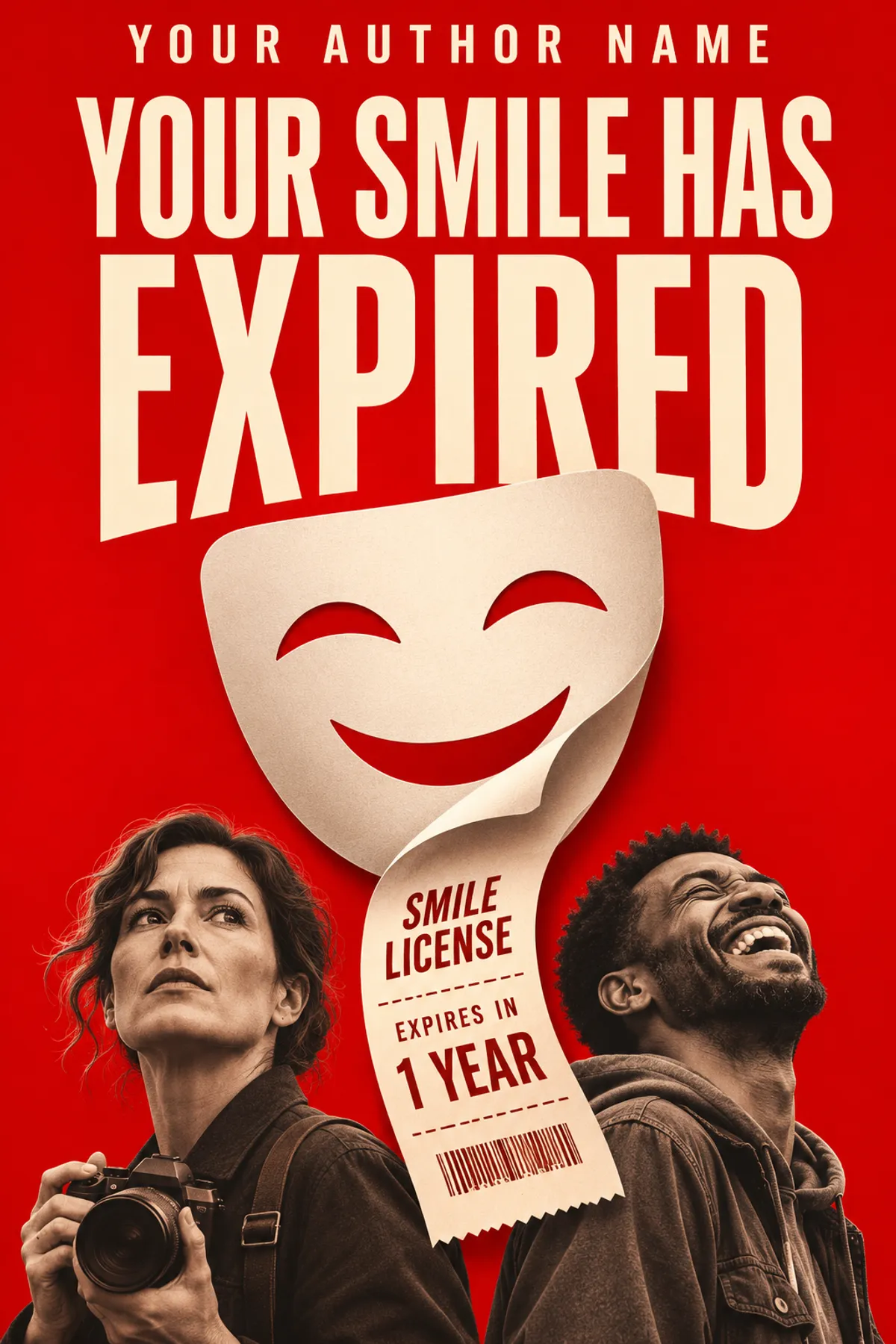
A public photographer discovers citizens' licensed smiles expire after one year. When a stranger laughs without renewing, she photographs an expression the government cannot categorize, then must decide whether making it famous would save him or give the authorities his face.
ImagineYourBook writes a fresh draft from this idea.
How it begins
The little girl in Tessa Vale's photograph was smiling illegally.
Her license had expired at midnight. The renewal office was closed for maintenance. By morning her school portrait showed the regulated neutral expression every unlicensed citizen learned to wear, except in one frame, where a laugh had escaped before she could catch it.
Tessa deleted that frame. Then she recovered it.
She had taken public portraits for seventeen years. Weddings, graduations, professional updates, annual expression renewals. Every face arrived with a code. Every code told the camera which muscles could move. Hers was licensed for reassurance, professional interest and mild seasonal joy. She had not purchased spontaneous delight since her divorce.
At lunch, a man laughed in the square.
Not a licensed chuckle. Not an approved response to municipal entertainment. He laughed as though something had surprised him into forgetting his face belonged to an account.
Tessa raised her camera. The recognition box failed to close around his mouth.
Amir Osei bowed to the three people watching him balance a paper cup on a traffic bollard. The cup fell. He laughed again. No warning sounded from his collar. He wore no collar.
Tessa lowered the camera. 'Your renewal is missing.'
'So is my cup.'
'They'll stop you.'
'For littering? I was going to pick it up.'
He did. The movement was ordinary enough to make his impossible face more unsettling. Tessa could photograph him, prove that unlicensed joy existed, send the image through every city feed. She could also give enforcement a clear portrait, a location and a time.
Her camera asked whether to identify an unknown subject.
Amir looked at it, then at her. The laughter left his face without being replaced by fear.
'Will you ask first?' he said.
Tessa thought of the recovered school frame. She turned the camera so he could see the blank screen.
'Yes,' she said.
Your idea. Your book.
Keep the spark. Change anything.
Create my bookCreated with ImagineYourBook. Free to use as inspiration.
Outline and characters
Develop this idea
Use photographic consent as the story's ethical engine. The city sells predictable public behavior, making licensed emotion convenient as well as coercive. Amir is a person with a strategy and private limits, not a symbol Tessa may deploy for his own good. The school portrait offers a parallel without putting children at the center of danger. Rebellion should include camera design and data control. The climax protects the right to be unrecorded alongside the right to be visible.
- Tessa recovers an unlicensed school-portrait laugh.
- Amir's spontaneous expression defeats recognition software.
- She asks permission before photographing him.
- A leaked test frame triggers enforcement interest.
- Expression licenses begin affecting access to work.
- Amir refuses to become a universal public symbol.
- Tessa designs a portrait that cannot identify its subjects.
- Photographers coordinate a consent-based exhibition.
- The city loses control of compulsory expression data.
- Tessa keeps one joyful moment outside the archive.
Characters
- Tessa Vale, 42. Public portrait photographer
- Amir Osei, 38. Unlicensed street comedian
Series possibilities
- Tessa documents other human behaviors the city has tried to convert into renewable products.