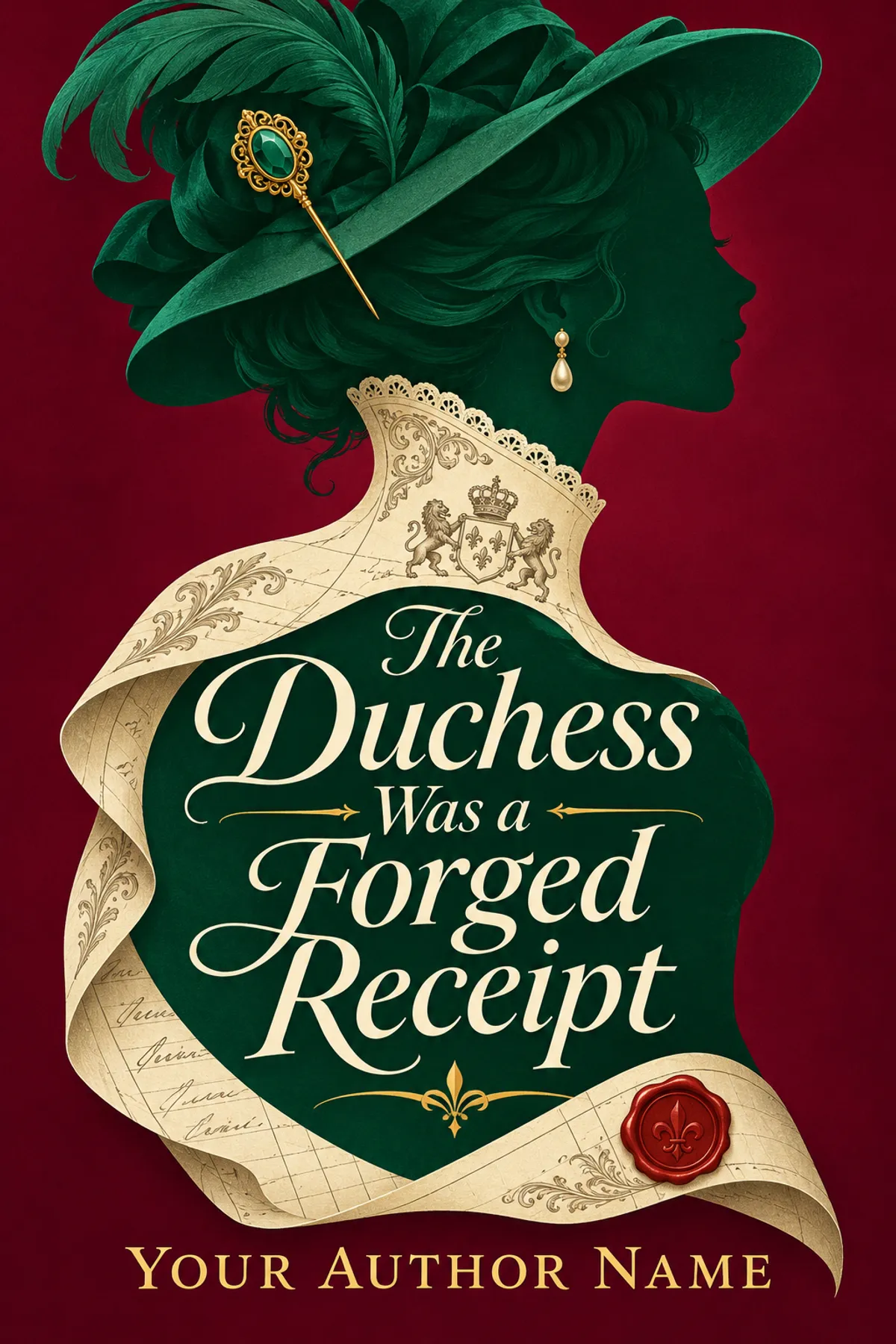
The Duchess Was a Forged Receipt
In 1894, a department-store auditor learns that a celebrated duchess exists only as a series of fraudulent returns. A murdered clerk has signed the final receipt.
ImagineYourBook writes a fresh draft from this idea.
How it begins
The duchess returned the same hat seven times.
Celia did not object to indecision.
She objected to the arithmetic.
Each return had been credited to a different account, although the hat had never left the stockroom.
Bram brought it to her desk on a tray.
Green velvet. Two feathers. A hatpin expensive enough to require its own apology.
"Has anyone seen her wear it?"
"Everyone says they have."
"Everyone?"
"People who might be invited somewhere."
Celia turned the receipts toward the window.
The signatures matched.
Too well.
A woman returning a hat in rain, in haste or in anger would leave some trace of the occasion. These seven signatures had the same small hesitation beneath the title.
Copied, perhaps.
Or signed in one sitting.
Below them, the approving clerk had written his initials.
H. Pell.
Celia had spoken to him that morning. He had asked whether she could review a delivery before the afternoon accounts closed.
Now a porter stood at the office door with his cap in his hands.
The stockroom stairwell had been roped off.
Mr. Pell would not be reviewing anything.
Bram took the tray back before Celia could drop the hat.
From the shop floor rose the comfortable noise of customers being told that everything suited them.
Celia looked at the last receipt.
It was dated tomorrow.
The duchess was due to return a necklace.
"Find the carbon copy," she said.
Bram hesitated.
"Mr. Pell took it upstairs."
"Where?"
"To the private fitting room."
Celia had never been allowed beyond that door.
She gathered the seven receipts, placed them in her ledger and stood.
At the stairwell, a manager stepped into her path.
"An unfortunate accident."
"Then you'll be relieved," she said, "that I am only looking for a customer."
Behind him, on a table prepared for an important arrival, waited a card bearing the duchess's name.
The chair beneath it was empty.
Your idea. Your book.
Keep the spark. Change anything.
Create my bookCreated with ImagineYourBook. Free to use as inspiration.
Outline and characters
Develop this idea
A Victorian department-store mystery can turn commerce into a rich social setting. Carbon copies, delivery labels and credit accounts provide fair clues without modern technology. Celia's position should give her access to records while limiting her power over influential customers. The invented duchess needs a practical purpose within the fraud. For your own historical mystery, research a particular trade before drafting, then let its ordinary paperwork reveal how status changes what people are willing to believe.
- Celia finds a duchess represented only by return receipts
- A clerk who approved the final return is murdered
- Bram shows that the goods never left the stockroom
- Society witnesses disagree about where they met the duchess
- Celia discovers the false identity links separate credit accounts
- A real customer is threatened with exposure as the invented noblewoman
- The killer attempts to destroy the paper returns ledger
- Celia reconstructs transactions from carbon copies and stock labels
- A physical delivery proves who could use the duchess's signature
- The fraud is exposed without sacrificing the customer used as its public face
Characters
- Celia Venn, 31. Department-store auditor tracing a duchess through fraudulent returns
- Bram Orr, 48. Stockroom clerk who preserves the receipts others discard
Series possibilities
- Celia audits a department whose sale totals include an entire room of goods nobody remembers stocking.