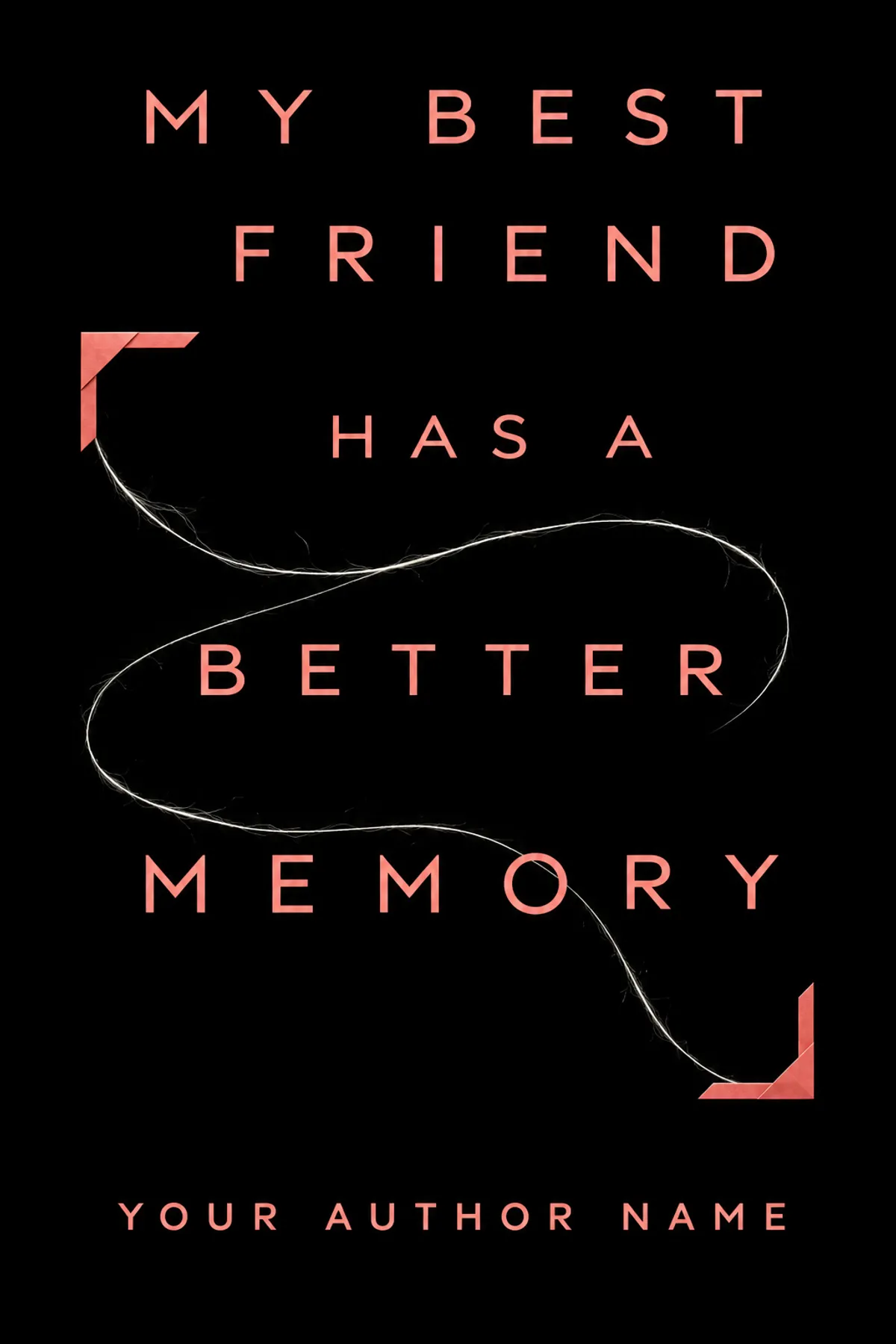
My Best Friend Has a Better Memory
A woman's oldest friend begins correcting memories with proof so convincing that the past seems to rearrange itself. An oral-history interviewer notices the corrections always benefit one absent person, and their investigation makes friendship's familiar shorthand feel like a carefully rehearsed script.
ImagineYourBook writes a fresh draft from this idea.
How it begins
Beth Mercer corrected the photograph before Claire had finished describing it.
'It wasn't raining,' Beth said.
Claire looked at the image between them. Two young adult women stood beneath a striped awning, shoulders wet, laughing at something outside the frame.
'We missed the bus because of the storm.'
'We missed it because you wanted to wait for him.'
Beth took another photograph from her folder. Same awning. Same afternoon. Sunlight on the pavement.
Claire felt a small, familiar embarrassment. Her friend had always remembered dates better. It was one of the reasons Claire had agreed to help with the reunion's oral-history project.
They sat in the community arts office while rain tapped the modern window. Beth's recorder lay between two mugs.
'You don't have to use it,' Claire said.
'We should get it right.'
The sentence was kind. That made it difficult to object to.
Claire turned the wet-shouldered photograph over. On the back, in her own old writing, she had put the date and three words: before the rain.
She did not remember writing them. She remembered standing under the awning while water ran down her neck. She remembered Beth saying they would laugh about it later.
'Who gave you these?' she asked.
'Everyone has been sending things.'
'Who sent this one?'
Beth looked at the folder rather than the picture.
In the corridor, someone called for an extension lead. The ordinary interruption made Claire want to leave the photographs alone. There was work to do. A reunion did not need an investigation.
Then she noticed the sign reflected in the shop window behind them. The shop had changed names the following year. Beth had told her that herself, only last week.
Claire pulled the recorder closer.
'Let's start again,' she said. 'This time, tell me what you remember before you show me what I'm supposed to see.'
Your idea. Your book.
Keep the spark. Change anything.
Create my bookCreated with ImagineYourBook. Free to use as inspiration.
Outline and characters
Develop this idea
Memory is naturally imperfect; contradictory recollection alone must not establish malice. Ground the manipulation in independently checkable dates, provenance and incentives. Beth should be neither infallible interviewer nor simple gaslighter, and Claire needs a reason to prefer some earlier version herself. Keep the historical allegation non-graphic and give affected adults control of disclosure. A repaired friendship can tolerate uncertainty without requiring both women to settle on one complete private narrative.
- Claire's memory conflicts with Beth's unusually polished evidence.
- An oral-history interview reveals corrections benefiting one absent adult.
- Photographic background details contradict the supplied dates.
- Beth admits receiving a curated archive from a reunion sponsor.
- Claire discovers she once accepted a useful false account herself.
- The absent person uses nostalgia to redirect an unresolved allegation.
- Friendship fractures over whether accuracy requires public disclosure.
- Beth preserves original interviews and identifies altered provenance.
- Claire states only what she can support while witnesses choose their participation.
- The reunion adopts transparent sourcing and the women rebuild trust without identical memories.
Characters
- Claire Rowan, 45. Community arts coordinator
- Beth Mercer, 46. Oral-history interviewer
Series possibilities
- Standalone friendship thrillers examine how shared shorthand can become a tool for rewriting adult histories.