The Mapmaker of Ordinary Joys
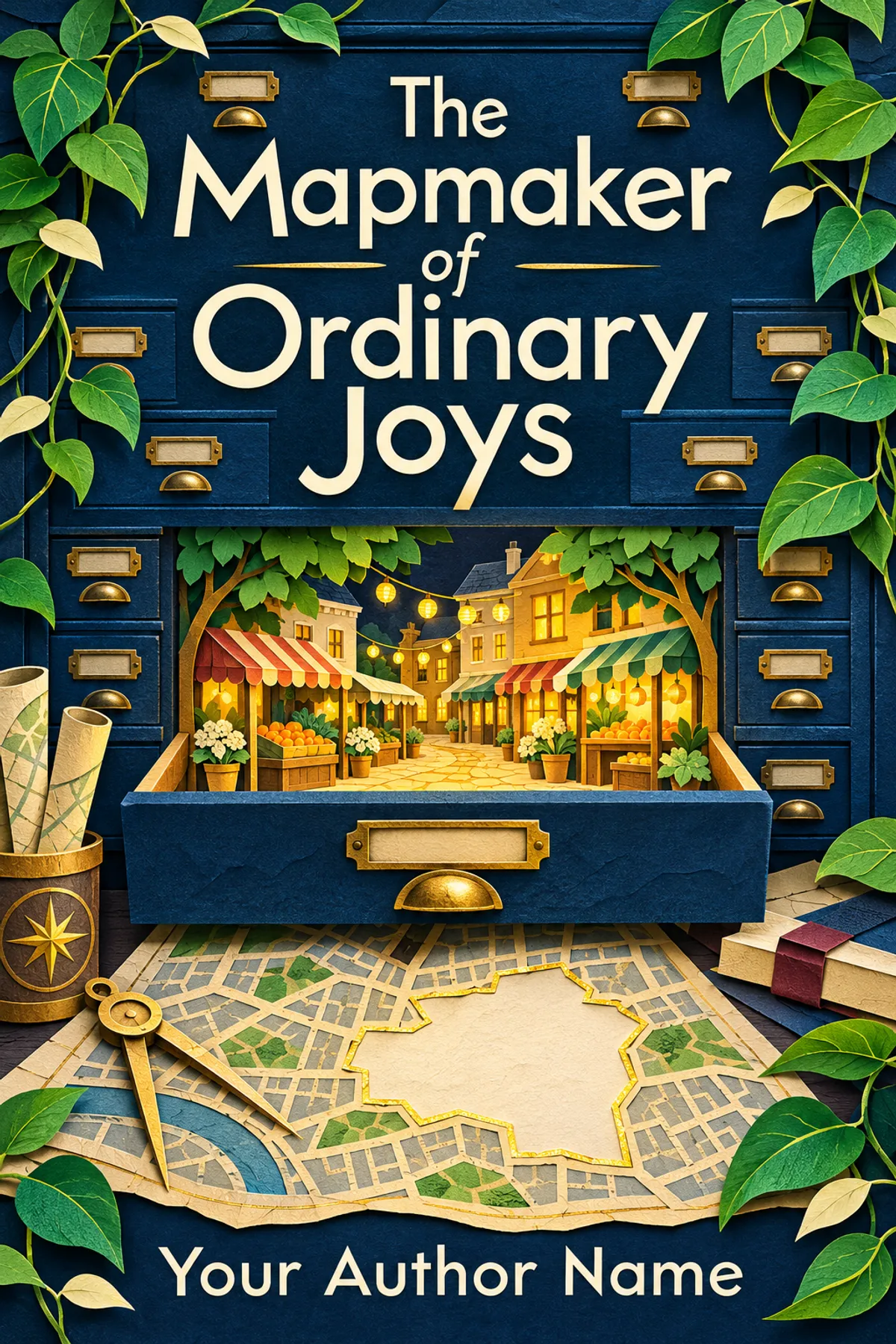
A municipal cartographer begins mapping brief moments of happiness and finds a blank district that ordinary street maps insist is a thriving neighborhood.
ImagineYourBook writes a fresh draft from this idea.
How it begins
The first mark appeared where a man dropped his oranges and three strangers helped him gather them.
Rafael had been drawing the street junction for a pedestrian-access survey. A small gold point formed beside the crossing, though his pencil contained no gold.
By evening, the map held seventeen points.
A shared umbrella. A bus driver waiting for someone who could not run. Two women outside the hospital laughing so hard that one had to hold the other's coat.
The marks faded when Rafael tried to photograph them. They remained when he looked directly at the paper.
For a week, he carried the map everywhere. He began taking routes he usually avoided, not because they were dangerous but because he had no reason to be there. Gold gathered in unexpected places: behind loading bays, outside a cheap repair shop, beside a bench with a view of nothing impressive.
One district stayed blank.
The official maps called it West Reach and showed new homes, landscaped paths and a busy commercial center. Rafael went there on Saturday.
The paths were clean. The shops were open. People passed him carrying groceries and ordinary private concerns. Nothing looked wrong enough to justify the empty paper.
Helen found him studying it outside the community room.
"Lost?"
"Trying to understand something."
He explained the marks as carefully as a man could explain impossible cartography to a stranger. Helen listened, then asked where he had been standing when they appeared.
"Nearby."
"And here?"
"I've walked all the main paths."
She opened the community-room door. Inside, six people sat around a table repairing a kettle. One was telling a story in a language Rafael did not understand. The others were smiling.
His map remained blank.
Helen watched his face.
"Perhaps it doesn't show joy," she said. "Perhaps it shows what you know how to notice."
Rafael folded the map and asked whether they needed another pair of hands.
Outline and characters
Develop this idea
The blank district should expose a limitation in the observer, not imply that a community lacks happiness. Give West Reach ordinary conflicts and pleasures rather than making it an ideal corrective neighborhood. The temptation to turn a personal phenomenon into a public ranking supplies a concrete ethical choice. Rafael's learning should come through participation and listening, not a single wise lecture. A collaborative practical map lets the ending produce something useful without claiming complete emotional measurement.
- Rafael discovers gold marks appearing on his map during moments he perceives as happiness.
- He follows them into overlooked parts of the city.
- West Reach remains blank despite its visible activity and prosperity.
- Helen challenges his assumption that the marks measure joy objectively.
- He spends time with residents whose humor, languages and relationships he initially cannot read.
- A municipal official wants to use the map to rank neighborhoods and direct funding.
- Rafael demonstrates how his own attention and familiarity shape its apparent evidence.
- He refuses the ranking project and develops a participatory map of places residents themselves value.
- The gold marks begin appearing in West Reach, but he no longer treats them as complete or comparable data.
- Rafael keeps the magical map private and helps publish a practical map built from many people's accounts.
Characters
- Rafael Ortiz, 41. Municipal cartographer
- Helen Morris, 57. Resident of a district missing from a map of joy
Series possibilities
- A companion story follows a resident creating a map of places where people are allowed to be sad.