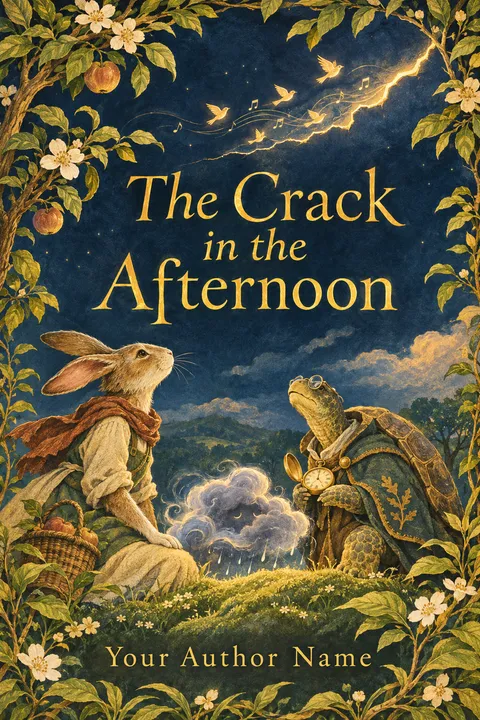

Our Town Is Missing Its Tuesday
A small town skips Tuesday every week, and most residents enjoy the convenience. When a seamstress discovers that her late husband's happiest memories all occurred on Tuesdays, she recruits a railway clerk to find out who owns the missing time.
ImagineYourBook writes a fresh draft from this idea.
How it begins
Elsie Ward had never liked Tuesdays until the town stopped having them.
Monday's washing went straight to Wednesday's ironing. Railway deliveries arrived early. The butcher praised the improved week. Nobody had to attend the committee that met on the second Tuesday of every month, which was widely considered evidence of progress.
Elsie was fifty-nine and took in sewing. At first she enjoyed the arrangement too. Customers who promised to collect on Tuesday could not complain about late hems.
Then she opened her late husband's pocket diary to check a measurement he had written in the back.
The first blank page was a Tuesday. So was the second. So was every place where he had drawn a small, untidy star.
She remembered the stars. A picnic spoiled by rain. A train they had missed on purpose. The afternoon he learned to mend a pocket badly enough to make her laugh.
She could recall that these things had happened. She could no longer remember them happening.
At the station, Harold Finch was sorting tickets into a drawer labeled ALL OTHER DAYS. Sixty-one, with thirty-nine years behind the counter, he had adopted the new calendar more neatly than anyone.
'Where are the Tuesdays?' Elsie asked.
'Withdrawn from service.'
'By whom?'
He showed her the timetable. Between Monday and Wednesday ran a thin teal line. Beneath it, in type so small Elsie borrowed his magnifying glass, stood a destination.
UNALLOCATED TIME. PRIVATE.
Harold took the glass back and looked again.
'That wasn't there yesterday.'
'We no longer have yesterday properly.'
Outside, a red train passed the platform without stopping. Every carriage window showed the same hour of golden afternoon.
Elsie recognized her own kitchen curtain in the final window.
She gripped the counter but did not follow. It would be too easy to mistake a glimpse for an invitation.
'What does a ticket cost?' she asked.
Harold opened the drawer. Inside lay one hundred and forty-three uncollected Tuesdays, each addressed to somebody else.
Your idea. Your book.
Keep the spark. Change anything.
Create my bookCreated with ImagineYourBook. Free to use as inspiration.
Outline and characters
Develop this idea
Elsie and Harold are human adults, and the missing time must not become a device that resurrects her husband. Her grief is specific, ordinary, and compatible with humor. Give residents credible reasons for liking the shortened week; restoring Tuesday is not automatically enough if the same pressures immediately consume it. The magical question of ownership should lead to understandable choices about time, work, remembrance, and the possibility of doing something new.
- Elsie notices that the convenient missing weekday is also erasing texture from treasured memories.
- Harold finds tickets to unallocated time that never appeared on the public timetable.
- They ask residents what they have gained and lost before attempting to reverse the change.
- A supervised journey reveals stored Tuesdays being used to extend a private investor's afternoons.
- Some residents refuse the return of a weekday associated with grief or exhausting work.
- Elsie confronts the difference between preserving memories of her husband and trying to recover him.
- Harold admits that the shortened week helped him conceal a decision he had postponed for years.
- They expose the calendar agreement and give residents clear terms for reclaiming their own time.
- The town rejects a uniform restoration that would merely impose another convenient rule.
- Tuesday returns with public choices about work and rest, while Elsie begins a new memory rather than repeating an old one.
Characters
- Elsie Ward, 59. Seamstress
- Harold Finch, 61. Railway clerk
Series possibilities
- Harold's revised timetable can reveal other stations where communities have misplaced an ordinary part of living.