
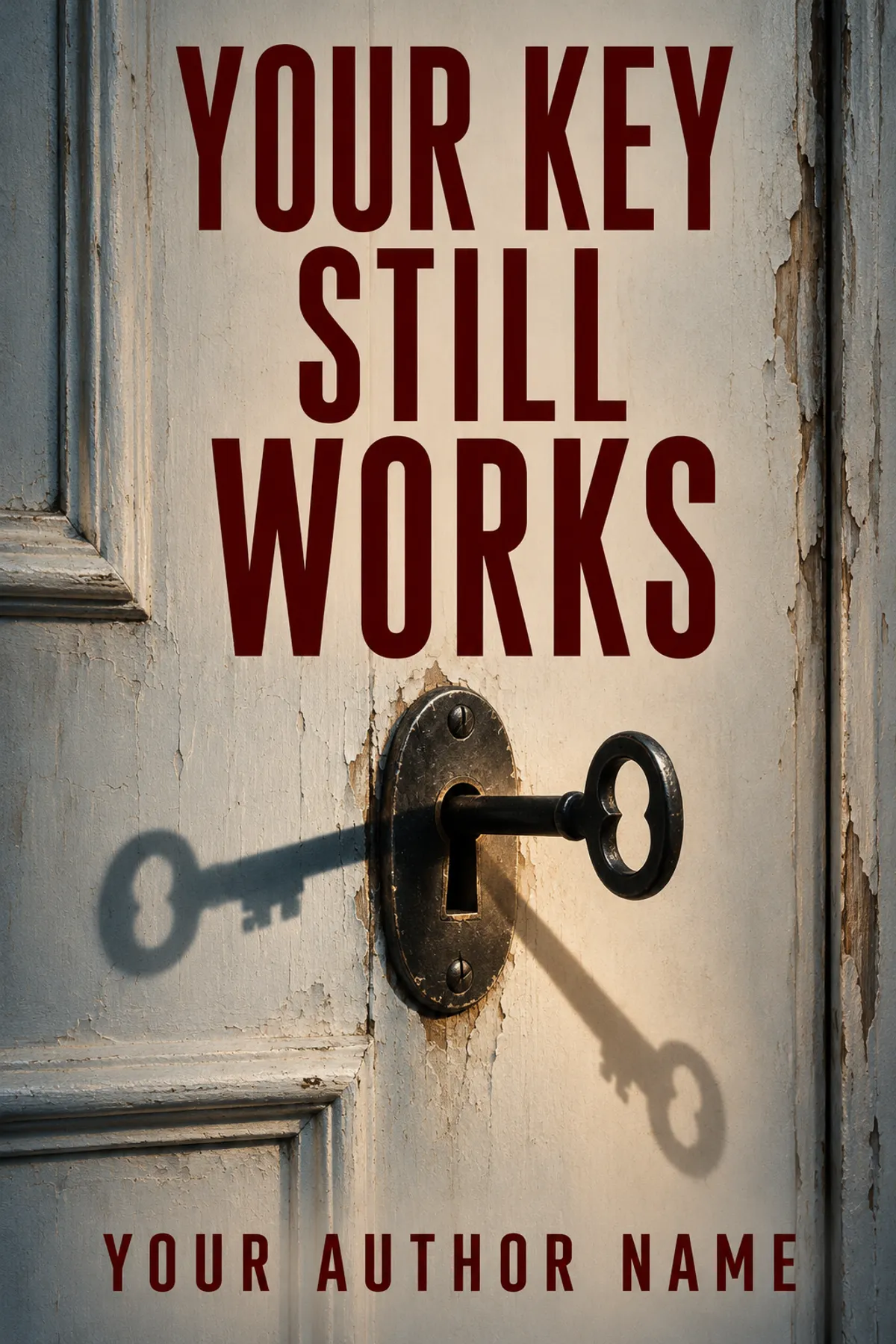
Your Key Still Works
A woman returns a borrowed key to a former friend and discovers an entire apartment furnished with objects from the life she deliberately left behind.
ImagineYourBook writes a fresh draft from this idea.
How it begins
The key still worked, although Lena had hoped it would not.
She had carried it for four years in the pocket of a coat she rarely wore. Returning it should have required an envelope, a stamp and less imagination. Instead, Ruth had sent a message asking her to leave it on the kitchen table.
Lena opened the door.
Her old kitchen table stood inside.
She knew the burn beneath the varnish, a dark crescent left by a pan during the last dinner she had cooked for her husband. The chairs were hers too. So was the red clock she had put out for collection after it stopped at twenty past three.
Here, it was ticking.
Lena remained in the doorway. Across the room, a cardigan hung over the back of a chair as though its owner had stepped away to answer the telephone. She had donated that cardigan in another city.
Her phone showed no new messages.
She called Ruth. From somewhere inside the apartment, a phone began ringing.
Lena ended the call. The ringing stopped.
She should leave. She knew that with the clarity of someone watching another person make a mistake. But on the table lay a birthday card addressed to her in her mother's handwriting. Her mother had died before Lena moved away.
She took one step inside.
The card was real. The date was wrong. It wished her a happy birthday next month.
Behind the kitchen doorway, a printer hummed. A sheet slid into its tray.
Lena could read the first line from where she stood.
WELCOME BACK, LENA.
She backed toward the open door, keeping the card in her hand. The hallway beyond it remained bright and ordinary. Somewhere upstairs, a vacuum cleaner struck a skirting board. She held onto that sound while the printer began another page.
Outline and characters
Develop this idea
Lena should respond to danger sensibly, leaving the apartment before investigating the wider scheme. Ruth's commercial purpose makes the reconstruction more disturbing than vague obsession alone. Distinguish authentic objects, fabricated documents and misleading permissions so the reveal is legible. The friendship's history can explain Ruth's access without excusing her choices. Let Lena's final selection of one genuine object express agency, avoiding the idea that recovery requires either preserving everything or erasing the past.
- Lena enters an apartment reconstructed from belongings she deliberately discarded.
- A forged future birthday card reveals that the room is an active production.
- She leaves and documents the encounter before contacting Ruth through a separate channel.
- Ruth admits creating memory spaces but claims Lena commissioned this one years earlier.
- Old messages show a limited request to preserve a few objects, later expanded without consent.
- Lena discovers Ruth has sold access to the reconstruction as an immersive grief experience.
- The personalized welcome system was meant to obtain a recorded emotional endorsement.
- Lena secures evidence of the unauthorized use with help from another affected client.
- Ruth's business is exposed and the materials are returned or destroyed according to their owners' wishes.
- Lena keeps the genuine card separately from the forged text and decides what her past may still contain.
Characters
- Lena Morris, 38. Woman returning a key to a former friend
- Ruth Calder, 40. Former friend who curates private memory spaces
Series possibilities
- A standalone companion follows a customer whose commissioned memory room contains a stranger's belongings.