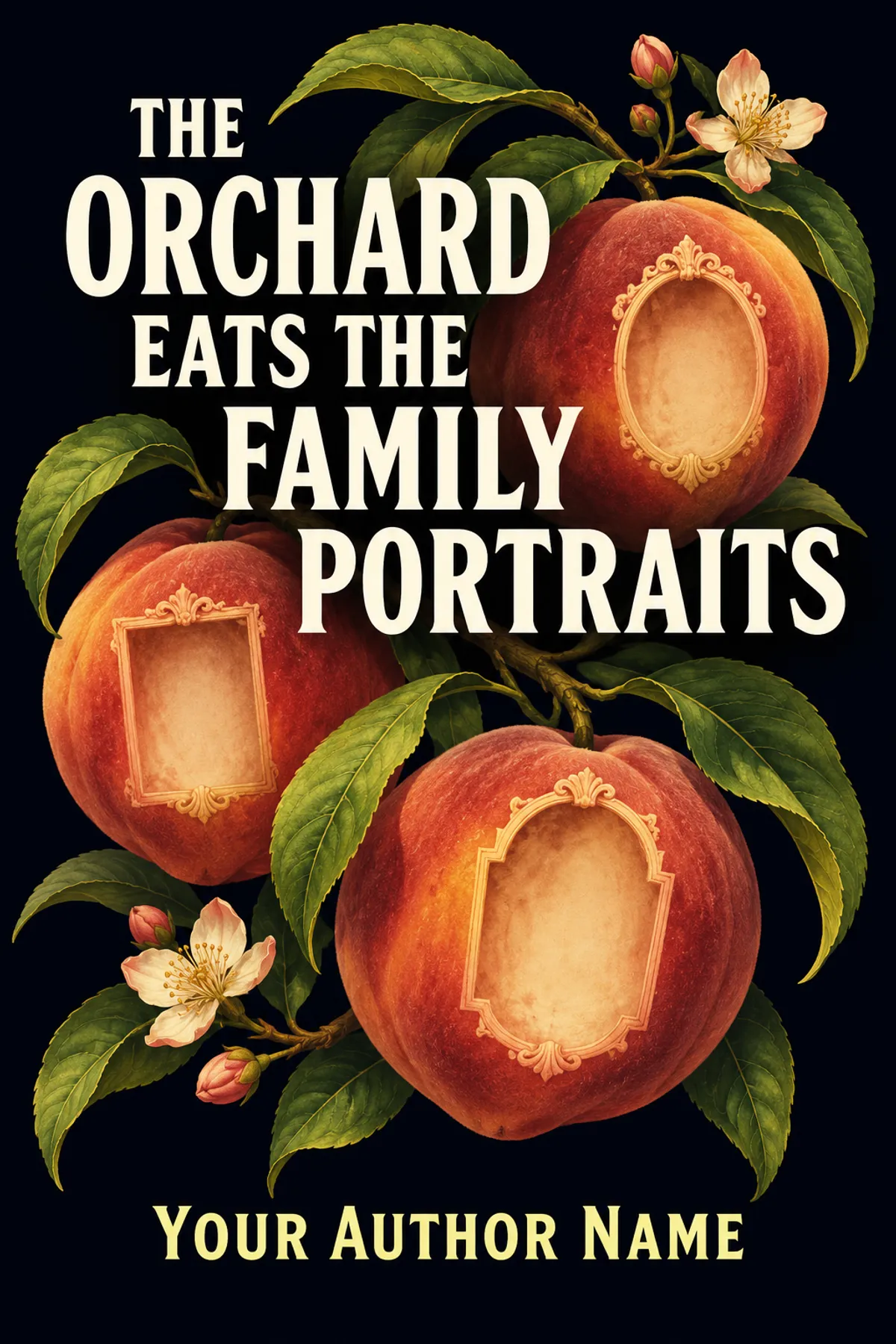
The Orchard Eats the Family Portraits
A family archivist finds old photographs losing faces as an abandoned orchard bears an impossible crop. Restoring the portraits means learning which relatives were erased willingly and which are trying to be found.
ImagineYourBook writes a fresh draft from this idea.
How it begins
My grandmother lost her face between breakfast and lunch.
In the photograph, I mean.
At breakfast she stood beside the orchard gate, one hand on my father's shoulder. By lunch, the space beneath her hat was a pale oval.
I checked the scan I had made the previous evening.
Her face was there.
I checked the original again.
Gone.
Outside the window, Rafi was carrying fruit toward the house in a shallow crate.
The orchard had not borne anything worth eating for twelve years.
Now the trees bowed beneath dark peaches.
I met him at the back door.
"What changed?"
He looked at the album in my hand.
Then at the crate.
"Who is it?"
"That's not an answer."
"It matters."
I showed him the photograph.
He did not seem surprised.
That frightened me more than the blank face.
Rafi set down the fruit.
One peach had a small pale hollow near its stem, shaped almost like the oval in the photograph.
"Don't cut them," he said.
I had not intended to.
Behind us, my phone rang.
My aunt's name appeared on the screen.
"Nina," she said before I could speak, "have you started on the orchard albums?"
"Yes."
"Then stop."
Her voice was steady in a way I remembered from family emergencies nobody later admitted had happened.
"Why is Grandma disappearing?"
A long silence followed.
Outside, a branch struck the window.
Not hard.
As though asking to be noticed.
My aunt took a breath.
"Because somebody has decided they can afford to miss her."
I looked at the peaches.
There were too many for one photograph.
Too many for one person.
On the table, the album opened under its own weight.
A wedding picture lay across the center.
In the back row, my own face had begun to fade.
Your idea. Your book.
Keep the spark. Change anything.
Create my bookCreated with ImagineYourBook. Free to use as inspiration.
Outline and characters
Develop this idea
Distinguish chosen privacy from erasure imposed by a powerful family. Nina should not restore every name publicly without considering consent and present risk. The orchard's exchanges need a repeatable rule and a cost introduced before the climax. Use the physical deterioration of photographs for dread rather than graphic bodily imagery. A truthful archive can preserve disagreement instead of manufacturing a harmonious family story.
- Faces vanish from photographs as the orchard produces unfamiliar fruit
- Nina compares duplicate albums stored away from the estate
- Rafi reveals that each harvest followed a family decision to forget someone
- Some erased relatives sought safety while others were excluded
- Nina refuses to treat every restoration as an automatic good
- The orchard begins taking recent portraits without permission
- A surviving aunt identifies the original bargain and its unequal costs
- Nina gathers consent from those whose names can be restored
- The family breaks the harvest ritual and preserves separate truthful records
- The orchard goes barren while one unclaimed portrait continues changing
Characters
- Nina Cole, 46. Family archivist
- Rafi Moss, 52. Caretaker of an inherited orchard
Series possibilities
- A seed from the last crop grows beside an unrelated family's recently altered wedding photograph.