
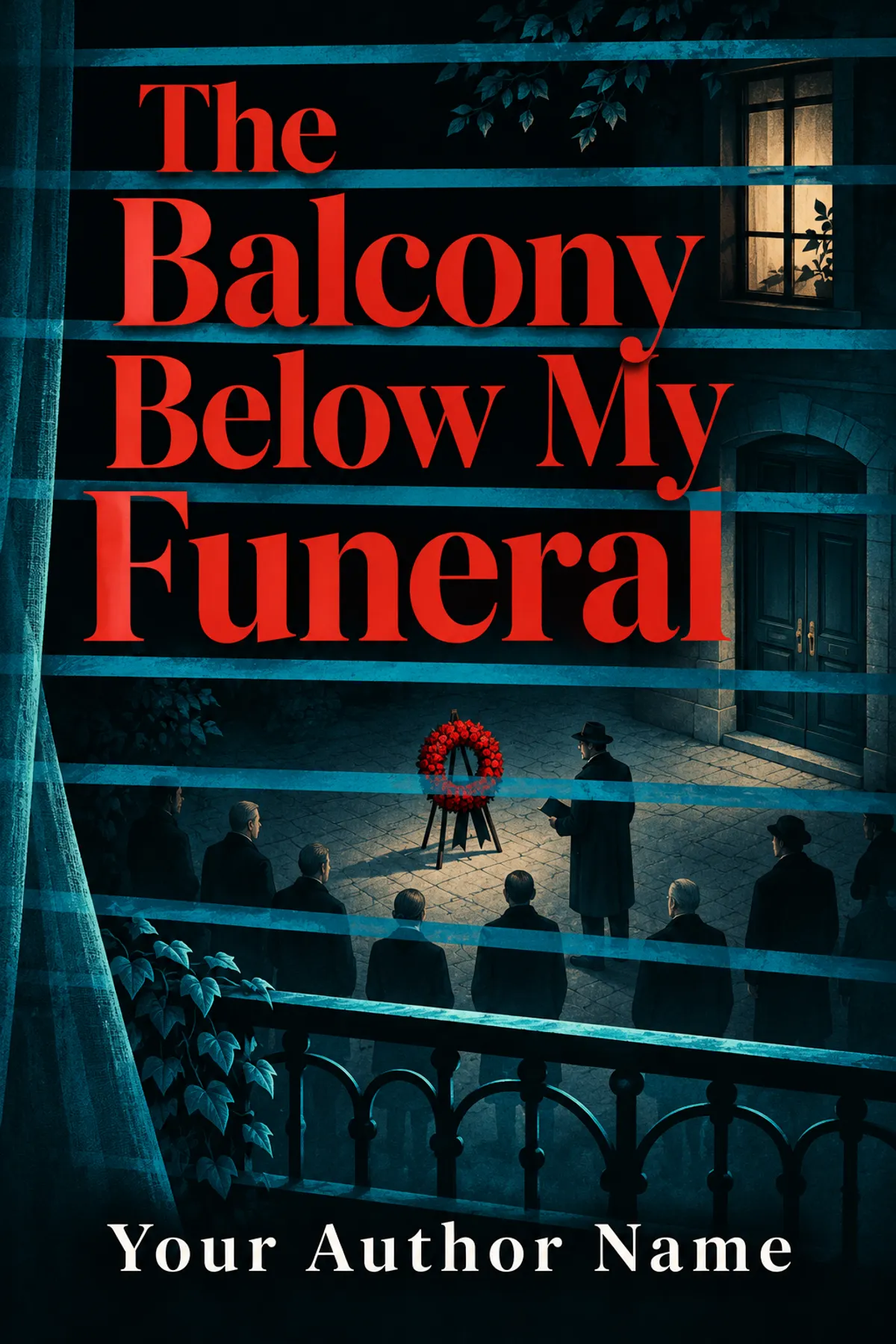
The Balcony Below My Funeral
A theater manager sees a funeral staged in the empty courtyard below her rented flat. The mourners use her name, and the man directing them knows which door she will try first.
ImagineYourBook writes a fresh draft from this idea.
How it begins
At nine twelve, the mourners began again.
Clara had counted six of them the first time. Now there were seven, all wearing black, all standing around the empty space where a coffin ought to be.
She opened her balcony door.
The courtyard below belonged to no one in particular. In daylight it held bicycles, overflowing planters, and a broken table nobody would admit owning. Tonight someone had moved everything against the walls.
A woman in a red scarf clapped once.
"From the name," she said.
The tallest mourner unfolded a sheet of paper.
"Clara Venn was a woman who knew when to leave."
Clara gripped the doorframe.
The woman in the scarf looked up.
There was no surprise in her face.
"Not yet," she called.
Clara stepped back into the flat.
Her phone lay beside the kettle. She picked it up, opened the camera, and returned to the balcony without switching on the kitchen light.
The mourners had rearranged themselves.
One now wore Clara's gray coat.
Not a similar coat. Hers. The left pocket sagged where she had caught it on a nail at the theater.
She had left it in the staff room that afternoon.
"Who are you?" she called.
The woman in the scarf checked her watch.
"She'll try the front stairs first," she told the others.
Clara stopped.
From the hallway beyond her flat came a soft metallic scrape.
She turned her camera toward the sound and began recording.
At work, she had always told young stage managers the same thing: when a performance goes wrong, establish what is happening before deciding what it means.
Below her, the tall mourner cleared his throat.
This time he read the sentence differently.
"Clara Venn was a woman who should have known when to leave."
She had approved enough rehearsal schedules to recognize the confidence of someone following one.
The hallway handle moved.
Your idea. Your book.
Keep the spark. Change anything.
Create my bookCreated with ImagineYourBook. Free to use as inspiration.
Outline and characters
Develop this idea
The terror should come from a plausible coordinated production, with each participant knowing only part of its purpose. Clara's theater knowledge gives her tools as well as vulnerabilities. Let her document observations and seek outside help early; blocked routes should have specific causes. A fair final reveal explains how the director predicted her actions without granting the antagonist magical omniscience.
- Clara sees actors rehearsing her funeral beneath her balcony
- The director predicts the exit she will try
- She contacts a technician who recognizes the production equipment
- The rehearsal uses details from a confidential workplace complaint
- Clara documents deliveries and paid performers
- A supposed rescuer steers her toward an isolated meeting
- She discovers the production is designed to discredit her evidence
- Rafi helps separate a frightened participant from the organizer
- Clara turns the final staged funeral into a witnessed disclosure
- She preserves the complaint's evidence and chooses her own public account
Characters
- Clara Venn, 44. Theater manager
- Rafi Cole, 39. Freelance stage technician
Series possibilities
- A prop invoice links the organizer to another private performance commissioned by a missing executive.