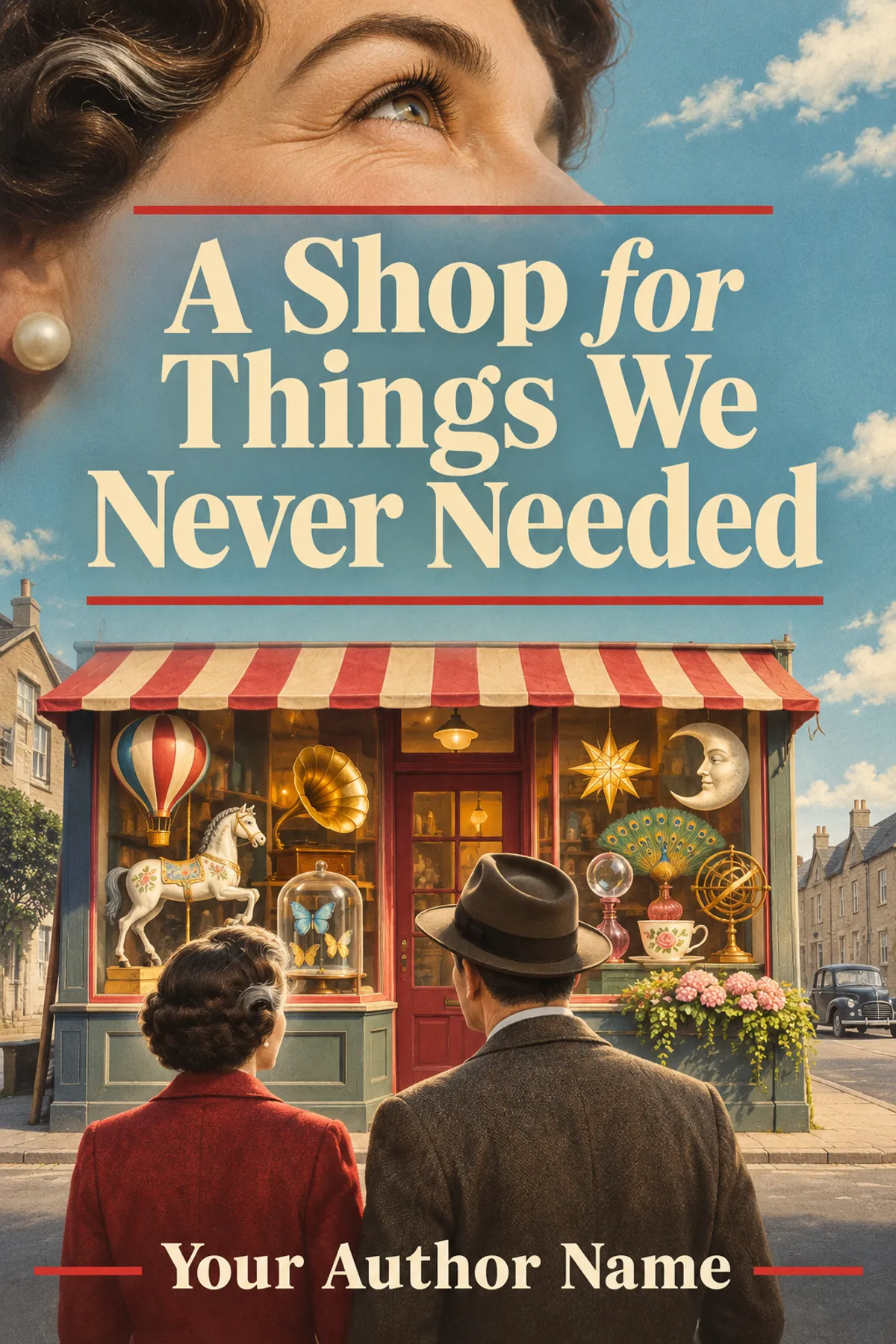
A Shop for Things We Never Needed
In a ration-weary town in 1950, a shopkeeper opens a store devoted to beautifully useless objects. A former factory planner comes to shut it down, then finds that its customers are buying reasons to imagine a life beyond being useful.
ImagineYourBook writes a fresh draft from this idea.
How it begins
Alice Brooks sold a blue wooden pear to a woman who had spent six years buying only things that could be boiled.
The woman held it in both hands.
'What is it for?'
'Looking at,' Alice said.
'And after that?'
'You may look again.'
The woman bought it.
By closing time, Alice had also sold a tiny ladder that reached nothing, a brass fish with no opening for coins, and a cushion embroidered with an imaginary railway station. Her ledger was not impressive. Her customers' expressions were.
At fifty-one, after years of measuring every purchase against a shortage, she had opened a shop for things nobody strictly needed. The town considered this either vulgar or healing. Business depended on the undecided.
Frank Mercer arrived carrying a planning folder. He was fifty-five, formerly responsible for organizing a factory floor, and had been appointed to review the use of the cooperative's shop premises.
'The allocation was for an essential service,' he said.
'I have chairs.'
'To sell?'
'To sit on while considering the question.'
He declined one, then accepted it when she put the kettle on.
Alice placed a small glass cloud on the desk between them. Inside it floated one permanently suspended raindrop.
'Imported?' he asked.
'Made above the bakery.'
'Useful?'
'The maker says it kept her from throwing away all her tools.'
Frank opened his folder. It contained measurements, rental figures, and a list of services the neighborhood lacked. Alice recognized every item. She had needed most of them herself.
For the first time that day, her certainty faltered.
'How much space does a useful life require?' she asked.
He looked at the glass cloud for longer than a man inspecting evidence should have done.
'I used to know,' he said.
Outside, the pear's new owner paused at the window and smiled at something she had chosen for no reason she was obliged to explain.
Your idea. Your book.
Keep the spark. Change anything.
Create my bookCreated with ImagineYourBook. Free to use as inspiration.
Outline and characters
Develop this idea
Treat beauty as meaningful without claiming it solves poverty or overrides competing needs. Alice and Frank both have defensible responsibilities, so the novel should let their practical disagreement remain substantial. The objects are handmade, specific, and gently absurd rather than magical cures. Their customers can leave unchanged or disappointed. A satisfying ending makes room for chosen pleasure through a viable arrangement, not through a miraculous wealthy benefactor buying the entire street.
- Alice opens her shop and attracts customers uncertain how to justify wanting beautiful useless things.
- Frank reviews whether the cooperative can afford to allocate scarce premises to it.
- They gather customers' accounts without pretending enjoyment replaces essential services.
- Local makers reveal skills they stopped using when every hour had to produce necessities.
- Alice's popular window display draws attention but not enough income to sustain the lease.
- Frank proposes efficiency changes that would erase the qualities people value most.
- A customer needs practical help Alice's objects cannot provide, challenging the shop's rhetoric.
- Alice works with neighbors on a shared-space proposal that preserves both utility and pleasure.
- The cooperative votes on transparent costs rather than sentimental claims of universal healing.
- The shop survives on a smaller honest footing, and Frank buys one thing without drafting its justification.
Characters
- Alice Brooks, 51. Shopkeeper
- Frank Mercer, 55. Former factory planner
Series possibilities
- The cooperative street offers linked stories about adults rebuilding desires that necessity taught them to suppress.