The Tailor Who Stitched the Sea
In a fictional port in 1921, a tailor receives a sail covered in repairs made by people who never returned home. Restoring it for a civic display brings him to a retired ferry clerk who remembers why some departures were never recorded.
ImagineYourBook writes a fresh draft from this idea.
How it begins
The sail arrived folded like a bedsheet for an impossible bed.
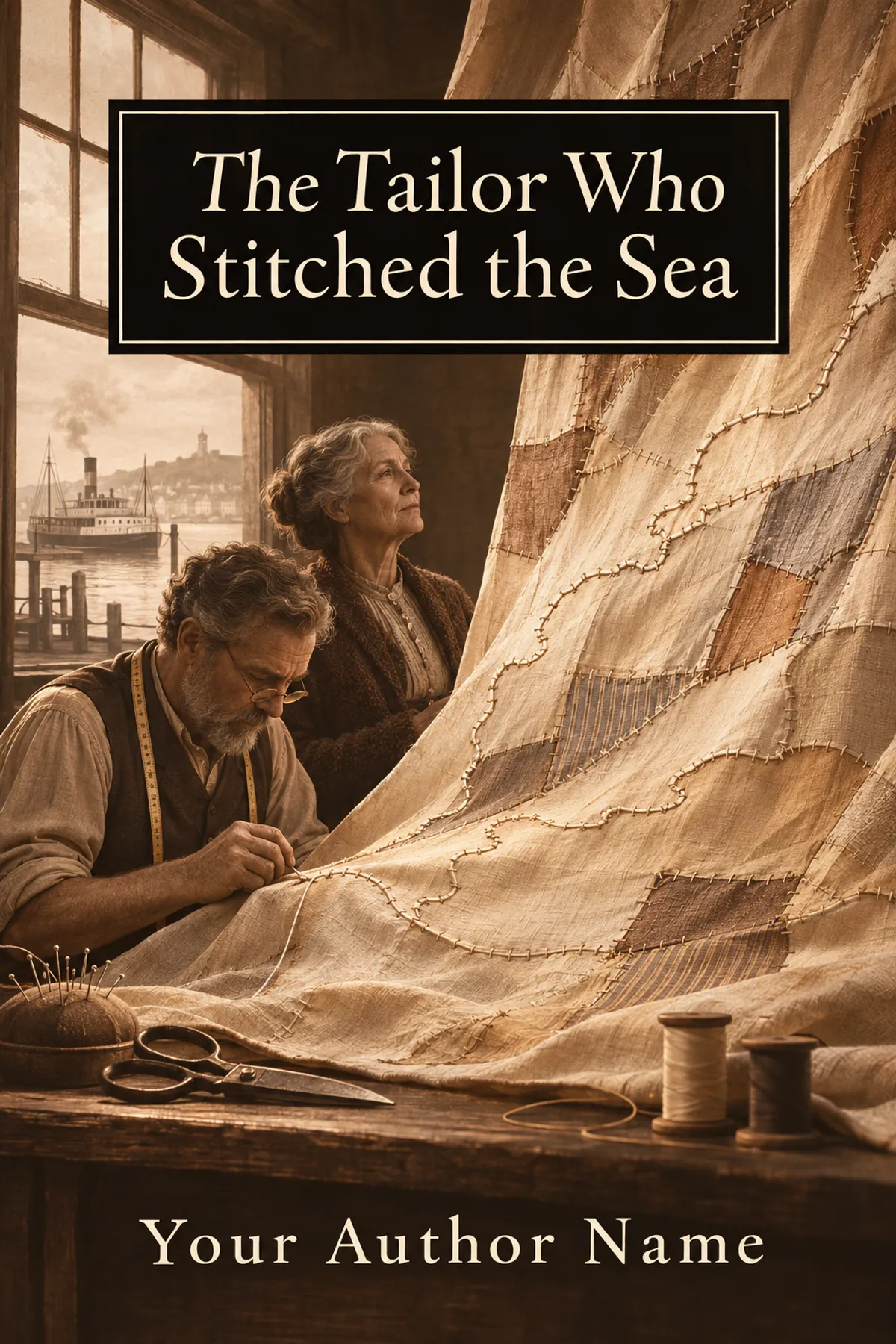
Thomas Finch cleared the wedding trousers from his cutting table and watched the harbor committee's clerk put a ruler beside the parcel.
'We thought you could make it presentable.'
'For a boat?'
'For the exhibition. The opening is Tuesday.'
Thomas was fifty-six. He had reached the age at which a committee's use of the word presentable generally meant removing evidence.
He unfolded the canvas. Salt fell onto the floorboards. There were patches in sailcloth, flour sacking, mattress ticking, and a strip of blue fabric embroidered with half a child's initial. No two repairs used the same stitch.
The clerk pointed to the blue piece.
'That rather spoils the unity.'
'It keeps the hole shut.'
'We are hoping for something more inspirational.'
After the clerk left, Thomas moved his lamp across the sail. The repairs followed a pattern too irregular to be decorative and too deliberate to be accidental. Along one seam, someone had stitched a date where only a person making the next repair would find it.
He checked the museum's proposed label. No vessel name. No owner. A celebration of local maritime courage.
At the foot of the invoice was a delivery address Thomas recognized. Edith Pike had worked the ferry office for thirty-four years. At sixty-one, she now repaired umbrellas in a room above the former ticket hall.
He took her a drawing of the seam.
Edith looked at it, then turned the paper over as though the reverse might offer an easier question.
'They want it cleaned?'
'They want the untidy parts replaced.'
Outside her window, a steamer sounded its departure. Edith waited until the note had faded.
'That blue patch belonged to a woman who got off here,' she said.
'The label says everyone continued north.'
'Yes. It would.'
She opened a drawer and removed a ferry ledger with six pages cut out. Thomas set down his drawing. Tuesday suddenly seemed a very long way away, and nowhere near long enough.
Your idea. Your book.
Keep the spark. Change anything.
Create my bookCreated with ImagineYourBook. Free to use as inspiration.
Outline and characters
Develop this idea
The sail should carry material evidence, not magically complete biographies. Let Thomas read workmanship while Edith supplies fallible institutional memory. Historical pain is most effective here through specific absences, contested records, and practical choices about display. Avoid turning anonymous travelers into decorative symbols of courage. The central conflict is whether a community can preserve an object honestly when uncertainty and uncomfortable arrivals are part of what it preserves.
- Thomas receives the damaged sail with instructions to erase its irregular repairs.
- Edith recognizes a patch connected to unrecorded arrivals rather than celebrated departures.
- They establish a repair map using stitch order, ordinary cloth, and surviving dates.
- Committee members resist naming people whose stories complicate the port's civic image.
- Thomas contacts families through an open invitation that does not demand public testimony.
- One returned account disproves Edith's confident memory of a particular crossing.
- A donor offers to fund restoration only if the exhibition retains its uplifting label.
- Thomas refuses to remove evidence but must find another way to pay his assistant.
- The opening presents the sail's gaps and repairs with clearly attributed, optional accounts.
- Edith records what she can honestly recall while the missing pages remain acknowledged as missing.
Characters
- Thomas Finch, 56. Tailor
- Edith Pike, 61. Retired ferry clerk
Series possibilities
- Linked historical novels can trace repaired objects through communities that official exhibitions have simplified.