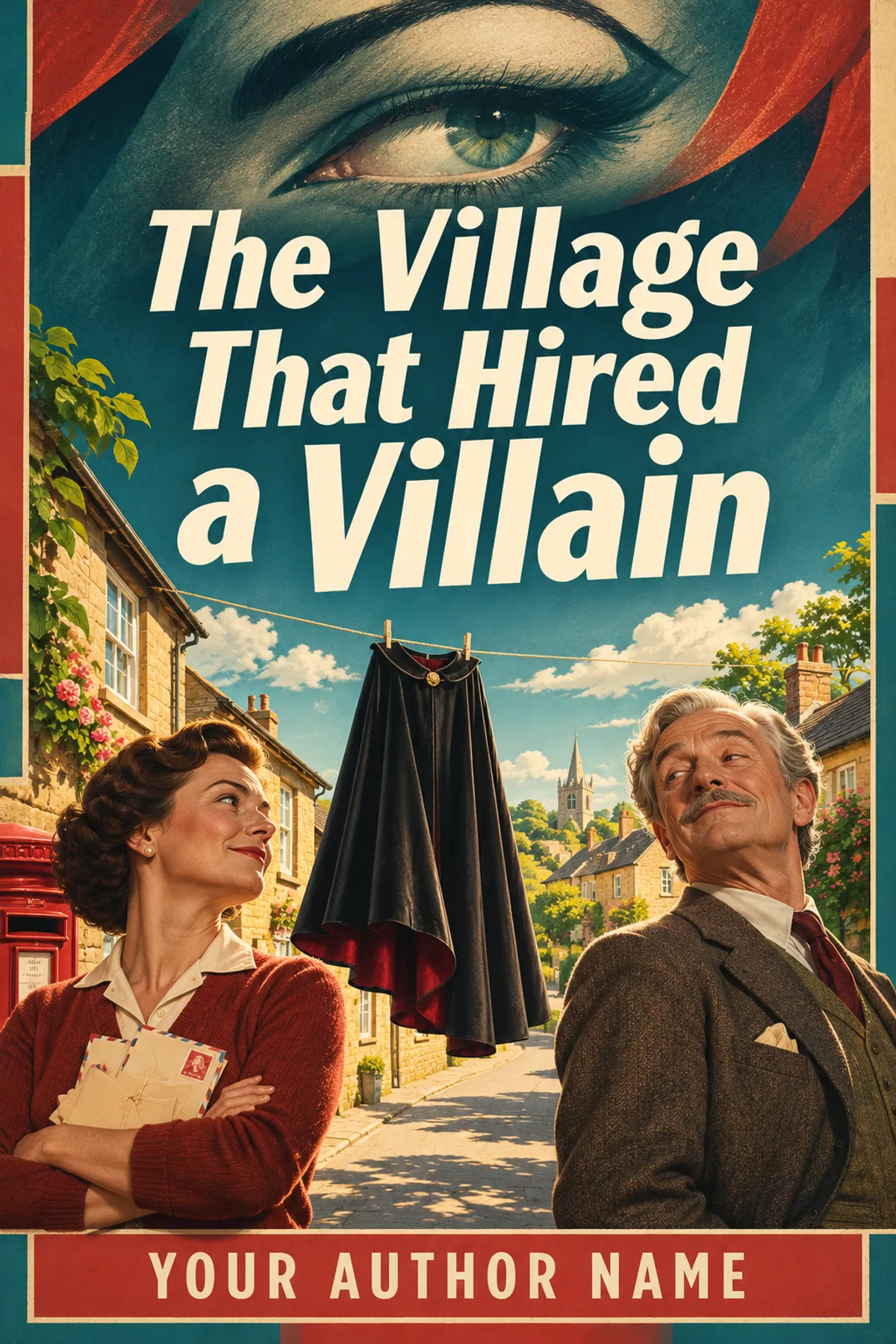
The Village That Hired a Villain
An overlooked village in 1952 pays a retired stage villain to give it a scandal worth visiting. The postmistress who invents his crimes and the actor who performs them must change their script when genuine wrongdoing threatens their increasingly devoted audience.
ImagineYourBook writes a fresh draft from this idea.
How it begins
Martha Lane advertised for a villain between the notice about lost hens and the parish whist results.
The village committee offered two pounds a week, a room over the post office, and all reasonable expenses except explosives.
Victor Shaw answered by return of post. His letter listed thirty-eight years of theatrical experience, excellent references from three murdered dukes, and an inability to digest onions.
Martha was forty-four and had spent seventeen years forwarding parcels to places more interesting than her own. She accepted him immediately.
He arrived on the eleven-ten bus wearing an immaculate black cape. At sixty-three, he could still make a driver reconsider asking for the correct fare.
'Where is the castle?' he asked.
'There is a disused water tower.'
'I have worked with less.'
Martha showed him the script. On Friday he would threaten to steal the church weathercock. On Saturday he would be thwarted by the village children, using a ladder supervised by the caretaker and absolutely no climbing. On Sunday he would repent in time for the cream teas.
Victor studied the pages.
'The motive needs work.'
'The motive is that nobody has bought a cream tea since Easter.'
'Not yours. Mine.'
Within a fortnight he had acquired a theatrical laboratory in the water tower, a respectable audience, and a correspondence column devoted to his eventual redemption. Visitors came from the county town. The butcher sold villainous sausages. Martha's postal receipts improved.
Then a real letter disappeared.
Not a prop. Not a ticket. A registered complaint about the quarry road, signed by six households whose walls had begun to crack.
The committee chairman suggested incorporating it into Saturday's entertainment.
Victor took off his cape. Without it, he looked tired and unexpectedly difficult to dismiss.
'Who was meant to receive that complaint?' he asked.
Martha checked the delivery book. There was a signature. It belonged to a man she had invented for the show.
For once, she could not think of a line.
Your idea. Your book.
Keep the spark. Change anything.
Create my bookCreated with ImagineYourBook. Free to use as inspiration.
Outline and characters
Develop this idea
Keep the invented villainy safe, consensual, and recognizably theatrical from the reader's perspective. The moral difficulty arrives when the village starts using its popular fiction to dismiss actual complaints. Martha is commercially resourceful, not foolish, and Victor's stagecraft should provide insight into how people direct attention. Avoid a single cartoonishly corrupt outsider. The resolution can preserve enjoyable performance while making a concrete separation between selling tickets and handling public obligations.
- Martha hires Victor to perform a harmless serialized scandal for visitors.
- Their clear boundaries and increasingly elaborate scripts build a devoted audience.
- A genuine registered complaint disappears under the name of a fictional character.
- Martha investigates postal handling while Victor traces who had access to his props.
- The committee asks them to preserve the tourist success instead of confusing the public.
- Villagers harmed by the quarry road resent being treated as another attraction.
- Victor refuses a profitable climactic performance that would turn their grievance into entertainment.
- Martha admits publicly that the villain was invented and distinguishes the real evidence.
- A revised village event gives affected residents the floor without requiring them to perform distress.
- The scheme continues as openly labeled theater, with its proceeds funding the road's independent examination.
Characters
- Martha Lane, 44. Postmistress
- Victor Shaw, 63. Retired stage actor
Series possibilities
- Martha and Victor's openly theatrical village can host further mysteries where a good story obscures a practical problem.