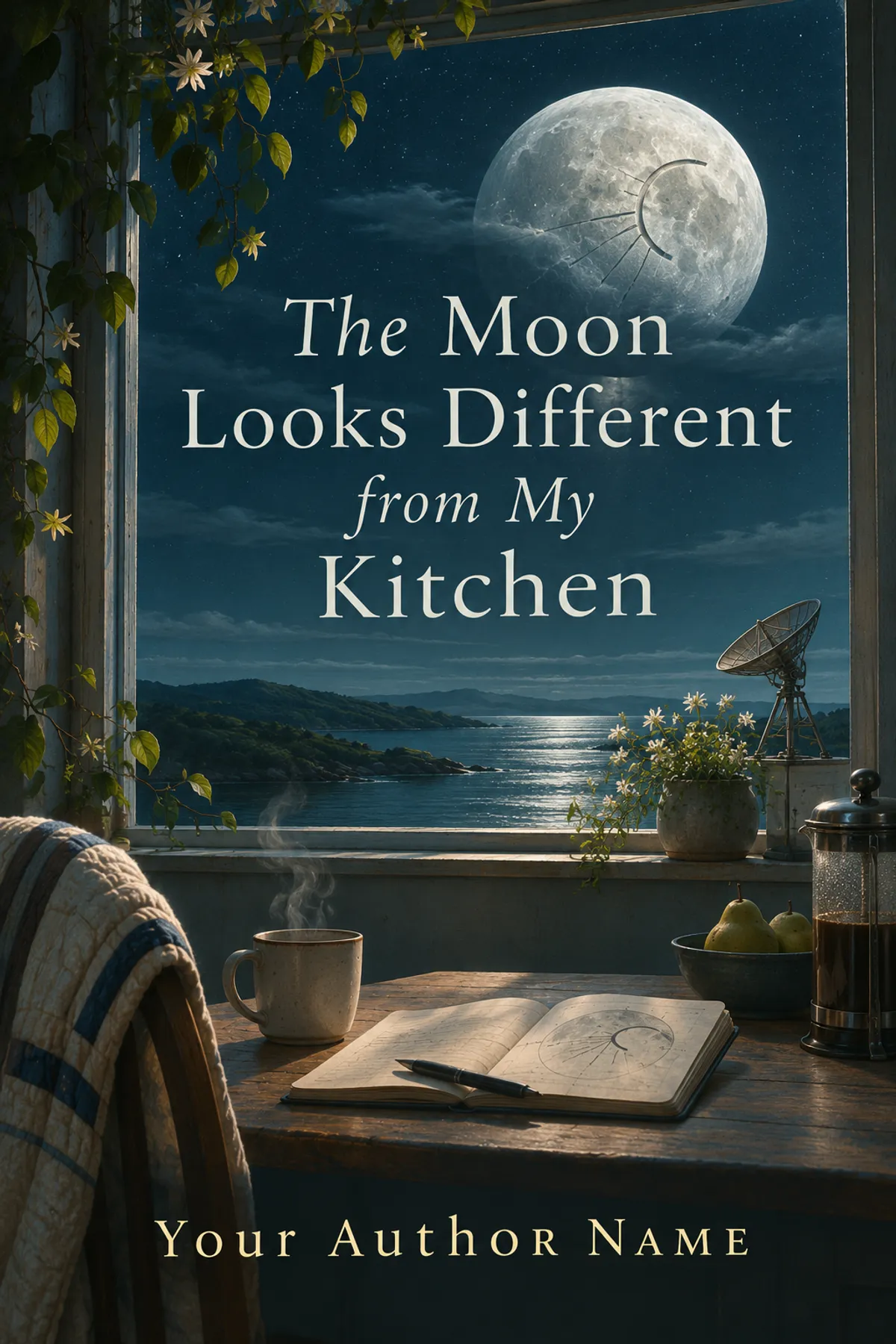
The Moon Looks Different from My Kitchen
A returning astronaut notices a new mark on the moon that nobody else remembers being absent. The search for its origin becomes a question of how to recognize a message whose intended recipient has not arrived yet.
ImagineYourBook writes a fresh draft from this idea.
How it begins
Ada Moss noticed the mark on the moon while waiting for the kettle.
The kitchen clock was three minutes slow. She had meant to correct it and was suddenly grateful for a smaller problem.
A narrow dark crescent crossed the familiar face, too straight to be a shadow and too large to be something she could reasonably ignore before breakfast.
She had spent eleven months in orbit looking at that moon.
It had not been there.
Her phone displayed a photograph from five years earlier. The mark crossed that image too.
Ada set the phone on the counter.
Outside, the city was waking. A bus sighed at the stop. Someone upstairs dropped a shoe. After nearly a year of filtered air and scheduled sunlight, she had expected ordinary sounds to make her feel returned to the world.
Instead the sky appeared to have been revised during the night.
She called Emil Solano.
He answered on the fourth ring. "If this concerns the welcome-home speech, I maintain it was shorter than the first draft."
"Look at the moon."
A pause. Curtains moving.
"I'm looking."
"The line."
Another pause, longer this time.
"Ada, that line has always been there."
She closed her eyes.
"Say that again after you open the folder I sent you from the station. The one you complained was too large."
While he searched, she watched steam begin rising from the kettle. A small, unnecessary domestic miracle. Water warming because she wanted tea, not because a mission schedule said it was time.
Emil stopped making keyboard noises.
"The file has changed," he said.
"What?"
"The image hasn't. The checksum has."
Ada looked at the moon again.
At the lower end of the mark, a small point of light blinked once.
On her counter, the kettle clicked off.
For several seconds, she couldn't tell which sound belonged to the more distant world.
Your idea. Your book.
Keep the spark. Change anything.
Create my bookCreated with ImagineYourBook. Free to use as inspiration.
Outline and characters
Develop this idea
Ground the emotional story in the disorientation of coming home, while marking the lunar phenomenon and communication mechanism as invented speculation. Ada should test memory against independent evidence instead of being declared uniquely correct by intuition. Emil's expertise needs limits and disagreement. A first-contact ending can preserve uncertainty while making a responsible response possible. The kitchen should remain more than a framing device: ordinary relationships are part of what the message puts at stake.
- Ada notices a new lunar mark from her kitchen
- Old images insist it has always existed
- Emil identifies a signal tied to her mission
- A shared memory provides a testable discrepancy
- The mark responds to a future transmission
- Official secrecy threatens independent verification
- Ada chooses an open scientific collaboration
- The message's intended recipient becomes clearer
- Earth prepares an answer without claiming certainty
- Ada reconnects cosmic wonder with ordinary home
Characters
- Ada Moss, 40. Returning astronaut
- Emil Solano, 47. Radio astronomer
Series possibilities
- Returning explorers find that the most unsettling discoveries begin inside familiar rooms rather than distant spacecraft.