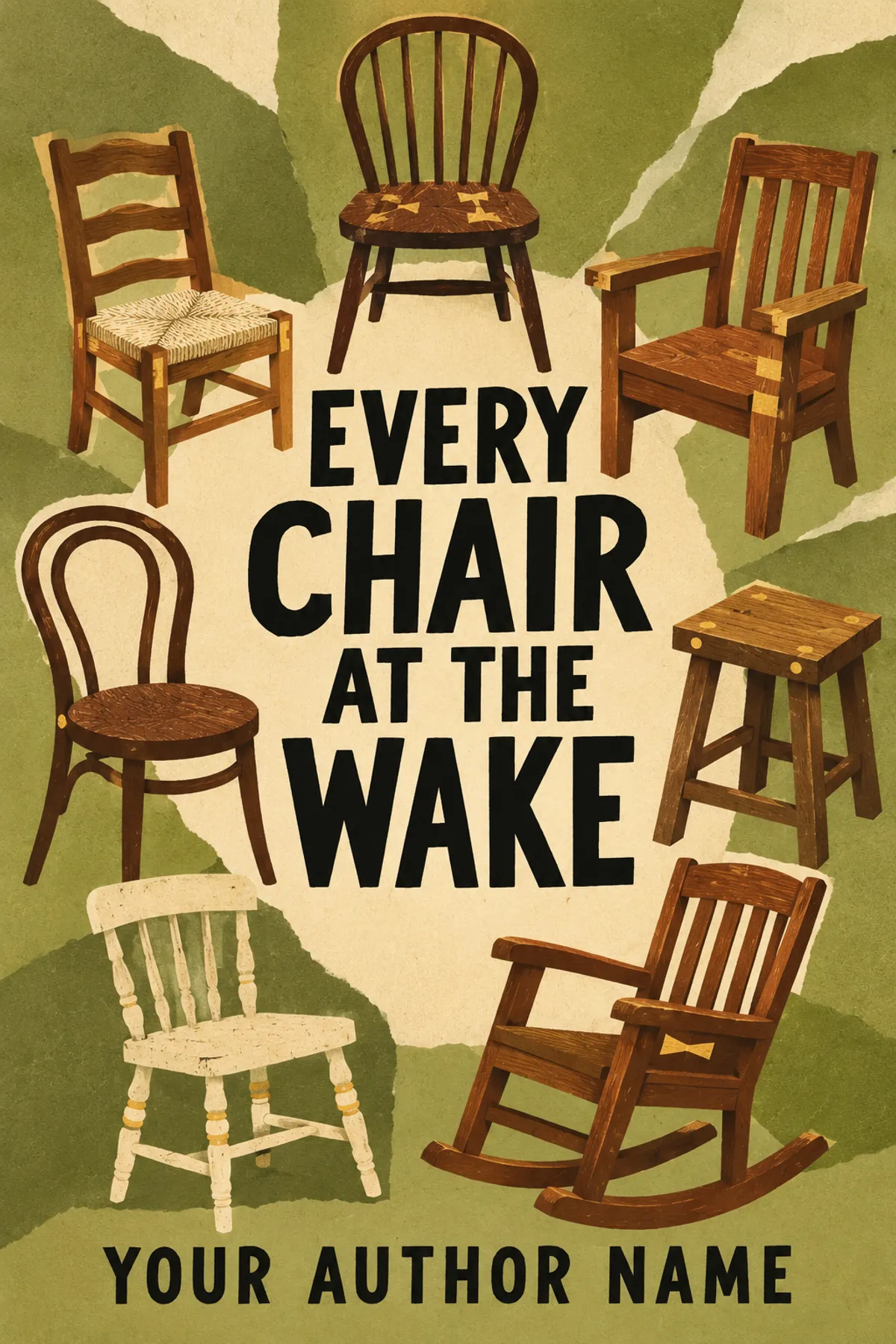
Every Chair at the Wake
At a community carpenter's wake, the chairs he repaired bring together people who knew incompatible versions of him, and his daughter must choose what an honest tribute can hold.
ImagineYourBook writes a fresh draft from this idea.
How it begins
The chairs arrived before the mourners, which gave Helen time to dislike them privately.
Her father had repaired every one. A kitchen chair with a mismatched leg. A folding chair reinforced beyond its original ambition. An armchair whose new seat was upholstered in fabric the owner had chosen against his advice.
He had told that story often. The owner had always been wrong in it.
Helen arranged the chairs in the hall, leaving enough space for people to move without apologizing. She had inherited her father's habit of noticing unstable furniture and none of his pleasure in explaining why it was unstable.
Owen brought the last chair in his van.
"He did this for me when I couldn't pay."
"I know."
"He never mentioned it?"
"Often."
Owen set the chair down carefully.
Helen regretted the answer, though not because it was false. Her father had been generous. He had also kept generosity polished like a tool he expected to use again. Both facts had lived in their house, taking turns at the table.
The first mourner arrived with a plate of sandwiches and a story about the winter he repaired her door. Another remembered a joke. Someone else had not spoken to him for eight years but came because the chair he made for her mother was still the most comfortable thing she owned.
Helen listened, holding the tribute she had written the night before. It contained three good anecdotes and a sentence she could not say without tightening her throat: He was always there for us.
Owen noticed the crossed-out line.
"You don't have to fit everyone into one speech."
Across the hall, a chair rocked on the uneven floor. Helen knelt, folded a piece of card and slipped it beneath the short leg.
The person sitting in it thanked her. She nodded and returned to the tribute, leaving a little more space between its sentences.
Outline and characters
Develop this idea
The repaired chairs should bring specific people and histories into the room rather than act as a single repeated symbol. Helen's account deserves authority without becoming the only true version. Avoid using a late revelation to redeem or condemn the father completely. Owen's shifting perspective can model how memory changes through listening. The wake's resolution is a form that can hold contradiction, and the final chair should remain useful furniture as well as an emotionally complicated inheritance.
- Helen prepares a wake using chairs repaired by her father.
- Mourners' stories reveal generosity, pride, impatience and absences that do not fit one tribute.
- Owen initially encourages a simpler celebratory account.
- Helen confronts the difference between her father's public usefulness and private unreliability.
- A mourner whose family he helped describes a kindness Helen had never heard him claim.
- Another guest explains a lasting hurt without asking the wake to become a trial.
- Helen decides to invite brief specific memories rather than deliver a total judgment.
- Owen admits his own rivalry shaped which stories he repeated.
- The wake holds affection and disagreement without resolving the man's character into one verdict.
- Helen takes home one ordinary repaired chair, able to use it without treating it as either proof of love or evidence against him.
Characters
- Helen Price, 44. Daughter of a deceased community carpenter
- Owen Davies, 61. Her father's longtime friend and occasional rival
Series possibilities
- A companion collection follows several chairs back to the homes whose stories briefly met at the wake.