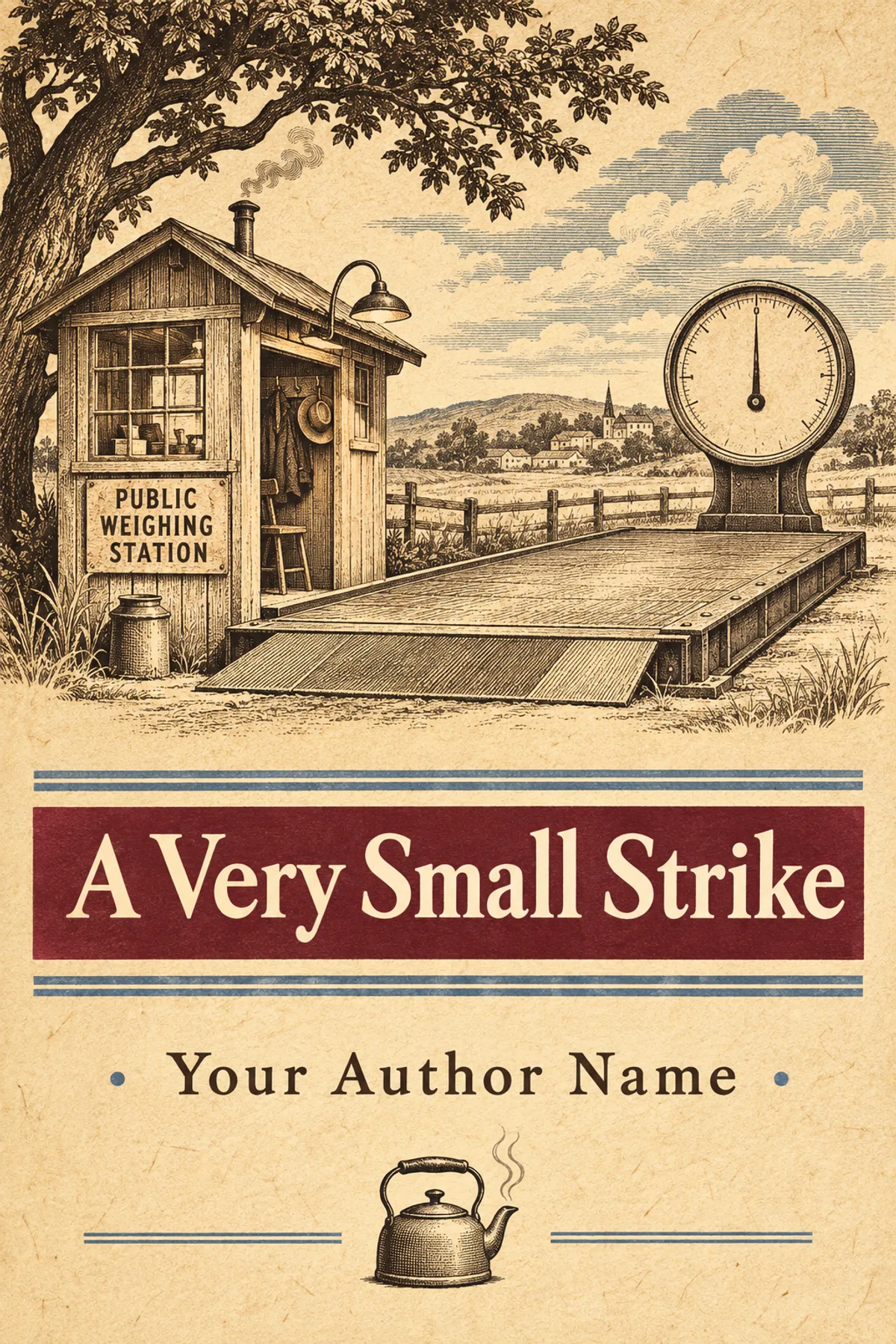
A Very Small Strike
The sole worker at a 1948 public weighing station goes on strike against himself after learning his job is being advertised as a volunteer opportunity. A café owner offers him a picket line, and the town discovers how much invisible work fits inside one small hut.
ImagineYourBook writes a fresh draft from this idea.
How it begins
Frank Bell placed the strike notice on the weighing-station window at eight fifty-nine.
At nine he went outside and became the picket line.
The notice said one worker was withdrawing his labor. It did not mention that the worker had also typed the notice, cleaned the window and borrowed the drawing pins.
Across the road, Winifred Cole raised the blind of her café. She watched Frank walk from one end of the hut to the other. The journey took seven steps.
'You look cold,' she called.
'I am making a point.'
'You can make it with tea.'
He accepted the mug but remained outside. Rules mattered. He had written them himself on the back of an old delivery sheet.
The first farmer arrived with a trailer at a quarter past nine.
'Are you open?'
'No.'
'You're here.'
'Exactly.'
Frank handed him the newspaper advertisement. The council sought a community-minded volunteer to operate the public weighbridge. Experience preferred. Expenses considered.
He had operated it for twenty-two years. He had expected to retire eventually. He had not expected the job to retire first.
The farmer read the advertisement twice.
'Could be a misprint.'
'Then they can print a correction.'
By ten there were four trailers in the road and a complaint about obstruction. Winifred brought out a chair.
'A picket line should be able to sit.'
'I don't want anyone thinking I'm on holiday.'
'Nobody who has seen you on holiday would make that mistake.'
She placed the chair beside him. From this angle, the hut looked smaller than the things it did: weighing crops, settling arguments, recording deliveries, letting drivers warm their hands.
A council car stopped. The man inside lowered his window.
'Mr Bell, surely we can discuss this without inconveniencing everyone.'
Frank looked at the waiting trailers. For once, inconvenience had made his work visible before he performed it.
Your idea. Your book.
Keep the spark. Change anything.
Create my bookCreated with ImagineYourBook. Free to use as inspiration.
Outline and characters
Develop this idea
The strike needs credible practical consequences without making safe access or food security a punchline. Research the chosen 1948 labor context and the station's authority before defining tactics. Frank's informal extra duties should be useful but debatable, so clearer scope matters as much as wages. Winifred can support him while protecting her own business. Keep the victory specific enough that both retirement and replacement become possible.
- Frank strikes after his paid job is advertised as voluntary work.
- Winifred supports him without turning the café into free campaign catering.
- Delayed deliveries expose the weighbridge's wider role in local trade.
- The council claims the advertisement was an efficiency measure.
- Farmers disagree about supporting wages versus avoiding immediate losses.
- Frank reveals how many unofficial duties have accumulated without payment.
- A volunteer applicant discovers the role's real hours and responsibilities.
- Winifred helps organize a transparent public cost comparison.
- The council withdraws the advertisement and funds a properly scoped replacement post.
- Frank negotiates retirement on his own schedule instead of disappearing into gratitude.
Characters
- Frank Bell, 60. Public weighing-station operator
- Winifred Cole, 56. Café owner
Series possibilities
- Small workplace disputes across the market town reveal the hidden labor behind apparently simple public services.