
Writing a book is not one decision. It is hundreds of decisions made, tested, revised, and tested again. A dazzling premise can still be undermined by continuity errors, repetitive prose, uneven pacing, or a romance that never quite delivers the emotional payoff readers expect.
That is why we built Manuscript Rewrite, a new ImagineYourBook feature for authors who already have a draft—and know it deserves a more accomplished next edition.
Introducing Manuscript Rewrite
Keep the book. Transform the edition.
Upload a Word, Markdown, text, or HTML manuscript. Describe the exact transformation in ordinary language. Muse creates a newly assembled edition chapter by chapter while your source stays untouched.
The launch test: one novel, four editions
For the launch evaluation, we took the same roughly 84,700-word romance novel and improved it through targeted manuscript rewrites instead of starting over. The book—Leaving My Billionaire After His Secret Son Called Him Papa (Everyone Knew But Me.)—opened with a formidable commercial hook.
A nine-year-old boy runs across a glamorous family gala, calls Camille's husband Papa, and jumps into his arms. Her husband knows him. His family knows him. Everyone in the room seems to know him. Camille does not.
The premise was already exceptional. The real question was how much better the same book could become without sacrificing what made it irresistible.
The quality curve
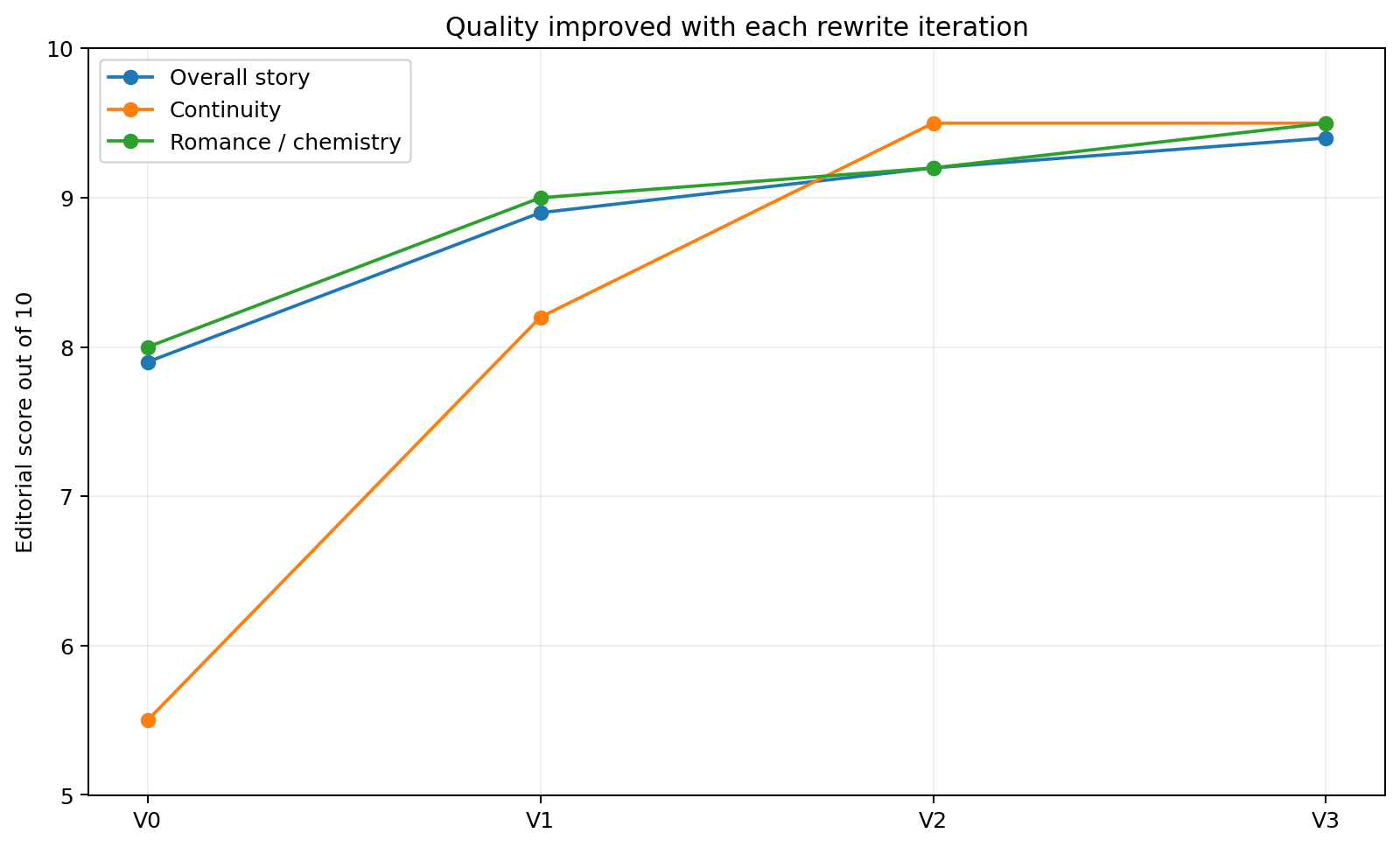
The most important result is not that every measure increased in a perfectly straight line. It did not. Each iteration made deliberate trade-offs. Version 1 became dramatically tighter. Version 2 repaired structural assembly and elevated the ending. Version 3 restored some length and heat while preserving the hard-won editorial gains.
That resembles professional editing far more closely than giving an AI one vague instruction to “make my book better.”
| Version | Principal change | Overall | Predicted Amazon rating* |
|---|---|---|---|
| V0 | Powerful premise, weakened by POV, chronology, pacing, and repetition problems | 7.9/10 | ~4.22 |
| V1 | Corrected POV and major continuity issues; tightened the middle | 8.9/10 | ~4.40 |
| V2 | Repaired structure, strengthened the heroine, clarified the HEA | 9.2/10 | ~4.53 |
| V3 | Restored emotional texture and deepened romance and spice without surrendering earlier gains | 9.4/10 | ~4.57 |
*Editorial estimates from the same evaluator, not actual Amazon customer ratings or a scientific benchmark.
The complete editorial comparison
The full scorecard shows where each edition advanced, where it traded one strength for another, and why the final result cannot be reduced to a single number.
| Editorial category | V0 | V1 | V2 | V3 |
|---|---|---|---|---|
| Premise / hook | 9.5 | 9.5 | 9.5 | 9.5 |
| Opening / Look Inside conversion | 9.0 | 9.2 | 9.3 | 9.4 |
| Prose | 7.8 | 8.8 | 8.7 | 8.9 |
| Pacing | 6.5 | 8.7 | 8.8 | 8.8 |
| Character depth | 8.5 | 9.0 | 9.2 | 9.4 |
| Camille | 7.8 | 9.1 | 9.4 | 9.5 |
| Alexandre / redemption | 8.2 | 9.0 | 9.3 | 9.4 |
| Children / family | 8.7 | 9.1 | 9.3 | 9.4 |
| Romance / chemistry | 8.0 | 9.0 | 9.2 | 9.5 |
| Spice | 4/5 | 3/5 | 2.5–3/5 | 4/5 |
| Emotional payoff | 8.3 | 9.0 | 9.3 | 9.5 |
| Ending / HEA | 8.0 | 9.1 | 9.5 | 9.5 |
| Continuity | 5.5 | 8.2 | 9.5 | 9.5 |
| POV consistency | 5.5 | 9.5 | 9.5 | 9.5 |
| KU bingeability | 8.4 | 9.2 | 9.4 | 9.5 |
| Commercial romance fit | 8.6 | 9.2 | 9.4 | 9.6 |
| Technical assembly | 7.0 | 5.8 | 8.8 | 8.9 |
| Overall story | 7.9 | 8.9 | 9.2 | 9.4 |
| Predicted Amazon average* | ~4.22 | ~4.40 | ~4.53 | ~4.57 |
What changed in each rewrite?
Version 0 · Approximately 84,700 words
The idea was stronger than the manuscript
The original draft contained something no line edit can manufacture: a killer hook. Yet Camille shifted from first person to third person in later chapters, a character's stated age contradicted the established marriage and pregnancy chronology, and the middle repeatedly explained themes the reader had already understood.
That is how one book could hold a 9.5 premise score and still earn only 7.9 overall. The right rewrite did not need to replace everything. It needed to identify what deserved to survive.
Version 1 · Approximately 73,300 words
The decisive developmental rewrite
The first rewrite fixed the most damaging problems. POV became consistent. Margot became eight throughout—not only as a replaced number, but in her behavior, school life, dialogue, and independence. The middle accelerated, Camille gained a stronger identity outside the marriage, and Alexandre's redemption emerged through actions rather than speeches.
The score leapt from 7.9 to 8.9, the largest gain in the study. But the new edition also exposed two assembly defects: one chapter split a question from its answer, and a generated ending chapter carried the placeholder title “New Chapter.” Story intelligence had improved faster than technical assembly.
Version 2 · Approximately 77,800 words
Fix the rewrite—do not restart the book
The next edition repaired version 1 instead of discarding it. The broken dialogue split disappeared. The placeholder became Epilogue · Open Orbits. Chronology aligned around Margot's age, Lucien's age, the length of the marriage, and the timing of Alexandre's paternity discovery.
The ending also became more satisfying. Camille did not simply resume her old life; she chose a professional future of her own and a new relationship on explicit terms. The result was a clearer romance HEA/HFN payoff and another meaningful rise, from 8.9 to 9.2.
Version 3 · Approximately 82,400 words
Editing does not always mean cutting
Version 3 became longer—and better. It restored emotional transitions, lived-in family moments, romantic chemistry, and heat without resurrecting the original repetition or continuity failures. Intimacy reinforced the character arc: Camille retained agency, and Alexandre learned to wait, follow, and respond rather than control.
The direction was not simply “add more sex.” It was strengthen the romantic payoff without weakening the story. That distinction carried the final edition to 9.4 overall.
The best version was not the shortest
| Version | Approximate words | Change from prior version |
|---|---|---|
| V0 | 84,700 | Starting manuscript |
| V1 | 73,300 | −11,400 |
| V2 | 77,800 | +4,500 |
| V3 | 82,400 | +4,600 |
Good editing is not synonymous with deletion. The first rewrite removed material the story did not need. Later editions added back material the reader did need: stronger emotional transitions, richer characterization, a clearer HEA, more dimensional family scenes, and more rewarding intimacy.
The objective was never to produce a statistically “cleaner” manuscript. It was to engineer a better reading experience.
Preserve what already works
The premise scored 9.5 in every version. The boy still crossed the gala and called Alexandre Papa. Alexandre still reacted like a father rather than a stranger. Camille still realized that the room's most devastating secret was written across everyone else's faces.
Iteration worked because the manuscript evolved around its strongest idea. Manuscript Rewrite is designed for that kind of direction: preserve this opening, protect this character, retain this voice—and transform what is holding the book back.
A novel is a network of dependent facts
Changing a character from twelve to eight is not a global find-and-replace. A convincing rewrite must consider her school year, speech, independence, musical experience, discovery of the secret, the marriage chronology, Camille's pregnancy, Lucien's age, and the timing of the paternity test.
An 80,000-word novel is not 80,000 independent words. It is a network of facts, promises, causes, relationships, and consequences. That is why continuity produced one of the clearest improvements in the study:
Continuity: 5.5 → 8.2 → 9.5 → 9.5.
What the experiment did—and did not—prove
The final edition was not “perfect.” It still contained a mechanical front-matter issue: an internal copyright template remained where the final author notice belonged. That was not a story failure. It was a publishing-pipeline failure.
This distinction matters. Once developmental editing and prose become strong enough, the bottleneck moves to deterministic work such as final QA, assembly, formatting, metadata, and publishing readiness. Authors should review every finished edition before publication.
Can anyone predict a 4.57-star Amazon book?
No one can know a future Amazon rating before real readers leave reviews. The 4.22 → 4.40 → 4.53 → 4.57 figures are editorial forecasts based on continuity, pacing, genre expectations, chemistry, emotional payoff, ending satisfaction, prose polish, and visible manuscript errors.
They are useful because the same evaluator applied the same framework to all four versions. The trend matters more than the decimal: each intentional rewrite made the manuscript more coherent, satisfying, and difficult to criticize.
From draft generation to book engineering
The most powerful use of AI may not be “write me a novel.” It may be: “Here is my novel. Make this specific edition better without destroying what already works.”
That creates a more sophisticated workflow. Write or generate the first manuscript. Read it. Gather editorial feedback. Then give exact, human directions for the next edition:
“Preserve the opening, but repair every timeline contradiction.”
“Make the heroine harder to win back and give her a life beyond the romance.”
“Reduce repetitive prose without flattening my voice.”
“Increase romantic tension and spice without changing the plot.”
“Strengthen the epilogue and make the happily-ever-after unmistakable.”
“Protect the scenes that already work. Rewrite only what makes the book weaker.”
For this manuscript, the progression was unmistakable: compelling but flawed at 7.9; decisively edited at 8.9; structurally polished at 9.2; emotionally complete at 9.4.
Beautiful books are rarely discovered in one pass. They are built one better edition at a time.
Frequently asked questions
AI manuscript rewriting, explained
What is ImagineYourBook Manuscript Rewrite?
It is a new ImagineYourBook feature that lets you upload an existing Word, Markdown, text, or HTML manuscript and describe the changes you want in ordinary language. Muse creates a new edition while your source manuscript remains untouched.
Can an AI manuscript rewrite preserve the parts that already work?
Yes. You can explicitly protect an opening, character, scene, plot point, voice, or other successful element while requesting precise changes elsewhere. Clear constraints help the rewrite preserve the book's identity.
Does better editing always make a manuscript shorter?
No. This case study became shorter during its major developmental edit, then regained useful length through stronger transitions, characterization, family scenes, romance, and intimacy. The target is a better book—not the fewest possible words.
Can Manuscript Rewrite fix continuity across a full novel?
It can apply book-level directions across chapters, including chronology, character ages, point of view, relationships, repeated explanations, and ending requirements. You should still read and review every completed edition before publishing.
How can I leave space for my own images?
Describe the images in your normal book or rewrite prompt and ask for clear placeholders. For example: “After the squat technique explanation, insert [IMAGE: squat-side-view — side view showing the starting position]. Keep this marker on its own line.” Use a distinct label for each image and specify a chapter or passage when placement matters.
Review the markers, download the Word file, and replace them with your images in Word or another document editor. Keep the existing paragraph styles to retain the surrounding formatting. Placeholders are text only; they do not upload or embed images in ImagineYourBook exports.
Are the predicted Amazon ratings actual customer ratings?
No. They are editorial forecasts for this specific manuscript, produced by the same evaluator using the same framework across every version. They are not observed customer ratings or a scientific benchmark.