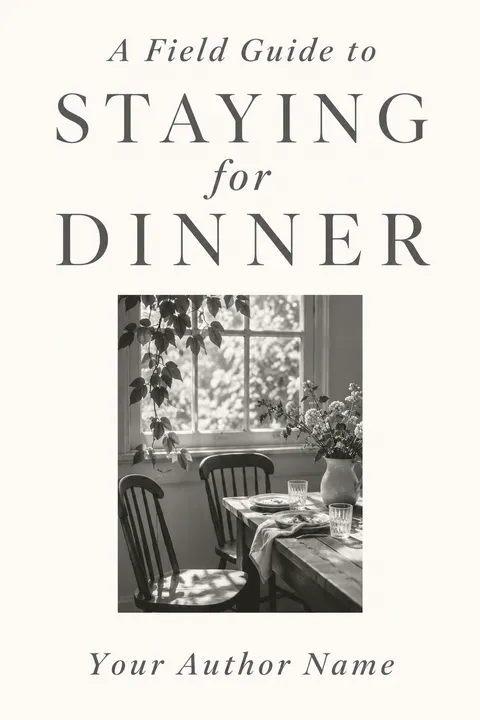

Your Spare Fork Is an Invitation
Turn a reason to see somebody into a gathering that fits the table and the host.
ImagineYourBook writes a fresh draft from this idea.
Introduction
At her first dinner party, Gwen invited four people and owned three forks.
She counted twice. There were also seven teaspoons, none of which had admitted where they came from. She had spent the afternoon looking at pictures of people serving elaborate food on long tables in gardens. By six o'clock she was standing under a fluorescent kitchen light wondering if soup could be eaten with a teaspoon.
She wanted to see Eli, who was moving across town. The evening did not need to prove she had a house fit for company. She could have written: "Come say goodbye to Eli. We have soup and a small table. Six to eight. Bring a fork if you can."
She sent that message to the group. Eli wrote back in twenty seconds.
"I have a fork I would like to say goodbye with."
The job of an invitation is to let somebody imagine arriving. Give them a time, a place and a little picture of what happens next. If the room is upstairs, say so and ask what would make it easier to join. If you want everyone to eat before they come, say that too. An evening is easier to say yes to when you know which version of yourself to bring.
Try designing the first ten minutes of a gathering before you design the menu. Where will someone put a coat? Can they find a seat if they need one? What can they do with their hands while people arrive? A pitcher on a table gives the first guest something to pour. A person who brings a fork has already helped.
They ended up eating soup with spoons, as people do. The fourth fork sat in the middle of the table with a ribbon tied around the handle. Nobody needed it. At eight Gwen put the kettle on for the last cup of tea, and Eli talked about the new bus stop outside his flat.
She would remember what he said about the bus. She had already forgotten what the soup cost.
Chapter plan
Develop this idea
Build the first chapter around the distinction between an occasion and an invitation. Show how a clear purpose lets a host simplify food, timing and space. The examples should include people with different budgets and access needs without assigning them extra work. Use small scripts that can be adjusted naturally. A useful final chapter should leave readers with a real date and a message they would send.
- Open on the fork count and the exhausting imagined dinner.
- Choose why these people are gathering now.
- Design for a table, floor or room you already have.
- Write the invitation as a useful description of the night.
- Ask about access, food needs and seating directly.
- Give guests an easy way to take a small role.
- Plan a low-effort beginning that welcomes late arrivals.
- Practice a gentle end and state the end time up front.
- Review what people remembered rather than what the photos show.
- Make three versions for a kitchen, a park and a phone call.
Series possibilities
- A sequel on recurring neighborhood gatherings that survive organizer turnover.