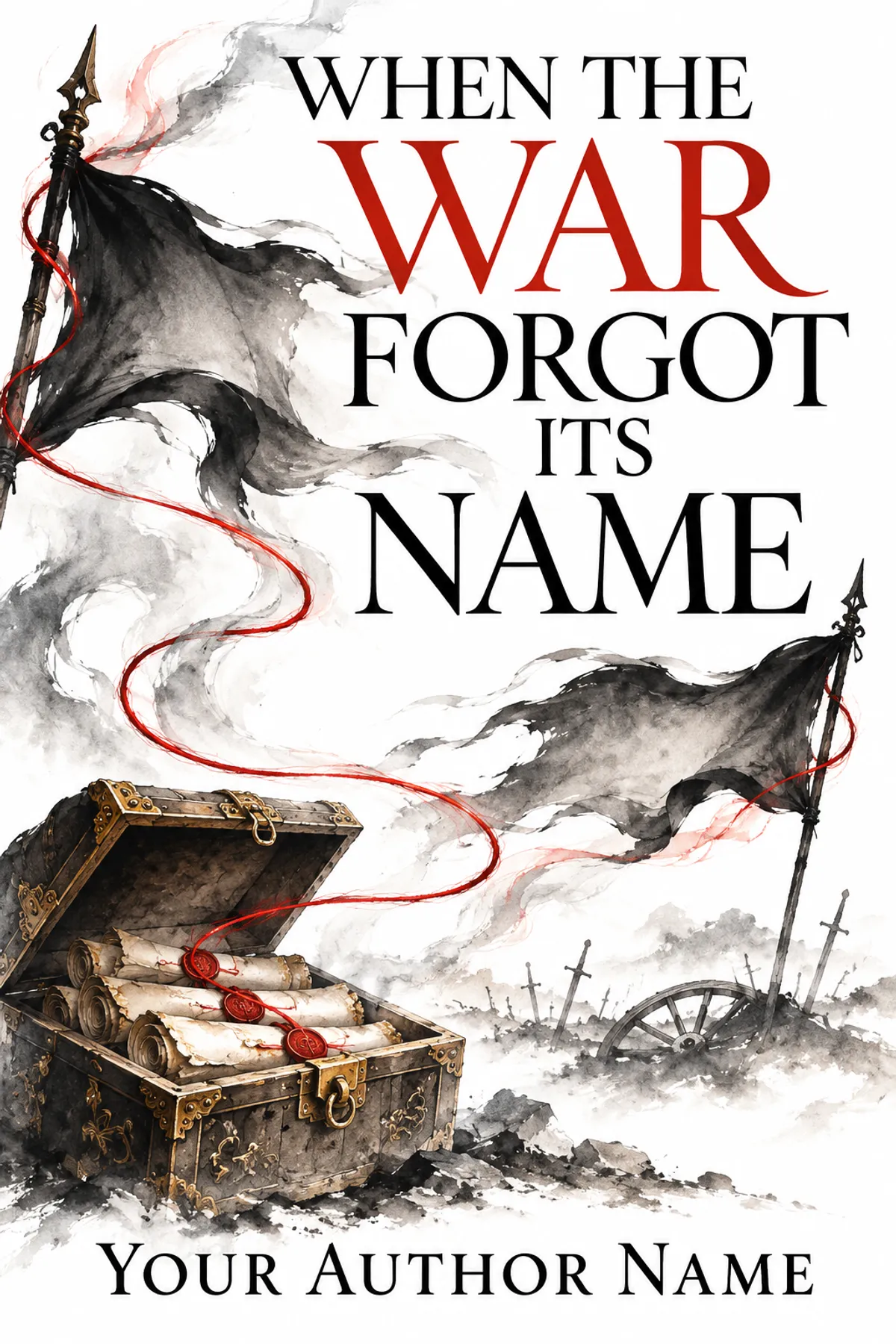
When the War Forgot Its Name
A battlefield interpreter finds both armies forgetting why they fight, then uncovers a merchant caste quietly selling the missing histories back to whichever side pays.
ImagineYourBook writes a fresh draft from this idea.
How it begins
The prisoner could name every part of his rifle except the enemy.
Sanaa asked the question in his own language, then in the border dialect, then in the trade speech both armies used when they wanted to buy something.
He gave her the same bewildered look each time.
Across the table, her commanding officer rubbed his forehead.
"He's pretending."
"Perhaps. What do you call them?"
The officer opened his mouth. Closed it.
Outside, the guns continued. People could apparently keep doing something long after losing the words that explained why.
Sanaa wrote the date at the top of her notebook and found she was uncertain which calendar the army used. She knew it had mattered yesterday. She remembered being corrected. She could not remember the correction.
A courier arrived at the tent carrying a sealed memory vial. Marcel Quinn wore the neutral badge of the history merchants, whose caravans crossed lines ordinary civilians could not approach.
"Your commander's subscription has lapsed," he said.
The room became very quiet.
Sanaa looked at the vial. A tiny image moved inside: a burning gate, a crowd, a flag she almost recognized.
"Subscription to what?"
Marcel's professional expression faltered.
"The campaign archive."
"Our own history?"
He glanced at the officer, who had reached for the vial with a need that looked disturbingly like hunger.
Sanaa moved it out of reach.
"Who owns the original?"
Marcel did not answer.
Beyond the canvas, a burst of firing stopped. Someone called for instructions. Nobody inside the tent moved.
The prisoner leaned toward Sanaa.
"If I remember," he asked, "will I want to kill you again?"
She looked at his hands, at the empty cup between them, at the vial in which somebody had packaged a reason to hate.
"I don't know," she said.
It was the first answer that afternoon she trusted completely.
Outline and characters
Develop this idea
Distinguish forgetting from reconciliation. Restoring history should include responsibility and conflicting testimony, not simply revive hatred or produce automatic peace. The merchant guild can contain dissenters and ordinary workers, preventing a monolithic villain group. Sanaa's language skills should reveal differences in framing and omission. Establish what memory storage can remove and what habits remain. The prisoner scene introduces the central moral question: people deserve their histories even when knowing them makes the next choice harder.
- Sanaa discovers soldiers on both sides forgetting the reasons and names behind their war.
- Marcel reveals that commanders purchase access to stored campaign histories.
- Expired subscriptions expose a guild's control over collective memory.
- Sanaa compares fragments from both armies and finds selective editing.
- Marcel admits he delivered profitable versions without asking what was omitted.
- Some leaders prefer continued forgetting to confronting their own responsibility.
- Others demand restored grievances as justification for renewed violence.
- Interpreters, witnesses and dissenting guild members reconstruct histories outside commercial control.
- The armies receive fuller accounts and must choose peace without enforced amnesia.
- Sanaa establishes a shared archive whose conflicting testimonies remain visible rather than resolved into one convenient story.
Characters
- Sanaa Ives, 44. Human battlefield interpreter
- Marcel Quinn, 36. Human courier carrying purchased histories between armies
Series possibilities
- The shared archive receives a memory of a treaty that neither former army admits signing.