
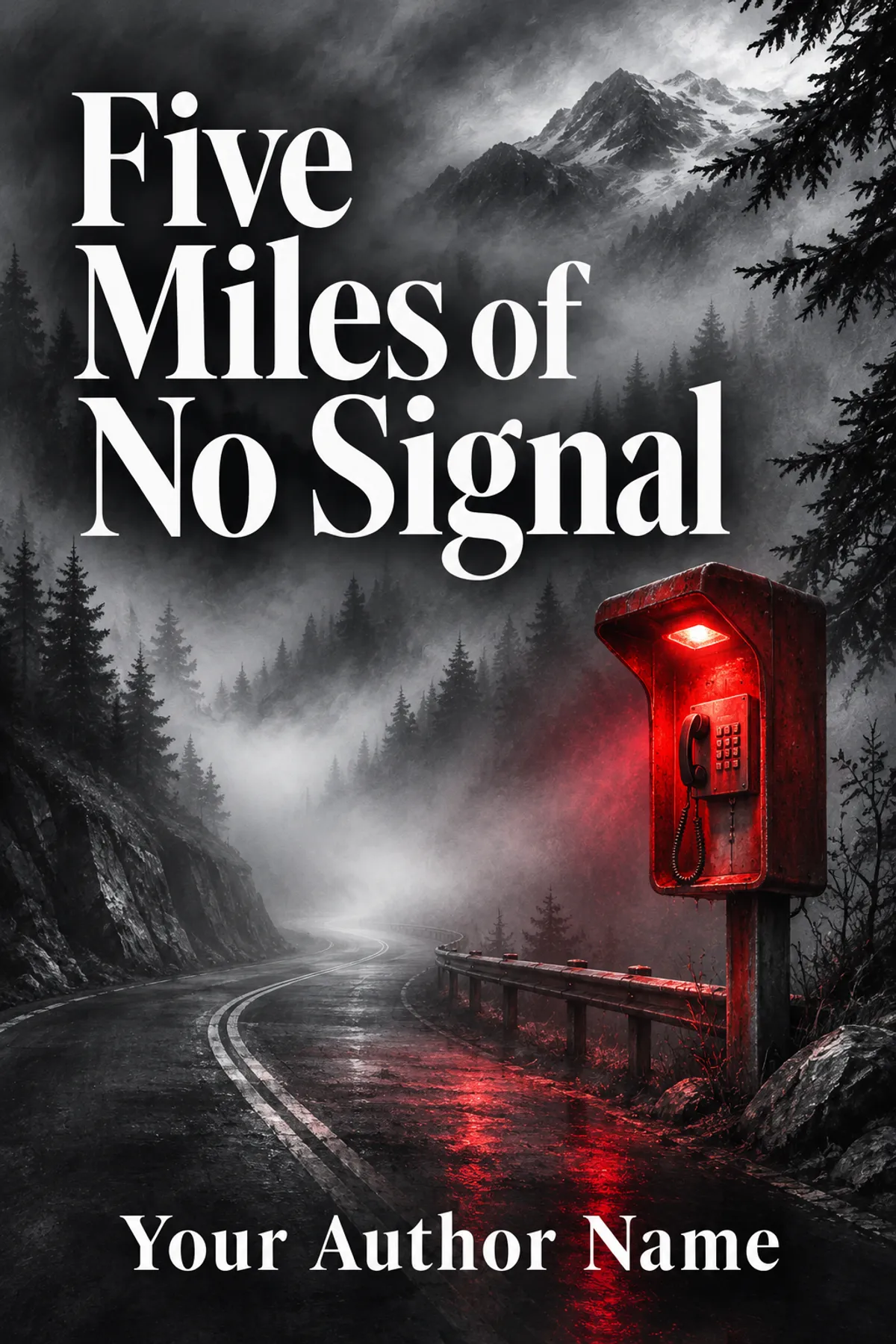
Five Miles of No Signal
An emergency telephone technician discovers that roadside help stations have been rerouted to a private number, then receives a call describing a journey she has not taken yet.
ImagineYourBook writes a fresh draft from this idea.
How it begins
The caller described the scarf Nora had not yet put on.
Red wool. Frayed end. A small burn mark near the label.
It lay on the passenger seat of her van, still inside her overnight bag.
Nora stood beside the roadside telephone with the receiver pressed to her ear. She had initiated a routine test call. The line should have reached a staffed control room. Instead, a woman was speaking through a layer of static about a journey Nora had not taken.
"At the fifth marker, you'll stop," the woman said.
"Identify yourself."
"Don't get out on the left."
The connection ended.
Nora remained still until the ordinary sounds returned: wind across the barrier, a bird somewhere below the road, the cooling tick of her van's engine.
She checked the unit's identifier and logged the failed test. Then she used her separate work radio to contact the regional team.
"Possible routing fault. Unexpected recipient. I'm pausing the inspection."
Eli Grant answered from the communications office.
"What did the recipient say?"
Nora looked toward the bag through the van window.
"Something personal."
He did not laugh.
"Stay at your current location while we check the route."
She appreciated the instruction because it matched what she already intended. Fear was easier to manage when nobody asked her to prove it by taking a risk.
While she waited, Nora reviewed the previous unit's test result. A connection had been reported successful. The destination number, however, differed from the approved record. So did the one before it.
Five miles of road. Several help points. One private number.
Her work phone rang. Eli again.
"That destination isn't in our system."
"Can you identify it?"
A pause.
"The subscriber record has your name."
Nora watched a strip of cloud move across the mountain. On the passenger seat, the red scarf lay exactly where she had left it.
Outline and characters
Develop this idea
Anchor most of the mystery in verifiable faults, records and motives, then reserve one carefully defined detail for uncertainty. Nora should respond competently to the first warning rather than follow dangerous instructions for plot convenience. Avoid technical steps that would function as a sabotage guide. The emotional connection to her former colleague can complicate interpretation without making grief equivalent to unreliability. The ending must resolve the actionable crime while clearly identifying the single unanswered element.
- Nora receives a test-call warning describing her belongings and a future stop.
- She pauses work and reports several emergency phones routed to an unauthorized number.
- Eli finds the number registered through records using Nora's identity.
- A roadside inspection reveals a concealed hazard near the predicted marker.
- Nora recognizes the caller's phrasing from recordings made by her deceased former colleague.
- Evidence points to a contractor using old training audio and stolen personnel information to manipulate inspections.
- One warning contains a detail absent from every recoverable recording.
- Nora and Eli coordinate a safe, documented investigation rather than following the caller's route.
- The contractor's diversion scheme is exposed and the network restored under independent verification.
- A final disconnected message repeats the unexplained detail, leaving one part of the warning unresolved.
Characters
- Nora Webb, 36. Roadside emergency-telephone technician
- Eli Grant, 41. Regional communications investigator
Series possibilities
- Nora encounters another communications anomaly that mixes verifiable interference with an impossible personal detail.