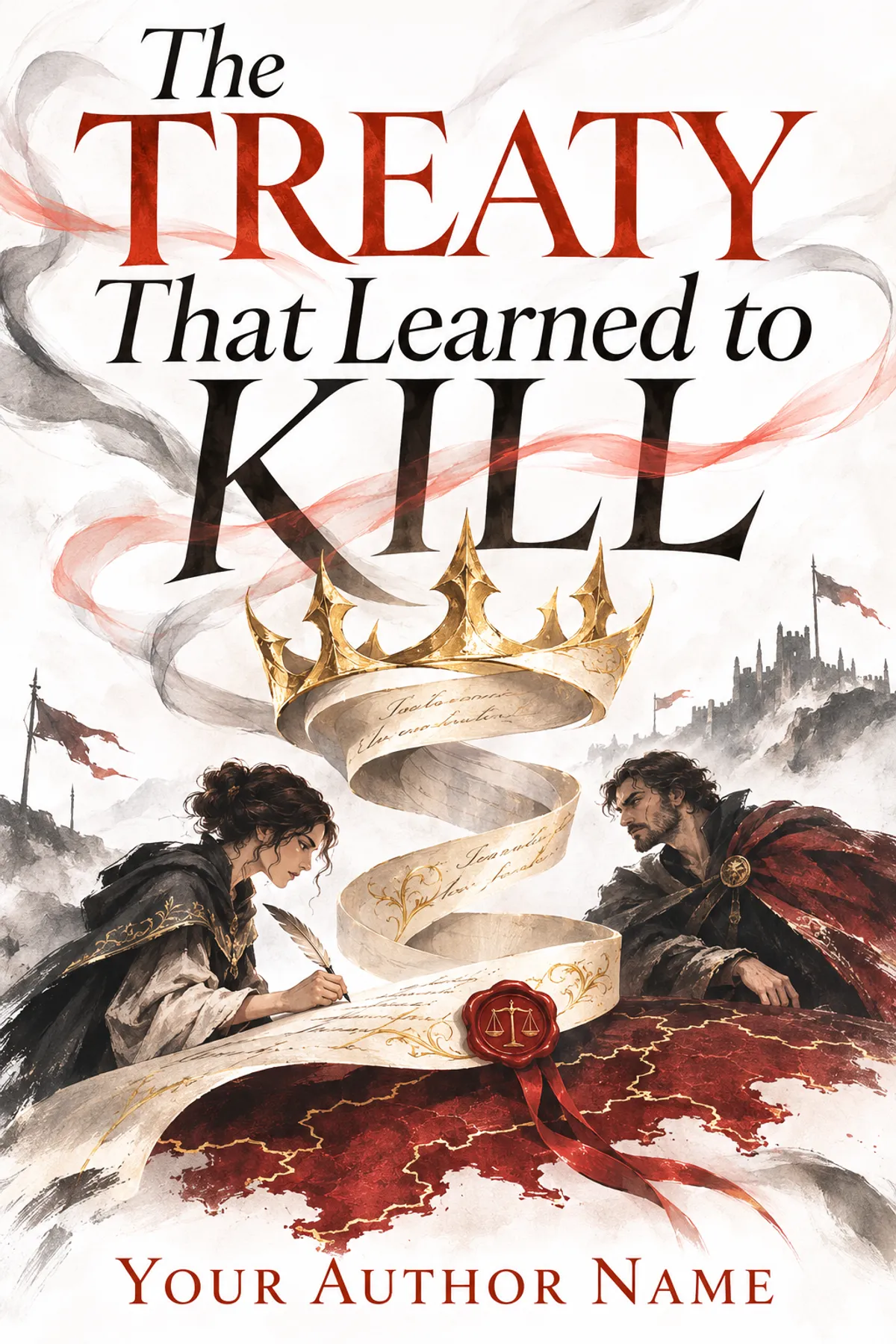
The Treaty That Learned to Kill
A royal copyist finds the peace treaty has begun removing people who violate its wording. To stop it, former enemies must admit which promises were impossible before another signature becomes a sentence.
ImagineYourBook writes a fresh draft from this idea.
How it begins
The clerk vanished over a borrowed pen.
Runa saw his hand reaching across the treaty table. The envoy nodded permission. A small courtesy in a room where even courtesy required an interpreter.
Then the chair was empty.
The pen fell.
For several seconds nobody moved.
Runa read the nearest clause.
No property shall pass between signatories except through an approved channel.
She had copied it yesterday.
It had meant customs duties.
Across the table, Farid Hale knelt beside the fallen pen. He did not touch it.
“Where did he go?”
The chairwoman called for the guards.
“That isn't an answer,” Runa said.
The treaty lay beneath its glass cover, gold letters shining with the restrained satisfaction of perfect work. She had spent six months preparing the final copy. Every ambiguity removed. Every repeated term aligned. A peace clear enough that neither kingdom could pretend to misunderstand.
Now a line appeared beneath the property clause.
Unauthorized exchange shall be corrected.
Runa took a step back.
Farid watched the new letters settle.
“Who gave it permission to decide?”
The chairwoman spoke of temporary enchantment faults, the importance of remaining calm and the excellent progress already made. Outside, the city waited to celebrate an agreement that would end twenty years of unpredictable danger.
Runa looked at the empty chair.
The clerk had been named Olin. He had a sister traveling down for the ceremony. He disliked the conference biscuits and secretly fed them to the stable dogs.
The treaty knew none of this.
It knew property.
Farid set his own pen on the floor.
“What happens if we disagree with it?”
Runa opened her working notes.
One phrase, altered in her handwriting, had become the basis of the new enchantment.
She had replaced reasonable interpretation with exact compliance.
At the time, it seemed an improvement.
The gold letters shifted again.
Runa closed the notes and looked across the table.
“I think,” she said, “we need people in this room who never signed anything.”
Your idea. Your book.
Keep the spark. Change anything.
Create my bookCreated with ImagineYourBook. Free to use as inspiration.
Outline and characters
Develop this idea
Choose a small number of treaty rules and show their consequences clearly before escalating. Runa's revision should have seemed helpful when she made it. Farid needs an admission that complicates his opposition. Avoid a final solution based on one clever loophole nobody could have anticipated. A stronger ending changes who can interpret and revise the agreement when circumstances and people inevitably change.
- A minor treaty violation removes a clerk.
- Runa finds a clause changing itself.
- Farid identifies an impossible mutual promise.
- The conference insists the text remain sacred.
- New disappearances follow ordinary compromises.
- Runa admits improving an ambiguous phrase.
- Farid reveals his delegation's hidden demand.
- They gather affected citizens as interpreters.
- A revised agreement requires continuing consent.
- Peace becomes work rather than an automatic punishment.
Characters
- Runa Sato, 38. Royal treaty copyist
- Farid Hale, 50. Envoy from a former enemy state
Series possibilities
- Runa's later work examines agreements whose beautiful certainty has become more dangerous than honest disagreement.