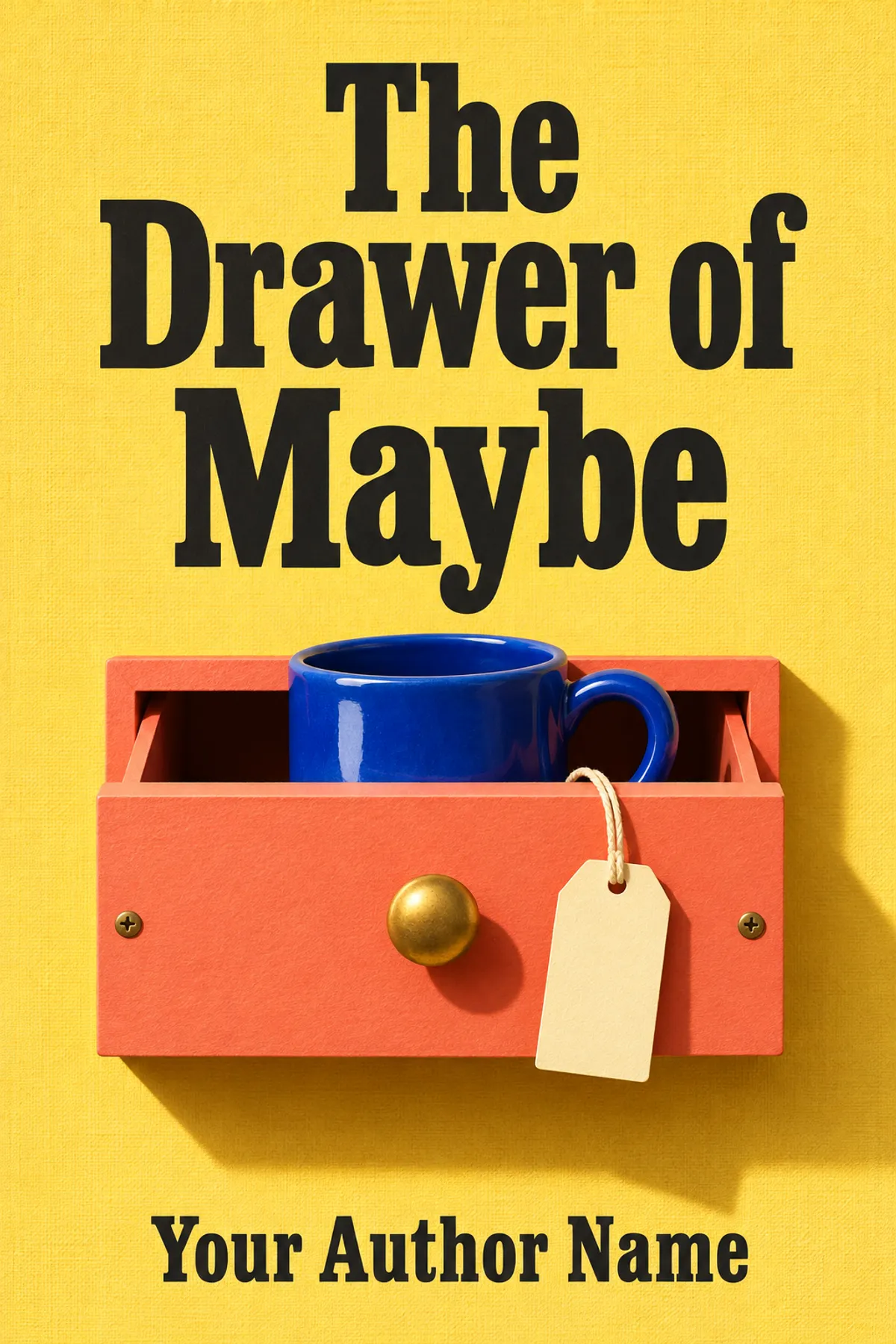
The Drawer of Maybe
Give uncertain belongings a temporary address so the question of what to keep stops spreading from room to room.
ImagineYourBook writes a fresh draft from this idea.
Introduction
The drawer shut. That was the problem.
Vera pushed it with her hip and it gave the neat little click a drawer makes when everyone has agreed to stop looking. Inside were two phone chargers, a packet of birthday candles, a blue mug laid on its side and a tiny metal bracket that might be holding up something important by its absence.
"Is the mug yours?" she asked Nikhil.
He turned it over. There was a chip in the glaze shaped like a country neither of them recognized.
"It came with the apartment," he said.
The apartment had come without a working doorbell. They both found it difficult to believe the landlord had supplied a mug.
A home can hold two kinds of indecision. One is about what an object means to you. The other is about whose decision it is. A good sorting system makes those questions easier to tell apart. The drawer was asking Vera to answer both every time she needed a candle.
Pick one object that keeps appearing in a space that should work better. Ask who can decide what happens to it. If the answer is uncertain, give the object a temporary address with a note that describes the uncertainty. A person might write "check if this is Malik's" or "see whether this fits the spare lamp." The note is a small promise to do a particular thing. "Sort later" is where notes go to retire.
Give that address an edge. A shallow tray works because another mug cannot disappear beneath the first one. If the tray is full, someone has to settle a question before adding a new one.
Vera left the blue mug by the door with a note for their neighbor, who had carried in a box on moving day. Nikhil put the bracket on a saucer and wrote "look behind the curtain rail."
That night the candle drawer shut with the same quiet click. This time nothing inside it was waiting for a verdict.
Chapter plan
Develop this idea
Center the book on one room or one kind of object before broadening the method. Give renters and shared households different versions of the same exercise. A useful chapter should end with an observable decision, such as identifying an owner or putting a return date on a label. Avoid presenting disposal as a moral victory. The reader needs usable space and a way to live with uncertainty.
- Open with a communal drawer that only shuts when someone stands on it.
- Separate obviously active, owned, borrowed and unclaimed objects.
- Choose one bounded waiting place sized to the available room.
- Make a label that specifies a decision and an expiration date.
- Invite the actual owner to choose without an audience.
- Design a safe exit for returns, recycling and repair.
- Handle emotionally loaded objects without making the box a test of willpower.
- Negotiate a shared-space rule where one person can veto disposal.
- Review the box against a recent ordinary week.
- Close with a printable one-drawer experiment and a small-home variant.
Series possibilities
- A companion guide to reducing household friction during a move.