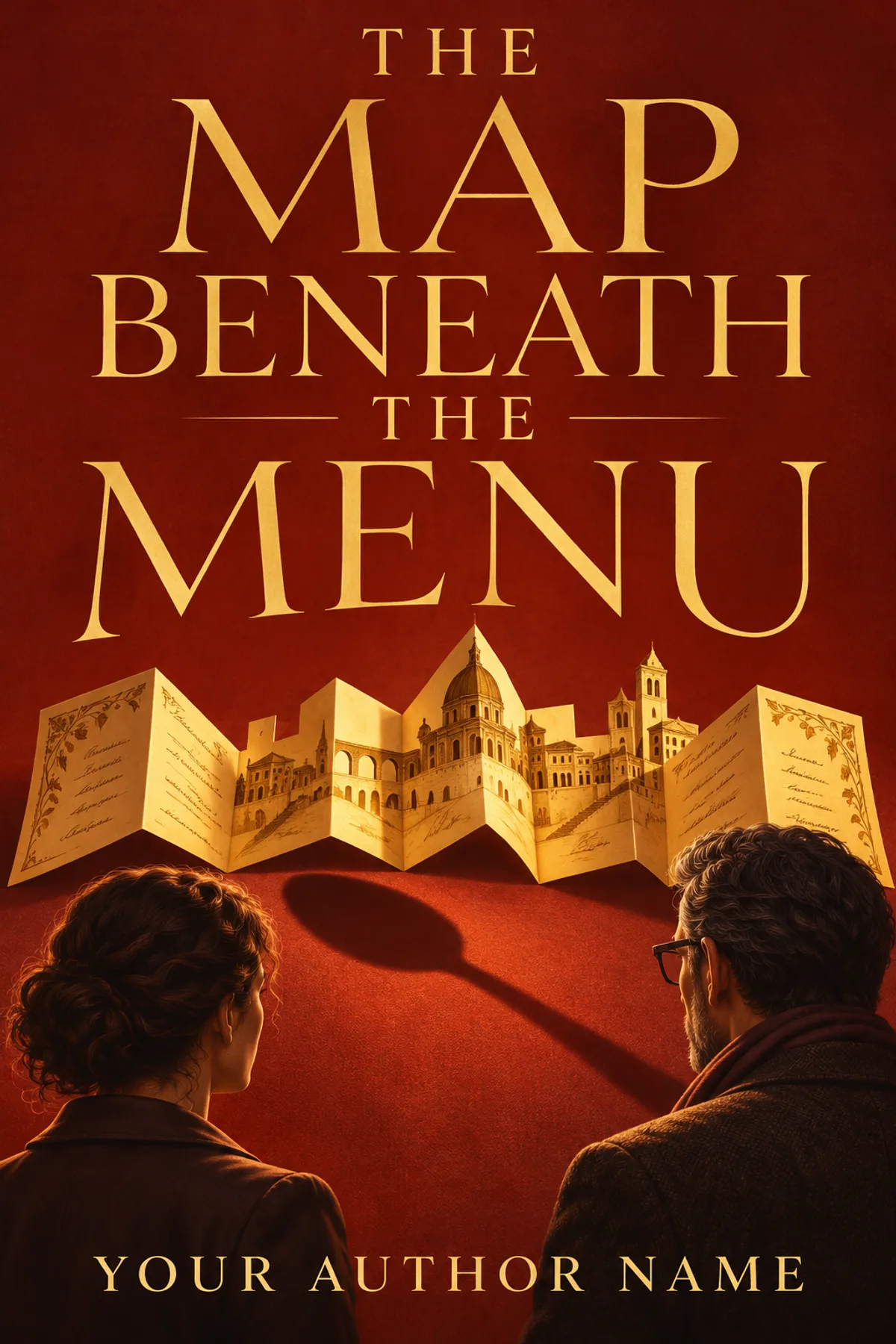
The Map Beneath the Menu
A restaurant conservator discovers that menus from a vanished dining society form a map only when the prices are ignored. A food historian follows her through an invented city's public kitchens, where the supposed treasure may be a debt powerful families prefer to forget.
ImagineYourBook writes a fresh draft from this idea.
How it begins
Sofia Crane found the first street between the fish course and the pudding.
It ran through a menu printed in 1887, hidden in the decorative line separating two prices. She would have missed it if the paste had not failed.
The paper lifted under her brush, revealing a second sheet beneath it. On the reverse, somebody had written the same list of dishes with no prices at all. The flourishes now joined neatly into a road.
Sofia turned the lamp. Three restaurant names occupied three corners. A fourth corner was blank.
She telephoned Marcus Wells before remembering that food historians, unlike conservation paste, usually required sleep.
He answered on the second ring.
'If this is about the mustard stain, I said probably.'
'It's a map.'
'Of the stain?'
'Of somewhere they didn't want the diners to notice.'
He arrived twenty minutes later with a street atlas and a loaf of bread. Sofia liked a colleague who understood the difference between emergency provisions and unnecessary questions.
The map led away from the vanished dining society's grand rooms, through alleys now occupied by shops selling the city's authentic past at modern prices. Marcus placed one finger on the blank corner.
'There was a public kitchen here.'
'Charitable?'
'That depends whose account you read.'
Sofia checked the edge of the original menu. A small mark repeated beside every meat dish. She had assumed it identified a printer. Marcus shook his head.
'A supplier's tally.'
'Which supplier?'
He opened the atlas to a page whose street name had changed twice. Beneath a modern hotel lay the outline of a building neither map properly named.
From the corridor came the click of the archive door. Sofia glanced at the clock. Nobody else should have been in the restaurant.
Marcus lowered his voice.
'Before we follow it,' he said, 'we should find out who asked you to restore this particular menu.'
Your idea. Your book.
Keep the spark. Change anything.
Create my bookCreated with ImagineYourBook. Free to use as inspiration.
Outline and characters
Develop this idea
Design the menu cipher in advance so readers can understand the discovery and later test it. Food history should reveal procurement, labor and status rather than provide decorative dish names. Keep the supposed treasure materially specific and distinguish historical debt from whatever remedy is legally available now. Research conservation methods to avoid implausible destructive handling, and let descendants influence how recovered records become public rather than treating them as narrative prizes.
- Sofia reveals a map beneath prices on a restored menu.
- Marcus identifies a vanished public kitchen at its missing corner.
- Other menus encode supplier routes rather than tourist landmarks.
- A collector offers to buy the incomplete restoration immediately.
- Kitchen accounts reveal unpaid provisioning concealed as charity.
- Sofia learns the commission came from a family disputing an inheritance.
- A false treasure rumor draws opportunists toward the wrong site.
- The leads authenticate receipts and seek descendants' input.
- They protect the archive while exposing the family's outstanding obligations.
- The kitchen's chosen history becomes public without selling its private records.
Characters
- Sofia Crane, 41. Restaurant conservator
- Marcus Wells, 48. Food historian
Series possibilities
- Sofia and Marcus uncover other culinary documents that map hidden relationships across the invented city's history.