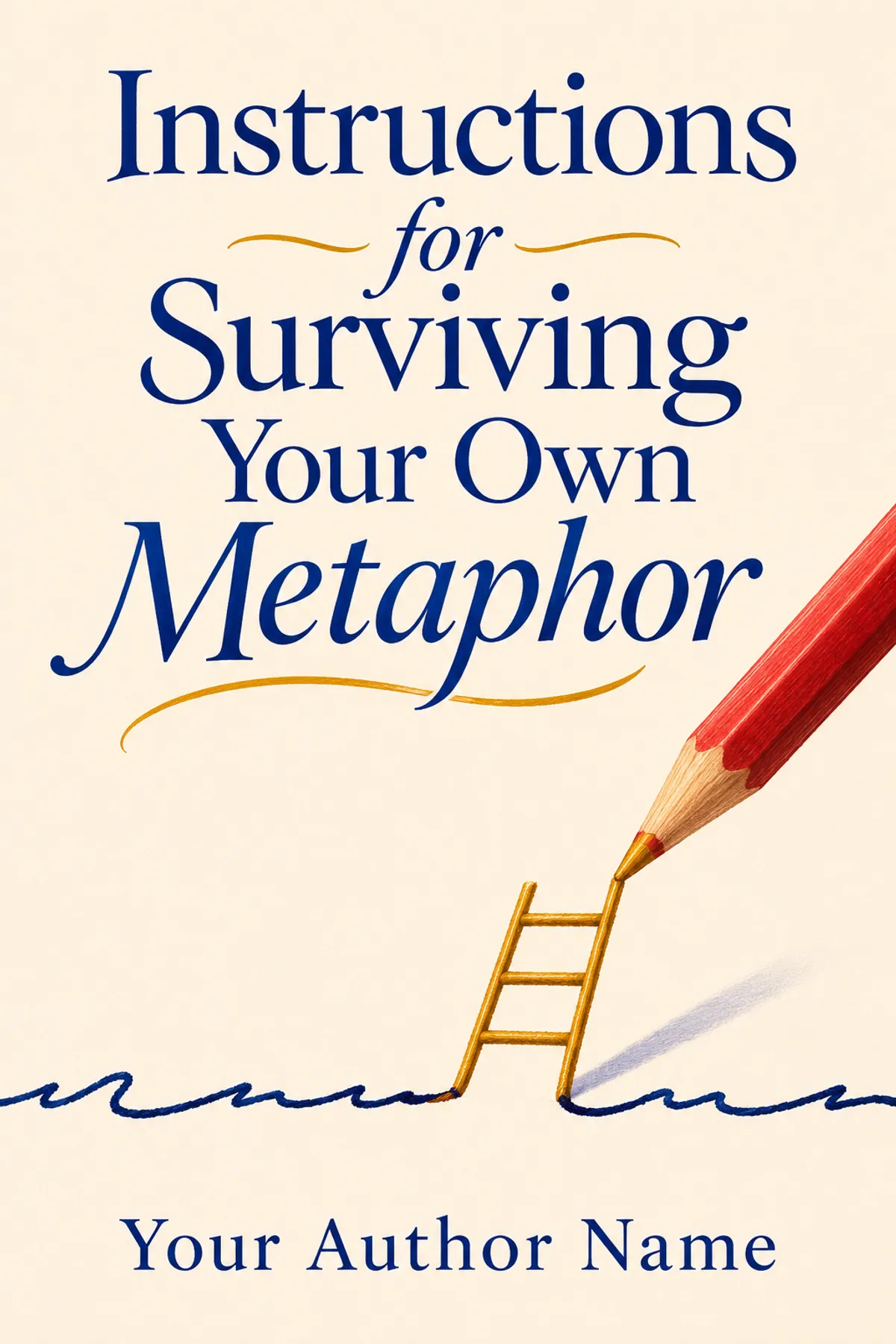
Instructions for Surviving Your Own Metaphor
A writing tutor collects accounts from people whose casual metaphors became physically true. The stories turn ordinary language into tender, inconvenient problems nobody can edit away.
ImagineYourBook writes a fresh draft from this idea.
How it begins
Pella arrived at the workshop dragging six suitcases and a small locked trunk.
Martin checked the course title.
Writing from Life. No residential component.
“Are you moving?” he asked.
“Apparently.”
She let go of the largest case. It rolled back toward her.
The other students watched with the careful politeness people reserve for a problem they hope is temporary.
“I told my sister I was carrying too much baggage,” Pella said. “Then this happened.”
Martin looked at the cases.
One bore an airline label from a trip Pella said she had never taken. Another had been tied shut with a man's necktie. The trunk made a faint sound whenever anyone mentioned work.
“Perhaps,” he began, then stopped.
As a writing tutor, he believed in the power of language. He had not expected it to require a luggage allowance.
A student offered to help carry the trunk.
It became heavier the moment he touched it.
“Thank you,” Pella said, “but other people's concern seems to count as an extra item.”
Martin canceled the opening exercise.
They tried labels. They tried asking the cases what they contained. They tried opening one with a butter knife borrowed from the community kitchen.
Inside lay a remark her father had made in 1998.
Everyone heard it.
Nobody repeated it.
Pella closed the case.
For a while, the room became very quiet.
Then the student by the window asked whether the remark had always been that heavy.
Pella sat down on the largest suitcase. It held her easily.
“No,” she said. “I think I've been adding things.”
Martin took out his notebook.
At the top of a clean page, he wrote Instructions.
He crossed it out.
Beneath it, he wrote What We Tried, and asked Pella whether she wanted her name included.
It was the first useful editorial question he had asked all morning.
Your idea. Your book.
Keep the spark. Change anything.
Create my bookCreated with ImagineYourBook. Free to use as inspiration.
Outline and characters
Develop this idea
Use each metaphor to generate a distinct practical problem and emotional choice. The humor should come from literal consequences, not from mocking people for ordinary distress. Vary story length and form: an incident report, a dialogue, a conventional narrative. Martin's urge to edit should become a limitation. Avoid a universal cure based on choosing positive words; language can shape experience without making people responsible for every hardship.
- Pella arrives dragging her emotional baggage.
- Martin records the first practical instructions.
- A man literally loses his train of thought.
- A couple finds their common ground shrinking.
- A worker carries an actual chip on her shoulder.
- Martin discovers his own words becoming solid.
- The accounts resist his neat editorial framing.
- Contributors rewrite the instructions collaboratively.
- Some metaphors are adapted rather than cured.
- The collection ends with a deliberately open sentence.
Characters
- Martin Shaw, 47. Writing tutor collecting accounts
- Pella Ren, 36. Accountant with literal baggage
Series possibilities
- A second volume could follow communities dealing with collective metaphors made real.