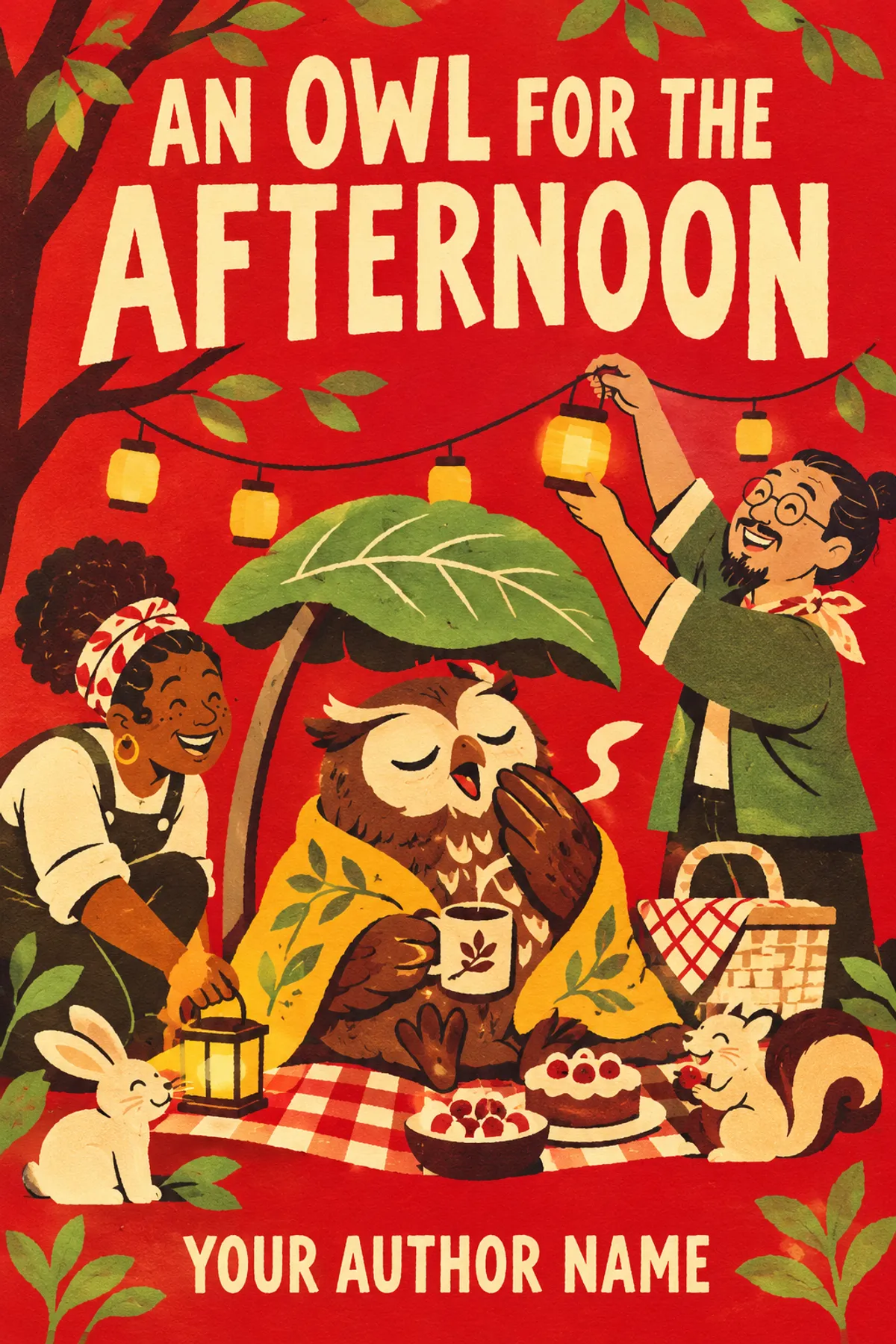
An Owl for the Afternoon
A night-working adult owl tries attending the village's afternoon picnic, and her friends discover that inclusion sometimes means moving the celebration instead of changing the guest.
ImagineYourBook writes a fresh draft from this idea.
How it begins
Olive had never been to an afternoon picnic.
She had heard excellent things about them, mostly from friends who told her while she was trying to sleep.
This time, she decided to go.
She set three alarms, brushed her feathers and packed a napkin. At two o'clock, she flew into the clearing and landed beside a basket of rolls.
"You made it!" Ben said.
"I am entirely awake," Olive replied.
Then she put her head in the basket.
Ben moved the rolls before she sat on them.
The village gardener offered a large green leaf for shade. Mouse brought cool water. Someone suggested a lively song. Olive opened one eye at the first note and closed it again at the second.
"Perhaps she needs a game," Ben said.
Olive caught the ball beautifully. She had been asleep when it arrived.
Everyone applauded.
She bowed to a tree.
By three o'clock, the picnic had become a series of attempts to keep Olive awake. The food waited. The games waited. Olive wished everyone would stop being so kind in such noisy ways.
Ben sat beside her under the leaf.
"What would make this easier?"
Olive considered saying another drink, a softer song or a different game.
Then she said what she actually meant.
"A different time."
Ben looked at the sun.
"But picnics are in the afternoon."
"Are they?"
Nobody at the picnic had ever asked a picnic.
The gardener said she had lanterns. Mouse said berries tasted fine after sunset. Ben admitted that the rolls would still be rolls.
Olive lifted her head.
For the first time all afternoon, she looked interested in staying awake.
"You could sleep now," Ben said, "and come back when the first lantern shines."
Olive thanked him, flew home and fell asleep before she had quite finished folding her napkin.
In the clearing, her friends began planning something they had never tried before.
Outline and characters
Develop this idea
Develop for ages three to six with visual humor that does not mock sleepiness or portray rest as a failure. The friends' first attempts are caring but mismatched, making the change in question meaningful. Avoid solving inclusion by excluding everyone who needs daytime hours; two connected portions can welcome different schedules. Human village adults may appear alongside woodland animals as shown in the cover. End through shared food and light, letting the adjusted plan demonstrate the idea without a concluding lesson.
- Olive makes a determined effort to attend an afternoon picnic despite working nights.
- Her friends offer well-meant ways to keep her awake.
- Comic mishaps show that effort and affection do not change her need for sleep.
- Ben asks what would actually help.
- Olive requests a different time rather than another wake-up trick.
- The group considers which parts of the celebration can move and which friends need earlier hours.
- They keep a small afternoon gathering and arrange a lantern picnic at dusk.
- Olive returns rested and contributes skills suited to the evening.
- Friends join the part that works for them without treating attendance as a test of loyalty.
- The final image shows two connected celebrations and a napkin Olive finally gets to use.
Characters
- Olive, 34. Adult owl who works through the night
- Ben, 38. Adult badger organizing a village picnic
Series possibilities
- Olive helps plan a village project with tasks available at both daytime and nighttime hours.